Developer Tools
OpenAdapter Review: Open-Source Coding Models in Claude Code, Cursor and Your Own Apps
OpenAdapter review: use GLM, Kimi, DeepSeek, Qwen and MiniMax in Claude Code, Cursor and your apps with one API key and a flat monthly plan.
CodeHype9 min read
Open-weight models like GLM, Kimi, DeepSeek and Qwen have become capable coding assistants, but using several of them is still awkward. Each provider has its own account, billing and API quirks, and pay-per-token pricing makes heavy agentic coding sessions hard to budget.
OpenAdapter bundles these models behind a single API key and a flat monthly plan. You can plug it into coding tools like Claude Code, Cursor and Windsurf, or call the same key from your own applications. Take a look at OpenAdapter's official website for the current model catalog.
This review covers what OpenAdapter offers, how to set it up, how its plans and request limits work, and the trade-offs to understand before you commit.
What Is OpenAdapter?
OpenAdapter is a subscription service that provides access to open-weight AI models through three interfaces: a browser chat, a terminal coding agent called Koda, and an API. It is aimed at developers who want predictable, flat-price access to open models inside their existing coding tools and apps.
Model families available include GLM, Kimi, DeepSeek, Qwen, MiniMax and MiMo, along with speech-to-text models. The homepage states that the live catalog contains 102 models (older parts of the documentation still say "40+"), grouped into four tiers: Freemium, Lite, Pro and Max. Some models run in secure enclaves (TEE).
OpenAdapter is listed in the Coding category on CodeHype, where you can also see the OpenAdapter product listing.
Key Features of OpenAdapter
One Key for OpenAI- and Anthropic-Compatible APIs
A single OpenAdapter key works with both an OpenAI-compatible endpoint and the Anthropic Messages endpoint. In practice, that means tools and SDKs built for either API format can usually connect by changing the base URL and key.
According to the documentation, the API supports:
- Chat completions and streaming
- Tool calling and structured output
- Embeddings
- Audio transcription and text-to-speech
Works With Popular Coding Tools
The integrations documentation covers a wide range of tools:
- Command-line agents: Claude Code, Aider, OpenCode, Pi and OpenClaw
- Editors: Cursor, Zed, Windsurf, Void and PearAI
- VS Code: through extensions such as Continue.dev, Cline, Roo Code and Kilo Code, rather than a direct integration
Automatic Model Routing
If you don't want to pick a model yourself, OpenAdapter provides routing aliases: auto-free, auto-lite, auto-pro and auto-max. Each one routes requests to a model in the matching tier.
Built-in Tools for Your Own Apps
Beyond chat models, the same key gives access to a built-in vector database, web search, scraping, OCR and document parsing tools, plus an "MCP Store". On paid plans, image understanding and web search are included. This makes OpenAdapter usable as a back end for simple AI features, not just as a coding assistant.
Bring Your Own Keys
You can also add your own keys from other providers, such as Anthropic, OpenAI, OpenCode or the Z.AI Coding Plan. Requests that use your own keys don't count toward your OpenAdapter plan quota.
How to Set Up OpenAdapter
Using the API
The quick-start guide follows the familiar pattern for OpenAI-compatible services:
- Create an account and copy your API key from the OpenAdapter dashboard.
- Point any OpenAI SDK at OpenAdapter's API base URL (api.openadapter.in/v1).
- Send the key as a Bearer token and choose a model.
Using Claude Code
OpenAdapter offers a one-line installer for macOS/Linux and PowerShell. Alternatively, you can set Claude Code's base URL and auth token environment variables to point at OpenAdapter manually.
By default, Claude Code's model names are mapped to open models (for example, its "sonnet" slot maps to a Kimi model, "haiku" to MiniMax and "opus" to GLM), and you can change the mapping. Usage is counted per request, not per token.
Using Cursor
In Cursor's model settings, paste the OpenAdapter key into the OpenAI API Key field, enable the base URL override with OpenAdapter's endpoint, verify the connection and add the models you want. Cursor's own built-in models still come from Cursor.
OpenAdapter Pricing and Request Limits
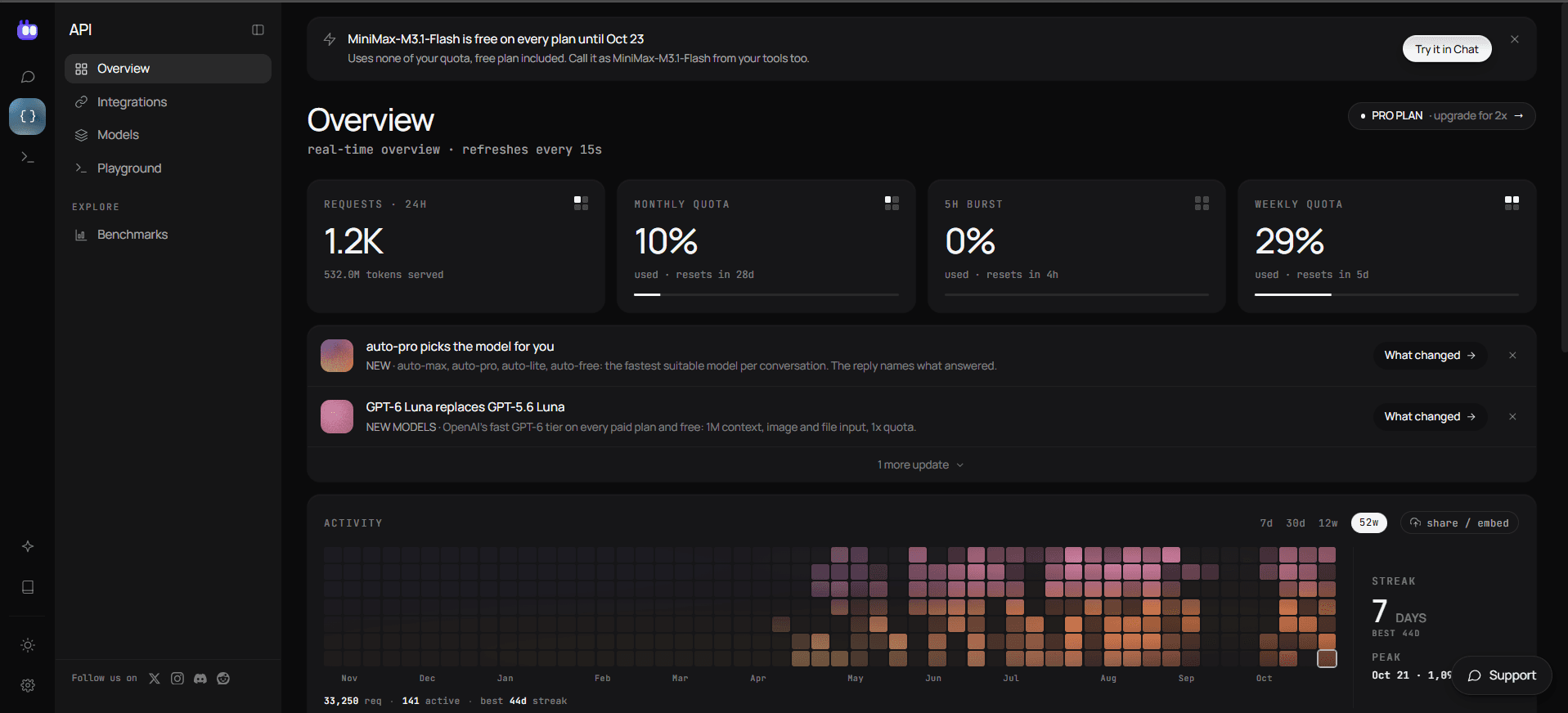
OpenAdapter charges a flat monthly price, but usage is metered in request credits with rolling limits. Here are the plans as shown on its pricing page at the time of writing (several were shown at discounted prices):
| Plan | Monthly price | Request limits | Vector DB | Notes |
|---|---|---|---|---|
| Free | $0, no card needed | 50 per day, 200 per month | 20 MB | Freemium, Lite and Pro tier models |
| Go | $6.99 | 500 per 5 hours, 2,400 per week, 5,000 per month | 20 MB | A set of 11 models, including private secure-enclave models |
| Lite | $14.99 | 700 per 5 hours, 2,800 per week, 10,000 per month | 200 MB | All models, image understanding, web search |
| Pro | $29 | 1,500 per 5 hours, 6,500 per week, 18,400 per month | 800 MB | Same features as Lite |
| Max | $79 | 3,000 per 5 hours, 15,000 per week, 45,000 per month | 2 GB | Same features as Lite |
A few things affect how far a plan goes:
- Requests are weighted. Free and community models cost 0.2 credits per call, standard models 1, premium flagship models 2 to 3, and top-tier models 5. Tool-call round trips cost one third of the model's usual weight.
- Small requests get a break. On paid plans, the first 50 small requests every 5 hours don't use credits.
- Limits roll. Each request ages out of the window on its own schedule, instead of a calendar reset.
- Per-minute limits apply by tier. Going over returns a rate-limit error.
- Refunds: paid plans are non-refundable unless local law requires otherwise. If you cancel, you keep access until the end of the paid period, then drop to the Free plan.
Because prices and quotas can change, check the official pricing page before you subscribe.
Use Cases
Running Agentic Coding Sessions on a Budget
Developers who use Claude Code or Cline heavily can run those sessions on open models at a fixed monthly cost, instead of paying per token.
Comparing Open Models
With one key and one endpoint, it's easy to switch between GLM, Kimi, Qwen and DeepSeek to see which works best for a codebase or task.
Adding AI Features to a Side Project
Indie developers can use the same key for chat, embeddings, the vector database and web search in their own app, without opening separate accounts for each service. If you're building something billable on top of AI APIs, our OpenCredits review covers a related piece of the stack.
Who Should Use OpenAdapter?
OpenAdapter is a good fit for:
- Individual developers who want open-model access in Claude Code, Cursor, Windsurf or VS Code extensions
- Developers who prefer flat monthly pricing over usage-based bills
- Indie hackers and students who want a free plan to experiment with
- Builders of small AI apps who want chat, embeddings, search and a vector store behind one key
It is not designed for teams sharing a key or for bulk automation. Its terms limit accounts to personal use, ban key sharing, and treat bulk automated jobs, high-frequency scripting and scraping as abuse.
Advantages and Limitations
Advantages
- One key, two API formats. OpenAI- and Anthropic-compatible endpoints cover most coding tools.
- Broad tool support. Documented setups exist for Claude Code, Cursor, Zed, Windsurf, Aider and several VS Code extensions.
- Predictable cost. Flat monthly plans with a free tier that doesn't require a card.
- Extras included. Vector database, web search, OCR and document parsing are available through the same key.
- Privacy statement. OpenAdapter says it does not store, log or retain the content of prompts or model responses.
Limitations
- Usage is still metered. Request credits, rolling windows and per-minute limits mean heavy users need to pick a plan carefully.
- Personal use only. Key sharing and bulk automation are not allowed.
- Third-party providers. Inference runs through providers including Chutes, 0G and OpenRouter, which, according to OpenAdapter's privacy policy, may use anonymized or aggregated data. Request metadata logs are kept for 90 days.
- No uptime guarantee. Service is provided as is and depends on upstream providers.
- Documentation is not fully consistent. Some pages still reference older model counts and model names.
- No direct VS Code integration. VS Code support relies on third-party extensions.
Final Verdict: Is OpenAdapter Worth It?
OpenAdapter makes open-weight coding models easy to use where developers already work. The combination of one key, OpenAI- and Anthropic-compatible endpoints and documented setups for Claude Code and Cursor removes most of the friction of trying several providers.
The value depends on your usage. The free plan is enough to test whether GLM, Kimi or Qwen suits your workflow, and the paid plans offer predictable pricing for regular use, as long as you understand the request credits and rolling limits. If you want to try open models in your coding tools without juggling multiple accounts, visit the official OpenAdapter website and start on the free plan.
Frequently Asked Questions
What is OpenAdapter?
OpenAdapter is a subscription service that gives developers access to open-weight AI models such as GLM, Kimi, DeepSeek, Qwen and MiniMax through one API key, a browser chat, and a terminal coding agent called Koda.
Does OpenAdapter work with Claude Code?
Yes. OpenAdapter supports the Anthropic Messages API format and provides a one-line installer and manual setup instructions for Claude Code.
Is OpenAdapter free?
There is a free plan with no card required, limited to 50 requests per day and 200 per month. Paid plans start at $6.99 per month at the time of writing.
Can I use OpenAdapter in VS Code?
Yes, through VS Code extensions such as Continue.dev, Cline, Roo Code and Kilo Code. OpenAdapter does not list a direct VS Code integration.
Does OpenAdapter store my prompts?
According to its privacy policy, OpenAdapter does not store, log or retain the content of prompts or model responses. It does keep request metadata logs for 90 days, and its inference providers have their own data practices.
Can I share an OpenAdapter key with my team?
No. OpenAdapter's terms limit plans to personal use and prohibit sharing keys.