Developer Tools
OpenCredits: How to Monetize AI Apps With Prepaid Credits and 390+ Models
Discover how OpenCredits helps developers monetize AI apps with prepaid credits, 390+ AI models, usage metering, and built-in checkout without monthly fees.
CodeHype18 min read
Building an AI application is becoming more accessible, but monetizing it can be much more complicated than developing its core features. Once users start making requests to AI models, developers need a reliable way to track usage, calculate costs, collect payments, manage credit balances, and ensure that API expenses do not exceed revenue.
For indie hackers, SaaS founders, and developers building AI chatbots, coding assistants, writing tools, or CV generators, implementing all these billing components can take significant time away from product development.
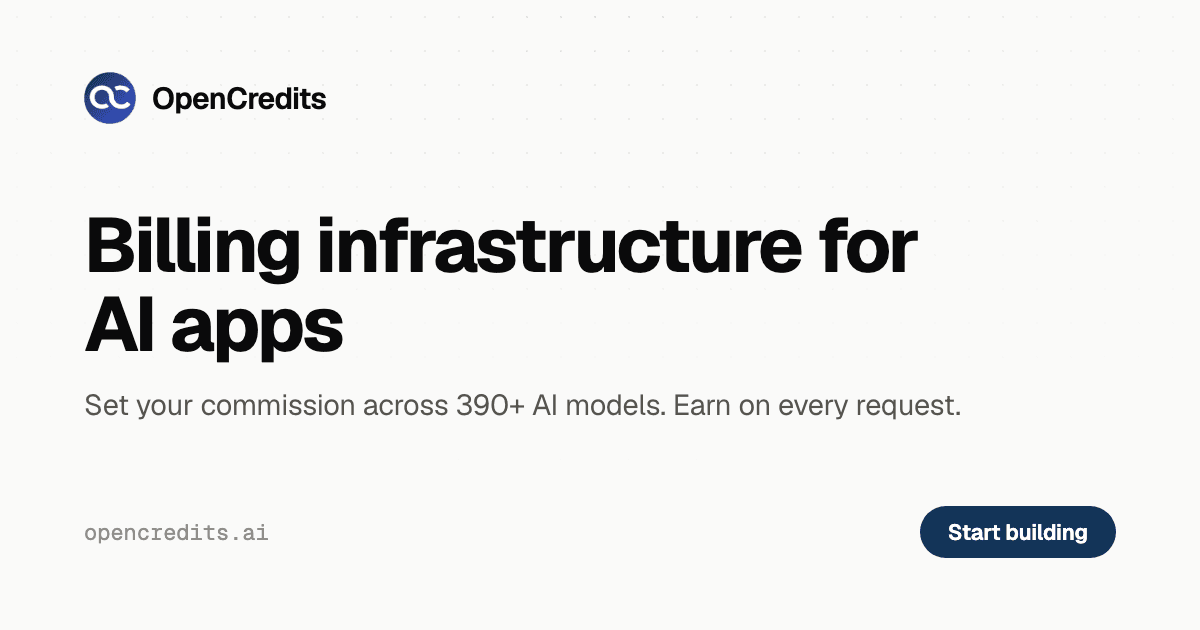
OpenCredits aims to solve this problem by providing billing infrastructure specifically designed for AI applications. Developers can add a checkout widget to their products, connect their existing AI SDKs to an OpenCredits endpoint, and let users purchase prepaid credits without leaving the application. They can also set a commission between 0% and 200% of the underlying provider cost and earn revenue on AI requests made through their apps.
Instead of building an entire billing system from scratch, developers can use OpenCredits to manage prepaid AI usage, connect to more than 390 AI models, and monetize requests through a unified integration.
What Is OpenCredits?
OpenCredits is a billing and monetization infrastructure platform for applications that use AI models. It allows developers to sell prepaid AI credits inside their products while handling usage metering, payment processing, credit accounting, and provider access through a shared system.
The platform is designed for developers who want to charge users for AI usage without building every financial and technical component themselves.
Consider an AI writing application. Every time a user generates an article, the application makes requests to an AI model, and those requests incur a provider cost. The developer needs to decide how users will pay, how much each request costs, how balances are updated, and what happens when a user runs out of credits.
OpenCredits provides infrastructure for these operations. Users purchase credits through a checkout embedded in the application, while requests are metered and deducted from their available balance. The developer configures a commission on the provider cost and receives the corresponding earnings through the platform's settlement process.
OpenCredits supports more than 390 models, including offerings from OpenAI, Anthropic, Google, xAI, DeepSeek, and other providers. It also works with existing OpenAI, Anthropic, and Vercel AI SDK integrations through a compatible endpoint approach.
The main benefit is that developers can focus on their product while using a dedicated service for billing and AI usage management.
Why AI Applications Need Dedicated Billing Infrastructure
AI applications have different cost structures from many traditional software products. A conventional SaaS tool might charge a fixed subscription for access to its features, but an AI application can incur additional costs every time a user makes a model request.
The cost may vary depending on the model, the amount of input and output, and the type of operation performed. This makes it important to track actual usage rather than relying only on a flat subscription.
1. AI API Costs Increase With Usage
When an application becomes popular, its API bill can grow alongside the number of users and requests. Without a suitable billing mechanism, developers may end up paying for usage that they have not monetized effectively.
A free application can be particularly difficult to sustain if users generate large amounts of AI output while the developer covers every request.
OpenCredits addresses this by allowing applications to sell prepaid credits. Users add funds before making requests, and their balances are adjusted as they use the application.
This gives developers a way to connect AI usage with a payment mechanism instead of absorbing every provider cost themselves.
2. Building Billing Takes Time Away From Development
A complete AI billing system involves more than adding a checkout button. Developers may need to implement payment webhooks, token metering, model-specific pricing, balance management, refunds, and safeguards against simultaneous requests incorrectly spending the same balance.
They also need to manage provider credentials and maintain records of individual transactions.
These systems can be difficult to build correctly, especially for solo developers who are trying to launch an MVP quickly.
OpenCredits brings these capabilities into a single integration, reducing the amount of billing infrastructure developers need to maintain themselves.
3. Requiring Users to Bring Their Own API Keys Creates Friction
Some AI applications ask users to provide their own model API keys. Although this can reduce the developer's direct usage costs, it introduces another setup step and requires users to understand how to obtain and configure credentials.
For an application aimed at mainstream users, this extra requirement can create friction during onboarding.
OpenCredits offers an alternative through prepaid credits. Users can purchase credits within the application and begin using its AI features without managing separate provider accounts themselves.
This is especially relevant to products such as AI writing assistants, coding tools, and chatbot applications where a simple onboarding experience can make a difference.
How OpenCredits Works
OpenCredits is designed around a relatively simple integration process. Developers configure their commission, add the checkout widget, and direct supported AI SDK requests through the platform.
Step 1: Set Your Commission
Developers choose the commission they want to earn on AI requests. OpenCredits allows a configurable rate from 0% to 200% of the underlying provider cost, and the rate can be changed later.
For example, if a request costs $1 at the model provider and the application uses a 20% commission, the commission amount would be $0.20 under the stated pricing model.
The developer can choose a different rate depending on the product, its operating costs, and the pricing strategy.
This gives AI application builders control over how they monetize usage rather than forcing them to use a fixed platform margin.
Step 2: Embed the Checkout Widget
OpenCredits provides a checkout widget that can be embedded using a script tag.
The checkout runs through Stripe and allows users to purchase credits inside the application. This means developers do not need to build their own payment pages or create an entirely separate purchase experience.
Users can top up their balances with amounts ranging from $5 to $500. The platform defines one credit as $0.01, so a $25 purchase corresponds to 2,500 credits before any usage deductions.
The checkout integration is intended to make adding prepaid AI payments more straightforward for existing applications.
Step 3: Connect Your Existing AI SDK
Developers can point their OpenAI, Anthropic, or Vercel AI SDK integration to the OpenCredits endpoint instead of implementing an entirely separate request system.
This approach allows an application to continue using familiar SDK patterns while OpenCredits handles the associated metering and credit accounting.
The platform's model catalog includes more than 390 AI models, giving applications access to a broad selection of supported model providers through one endpoint.
Developers should still review the documentation for supported models, request formats, and any integration-specific requirements before deploying the setup in production.
Step 4: Meter Usage and Update Credit Balances
When a user makes an AI request, OpenCredits meters the usage and deducts the corresponding amount from the user's credit balance.
The platform describes a ledger process that reserves the maximum expected request cost and then settles the actual cost after the request completes. Any unused reservation is released.
This approach is important because multiple requests may happen close together. A properly coordinated balance system helps prevent concurrent operations from incorrectly spending the same credits.
OpenCredits also describes idempotent settlement, intended to prevent duplicate charges or duplicate credit grants when events are processed more than once.
Step 5: Receive Your Commission
The developer earns the configured commission on eligible requests made through their application. OpenCredits states that commissions are settled monthly.
Because the platform manages the billing infrastructure, developers can focus on building features, improving the user experience, and attracting customers rather than maintaining a separate usage-billing system.
Key Features of OpenCredits
OpenCredits combines several billing, integration, and monetization features that are particularly useful for applications built around AI model usage.
1. Access to More Than 390 AI Models
Supporting multiple AI providers can help developers build flexible products and offer different model options to users.
OpenCredits provides access to more than 390 models, including models associated with OpenAI, Anthropic, Google Gemini, Grok, DeepSeek, and Llama.
For example, an AI writing tool might use one model for everyday content generation and another for more complex tasks. A coding assistant could offer different model choices based on the type of request.
A unified endpoint can reduce the need to configure separate billing and provider connections for every supported model. The actual availability and behavior of each model remain subject to the platform's supported integrations.
2. Built-In Checkout and Payment Processing
Payment integration is often one of the most time-consuming parts of monetizing an application.
OpenCredits provides an embedded checkout experience through Stripe. Developers do not need to build custom checkout pages or manage the payment webhook infrastructure themselves.
According to the platform, Stripe acts as the merchant of record and handles VAT, sales tax, refunds, and chargebacks.
This can reduce the operational burden of collecting payments, although developers should still review the platform's terms and understand how refunds, disputes, and their own revenue settlements are handled.
3. Prepaid AI Credit System
The platform uses credits rather than requiring end users to think directly in terms of model tokens and provider-specific usage prices.
One credit equals $0.01, and users can purchase credit packages from $5 to $500.
This creates a familiar balance-based payment experience for AI applications. Users can see their available credits and understand that different requests consume different amounts.
For developers, prepaid balances also help connect usage with a funded account, reducing reliance on an unrestricted pay-as-you-go experience.
4. Configurable Commission From 0% to 200%
OpenCredits allows developers to set a commission as a percentage of provider cost. The available range is 0% to 200%, and developers can adjust the rate at any time.
This is useful for products that need different monetization strategies. An AI utility might use a small commission to keep usage affordable, while a specialized application could charge more to support additional product features and operating expenses.
However, the configured commission should not be confused with total business profit. Developers may still have costs related to hosting, development, customer support, marketing, and other operations.
5. Shared Credit Balances Across Applications
One of OpenCredits' distinctive features is that credits belong to users rather than being restricted to a single application.
A user who already has an OpenCredits balance from another participating app can allow a new application to spend from that balance, subject to a limit set by the user.
This can reduce friction for users who move between compatible applications because they may not need to complete another purchase before getting started.
Each application still has its own key, and usage earns a commission for the application making the request. The platform also describes scoped keys, so revoking one application's access does not automatically revoke access for other applications.
Shared balances create an interesting model for an ecosystem of AI applications, although the practical benefit depends on user adoption across participating products.
6. Usage Metering and Credit Ledger
A reliable credit ledger is essential for applications that charge users according to model usage.
OpenCredits handles request metering and describes a serialized ledger that reserves a request's maximum cost before settling the actual cost. This is designed to manage balance changes consistently when multiple requests are processed.
The system also provides balance and usage history APIs, allowing applications to retrieve a user's current balance and request history.
These features can save developers from implementing and maintaining their own usage database and accounting logic.
7. Webhooks and Event Management
Applications often need to react to billing events, such as a user purchasing credits or a balance being updated.
OpenCredits provides webhooks for relevant events. Its documentation describes HMAC-signed webhook messages and automatic retries when delivery fails.
Signed events help applications verify that incoming messages originate from the expected source, while retries can reduce the chance that a temporary delivery failure causes an event to be missed.
Developers should still implement webhook verification and event handling according to the platform's documentation.
Which AI Applications Can Use OpenCredits?
OpenCredits is designed for developers building products where users generate AI requests and need a convenient way to pay for usage.
- AI chat applications: Developers can offer a prepaid balance for users who interact with AI assistants, ask questions, or generate responses.
- Coding assistants: AI coding products can charge for model usage without requiring every user to configure a separate provider API key.
- AI writing tools: Applications that generate articles, outlines, social posts, and other content can connect usage with prepaid credits.
- CV and resume generators: Developers can let users purchase credits for AI-assisted resume creation, editing, and related features.
- AI productivity tools: Products that rely on repeated model requests can use prepaid credits to manage usage costs and introduce a clear payment mechanism.
- Indie SaaS products: Solo founders can use the platform to test monetization without first building a complete payment and credit-management system.
The main requirement is that the product uses supported AI model requests and benefits from usage-based billing. An application that charges only a fixed subscription and has minimal variable AI costs may not need the same infrastructure.
OpenCredits Pricing: No Monthly Platform Fees
OpenCredits is free to set up and does not charge a monthly subscription fee according to its published pricing information.
Instead, developers set a commission on the provider cost of requests made through their applications. Users purchase prepaid credits, and the configured commission determines the developer's earnings under the platform's billing model.
| Pricing detail | Published terms |
|---|---|
| Setup cost | Free |
| Monthly subscription | None |
| Commission range | 0% to 200% of provider cost |
| Credit value | 1 credit = $0.01 |
| User top-ups | $5 to $500 |
| Commission settlement | Monthly |
Consider an illustrative example in which users generate $1,000 of provider usage in one month and the developer sets a 10% commission. The commission would be $100 for that usage under the stated model.
At a 20% commission on the same provider usage, the corresponding commission would be $200.
These examples are calculations based on the configured commission, not guarantees of revenue. Actual earnings depend on user activity, provider costs, the applicable commission settings, and the platform's settlement terms.
The absence of a monthly subscription can make OpenCredits attractive to developers who want to test monetization without committing to another recurring software expense.
What Developers No Longer Need to Build
One of OpenCredits' biggest selling points is the amount of billing infrastructure it aims to replace.
Without a dedicated service, a developer may need to build or maintain:
- Payment checkout pages and payment webhooks
- Token usage metering and model-specific price tables
- A credit ledger with safeguards against concurrent spending
- Balance and transaction history APIs
- Provider account configuration and credential management
- Billing event handling and retry logic
OpenCredits combines these components into a shared integration. Instead of spending weeks creating a billing system, developers can concentrate on the application itself.
This is particularly valuable for indie hackers and small teams that need to validate an idea quickly. Billing infrastructure is necessary for a sustainable AI product, but it is rarely the feature that differentiates the product from its competitors.
By outsourcing these operational components, developers can devote more time to user experience, product quality, and distribution.
Real-World Adoption: Claude Code Chat
OpenCredits was developed partly in response to a practical problem faced by one of its cofounders.
The creator of Claude Code Chat, a VS Code extension, wanted users to open the extension and begin working without having to manage a complicated combination of API keys, balances, and payments.
OpenCredits emerged from that need. According to the OpenCredits website, Claude Code Chat now runs on the platform, with more than 212,000 requests metered and billed.
This example demonstrates the kind of product for which OpenCredits was designed: an AI-powered developer tool that needs to make model access and payment handling straightforward for users.
It also provides a concrete example of the platform being used in an existing application rather than being presented only as a theoretical billing solution.
Limitations and Things to Consider
Although OpenCredits can simplify AI billing, developers should evaluate several factors before adopting it.
- Platform dependency: Routing billing through an external service introduces a dependency on its availability, supported models, and integration behavior. Review the documentation and understand how the application should respond to billing or provider errors.
- Commission economics: A percentage of provider cost does not automatically guarantee a sustainable business. Developers need to account for their other operating expenses and choose pricing that makes sense for their product.
- Integration requirements: The platform aims to reduce implementation work, but developers still need to configure the checkout, SDK endpoint, application keys, and any required event handling correctly.
- User experience: Prepaid credits are easy to understand for many users, but the application should clearly explain credit balances, request costs, and how users can add more credits.
- Billing terms: Review how monthly settlements, refunds, chargebacks, taxes, and other payment events affect the application and its earnings. OpenCredits states that Stripe handles several payment responsibilities, but developers should understand the exact terms that apply to their use case.
These considerations do not negate the value of dedicated billing infrastructure. They help ensure that the chosen approach fits the product's technical requirements and business model.
Final Verdict: Is OpenCredits Worth Trying?
OpenCredits targets a specific but important challenge for AI developers: monetizing applications without building an entire payment and usage-billing system.
Its combination of embedded checkout, prepaid credits, usage metering, configurable commissions, and access to more than 390 models gives developers a way to connect AI requests with a payment workflow. The shared credit balance feature also creates the possibility of a smoother experience across compatible applications.
The platform is especially relevant to indie hackers, SaaS founders, and developers building AI chat applications, coding assistants, writing tools, and other products where usage costs increase with customer activity.
Its free setup and lack of monthly platform fees make it worth evaluating for developers who want to test a credit-based business model. Still, the long-term value depends on the quality of the integration, the economics of the commission model, and the needs of the target users.
If you are building an AI application and want to focus on product development instead of implementing checkout, metering, and credit accounting from scratch, OpenCredits is worth exploring.
Frequently Asked Questions
1. What is OpenCredits?
OpenCredits is billing infrastructure for AI applications. It lets developers sell prepaid credits inside their products, meter AI model usage, and earn a configurable commission on requests without building a complete billing system themselves.
2. Is OpenCredits free to use?
OpenCredits is free to set up and has no monthly subscription fee according to its published pricing. Developers earn through a configurable commission on provider costs, while users purchase prepaid credits to access AI functionality.
3. How many AI models does OpenCredits support?
OpenCredits advertises access to more than 390 models, including models from OpenAI, Anthropic, Google, xAI, DeepSeek, and other providers.
4. How does OpenCredits make money for developers?
Developers set a commission between 0% and 200% of provider cost. When users make eligible AI requests through the application, the configured commission is attributed to that application, with settlement handled monthly according to the platform's terms.
5. What is the value of one OpenCredits credit?
One OpenCredits credit equals $0.01. Users can purchase prepaid credit packages ranging from $5 to $500.
6. Does OpenCredits support existing AI SDKs?
Yes. The platform describes support for OpenAI, Anthropic, and Vercel AI SDK integrations through its endpoint. Developers can retain their existing SDK patterns while directing requests through OpenCredits.
7. Does OpenCredits handle payments and taxes?
OpenCredits states that Stripe acts as the merchant of record and handles VAT, sales tax, refunds, and chargebacks. Developers should review the applicable terms to understand their responsibilities and settlement arrangements.
8. Can users share credits between different applications?
Yes. OpenCredits describes shared balances that belong to users rather than individual applications. Users can authorize another participating app to spend from their balance up to a limit they set.
9. What happens when an AI request costs less than the reserved amount?
OpenCredits describes a process in which the system reserves the maximum expected cost and then settles the actual cost after the request completes. Any unused reservation is released back to the user's available balance.
10. Who should use OpenCredits?
OpenCredits is suitable for developers building AI chatbots, coding assistants, writing tools, CV generators, and other AI applications that need usage-based billing. It is particularly relevant to indie hackers and small teams that want to avoid building payment and credit-management infrastructure from scratch.