Business Tools
Xcellerate OPS: AI-Powered Service Desk and Business Operations Platform for European Businesses
Discover Xcellerate OPS, an EU-hosted service desk platform combining AI automation, ticketing, CRM, project management, time tracking, invoicing, and multilingual support.
CodeHype13 min read
Service businesses often rely on a collection of separate applications to manage customer support, projects, sales, employee time, contracts, and invoicing. While each tool may solve an individual problem, keeping everything connected becomes increasingly difficult as a team grows. Customer conversations get scattered across channels, billable hours go unrecorded, and important knowledge stays with individual employees instead of becoming a resource for the entire organization.
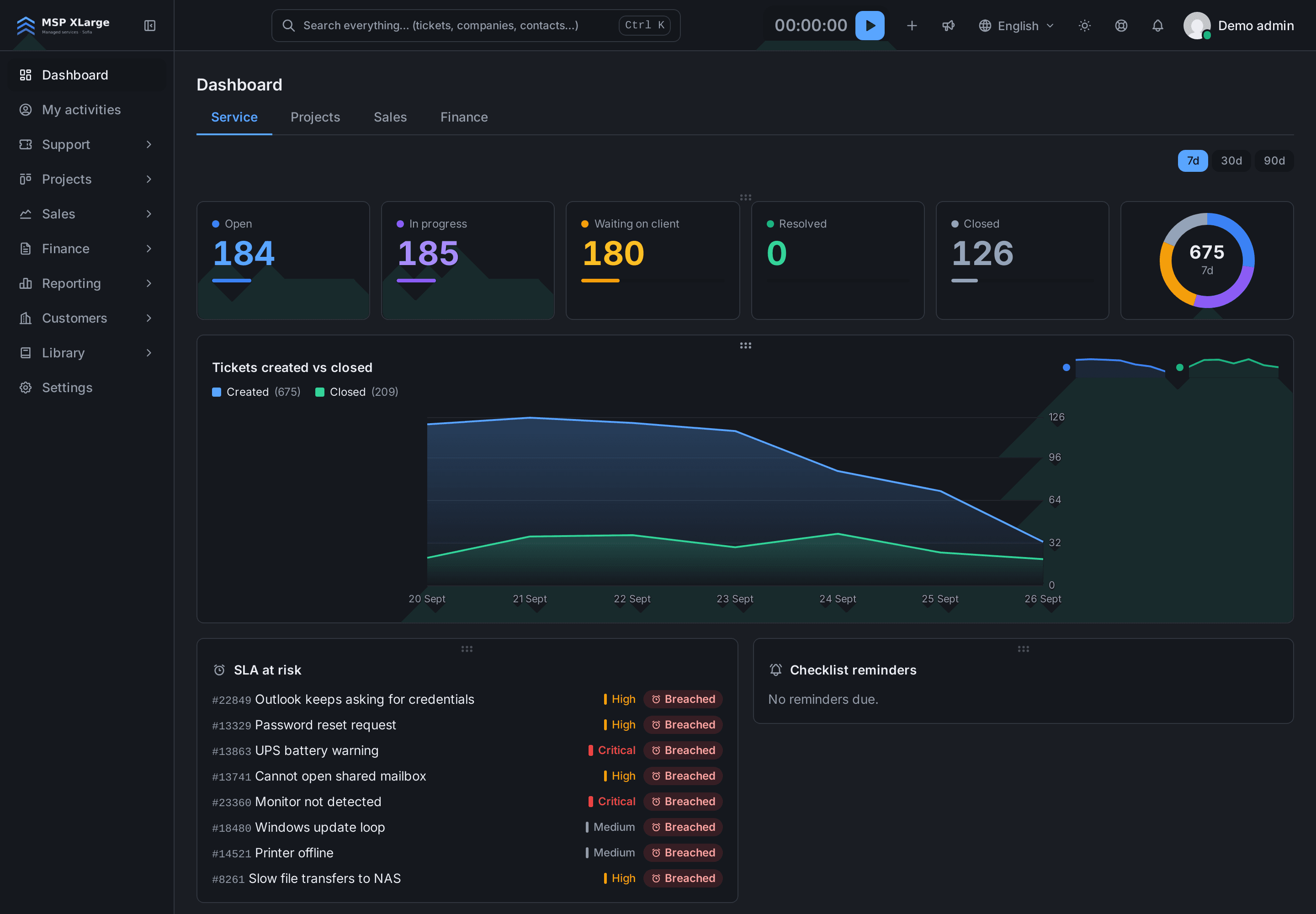
Xcellerate OPS addresses this problem by bringing service desk operations and business management into one multilingual, EU-hosted platform. Built by RMM Labs, it combines ticketing, CRM, project management, time registration, invoicing, automation, and AI-powered assistance in a modular workspace designed for service businesses.
The platform also introduces shared AI memory, allowing teams to turn resolved support tickets and existing documentation into reusable knowledge. Rather than treating every interaction as a new problem, Xcellerate OPS helps teams preserve reviewed solutions and use them in future workflows.
For managed service providers, IT support companies, consultancies, agencies, and other European service businesses, Xcellerate OPS offers an approach to service management that connects customer operations, team knowledge, and billing.
What Is Xcellerate OPS?
Xcellerate OPS is an AI-powered service desk and business operations platform designed for service businesses that want to manage their work from one workspace.
Its functionality extends beyond traditional helpdesk ticketing. Businesses can start with customer support and gradually introduce projects, time tracking, quoting, invoicing, sales pipelines, client portals, and other operational modules as their requirements change.
This modular structure is particularly relevant to managed service providers and professional service teams that need to connect customer requests with the work required to resolve them. A support conversation can become a tracked activity, the activity can contribute to an approved timesheet, and the recorded time can then flow into invoicing.
Xcellerate OPS also includes AI features that assist with ticket triage, response drafting, quality assurance, translation, and autonomous handling of selected enquiries. Teams can configure how much responsibility AI colleagues receive, from no autonomous action to draft-only or autonomous operation.
The platform is hosted in the European Union and advertises support for 25 interface languages, making it relevant to businesses serving customers and employees across multiple European markets.
AI Service Desk Software That Connects Customer Support and Operations
A conventional helpdesk primarily focuses on managing support requests. However, service businesses need to manage the wider process surrounding those requests, including customer relationships, project work, employee time, service agreements, and payments.
Xcellerate OPS brings these activities together so teams can manage more of the customer lifecycle without continually switching between separate applications.
Omnichannel ticketing and customer communication
Customer enquiries can arrive through email, Microsoft Teams, WhatsApp, and website chat. Xcellerate OPS brings these conversations into a unified service queue, giving employees a central place to manage requests and follow their progress.
A shared queue helps teams maintain visibility into incoming work, outstanding tickets, service-level agreements, and workload. Instead of requiring staff to monitor several disconnected communication tools, the platform provides a consolidated view of service operations.
For IT support providers and customer service teams, this can make it easier to prioritize requests, coordinate responses, and maintain continuity when another employee takes over a ticket.
CRM and customer relationship management
Customer information is more useful when it is connected to the work performed for that customer. Xcellerate OPS includes CRM capabilities alongside its service desk, allowing businesses to connect customer relationships with ongoing operational activities.
This integrated approach is relevant to service companies where the same customer may have open support tickets, active projects, contracts, quotations, and invoices at the same time.
By bringing these activities into one workspace, the platform helps teams work with a more complete view of each customer relationship.
Projects and professional services automation
Xcellerate OPS includes projects and professional services automation features for teams that deliver client work.
Businesses can introduce project management, budgets, quoting, and related operational modules as their needs grow. This makes the platform relevant to consultancies, IT service providers, and agencies that need to coordinate delivery work alongside customer support.
The goal is to connect day-to-day service activities with the commercial side of running a business, rather than managing delivery and billing in isolation.
AI Colleagues That Can Work Across Service Workflows
One of Xcellerate OPS's distinguishing features is its approach to autonomous AI colleagues.
Instead of limiting AI to a chatbot that answers questions or generates text, the platform allows configured AI colleagues to work within service and sales workflows. Depending on the team's settings, an AI colleague can read an enquiry, prepare or send a response, qualify a prospect, and escalate work when necessary.
For example, a service business could configure an AI colleague to process incoming support requests, answer appropriate questions, and route more complex issues to a human technician.
A sales team could use a similar workflow to respond to an initial enquiry and qualify a potential customer before passing the opportunity into the sales pipeline.
Configurable autonomy and human oversight
AI automation can create operational risks if a system has more authority than it needs. Xcellerate OPS addresses this by allowing autonomy to be configured for individual teams and actions.
Its documented options include:
- Off: the AI colleague does not act autonomously.
- Draft-only: it prepares work for human review.
- Autonomous: it can perform permitted actions independently.
Autonomy is off by default, according to the product website. AI colleagues are also designed to hand work back when they encounter errors or situations outside their capabilities.
The platform marks autonomous AI-generated replies across channels to support transparency. This approach gives service businesses a way to introduce AI gradually while keeping control over which tasks can be performed without human approval.
Permanent AI Memory for Service Teams
Support teams repeatedly encounter similar problems. When a technician resolves an issue, the solution may remain buried in a ticket or in that employee's personal knowledge. Another technician facing the same problem may have to investigate it again.
Xcellerate OPS addresses this through permanent AI memory, which brings together the team's knowledge base, documentation, product catalogue, and resolved support tickets.
When a ticket is closed, its solution can become a reusable knowledge resource after review. Team leads can promote, correct, or delete proposed solutions, helping the organization maintain control over the information its AI colleagues use.
This creates a workflow in which previous resolutions can support future assistance instead of being lost in historical tickets.
How shared AI memory can help reduce repeated work
Consider an IT support company that regularly handles account configuration problems. A technician resolves an issue and documents the correct procedure in a ticket. Once reviewed and promoted, that solution can become available to the team's AI workflows.
When a similar request arrives, the AI colleague can draw on the existing knowledge instead of starting from scratch. The technician can then focus on cases that require investigation or specialist expertise.
Xcellerate OPS also states that summaries, classifications, and translations are computed once and retained, reducing the need to repeat those processing steps. Its dashboard shows the AI credits users did not spend during the relevant period.
The potential benefit is not simply faster individual responses. It is the ability to make operational knowledge available across the team and reuse previous work more consistently.
Multilingual Helpdesk Software for European Businesses
Supporting customers and employees across different countries introduces language and localization challenges. A technician may work most effectively in one language while a customer expects support in another.
Xcellerate OPS is designed around multilingual operations, with a staff interface available in 25 languages. Employees can use their preferred interface language, date format, and timezone.
The platform also supports AI translation across customer conversations and knowledge resources.
A technician can respond in their own language while a customer reads the response in theirs, including through supported channels such as email, Teams, WhatsApp, and the customer portal. Knowledge articles and portal content can also be adapted to different languages.
Customer-facing pages for quotation acceptance, invoice payment, and surveys are designed to follow the visitor's browser language automatically.
For companies operating across Europe, these features can help create a more consistent customer experience without requiring every employee to communicate fluently in every language supported by the business.
EU-Hosted Software and Data Residency
Data location can be an important consideration when choosing service desk software, particularly for European businesses handling customer records, support conversations, and operational documentation.
Xcellerate OPS states that it is developed and operated by RMM Labs Ltd in Bulgaria and hosted entirely within the European Union. The company positions this as part of its approach to European data sovereignty and GDPR alignment.
The platform also describes a database-per-tenant architecture, giving each workspace an isolated database rather than combining customer data in a shared database.
For businesses evaluating EU-hosted service desk software, these are useful architectural considerations to examine alongside access controls, retention policies, encryption, backups, and contractual terms.
Hosting data in the EU does not, by itself, establish compliance with every applicable data protection obligation. Organizations should still assess how the platform is configured and how their own data processing responsibilities apply.
AI Act Compliance Features for Service Businesses
As businesses introduce AI into customer-facing workflows, they need to understand where AI is used and how it operates.
Xcellerate OPS includes an AI Act compliance center designed to disclose, log, and govern AI features. Its approach to autonomous AI colleagues also includes marking AI-generated replies and maintaining team-level control over permitted actions.
The platform describes AI memory as being redacted before storage, governed by the team, and included in its AI Act register. It also states that stored memory can be erased when a customer leaves.
These capabilities can help organizations document and manage their use of AI. However, the presence of an AI compliance center should not be interpreted as an automatic guarantee of compliance with every provision of the EU AI Act. Applicable obligations depend on the organization's role, the AI system's intended use, and the relevant legal requirements.
For service businesses adopting AI automation, built-in governance features can provide a starting point for establishing clearer internal controls.
Time Tracking, Timesheets, and Invoicing in One Platform
For service businesses, profitability depends partly on how effectively they record and bill the work they perform. When support tickets, employee timesheets, and invoicing systems are disconnected, billable time can be missed or require manual reconciliation.
Xcellerate OPS connects time registration with approved timesheets and invoicing workflows.
Employees can record work associated with service activities, while managers can review and approve timesheets before the recorded time flows into invoices. This helps connect the operational work performed by the team with the revenue it generates.
The platform also includes expenses, quotations, contracts, and billing capabilities. Businesses can therefore manage more of the commercial process alongside customer support and project delivery.
For managed service providers, consultancies, and agencies, integrating these workflows can make it easier to review service costs, understand project budgets, and maintain a clearer record of billable activity.
Modular Business Operations Software That Grows With Your Team
Not every business needs a complete service management suite from the beginning. A small IT support company may initially need ticketing and a knowledge base, while a more established provider may also require project budgets, time tracking, contracts, and invoicing.
Xcellerate OPS follows a modular approach, allowing businesses to activate the capabilities they need as their operations develop.
1. Light helpdesk
Start with omnichannel ticketing, service-level agreement management, and a knowledge base. Teams can hide modules they do not currently need.
2. Service desk and PSA
Add projects, budgets, time tracking, timesheets, quotations, and invoicing to support a more comprehensive service operation.
3. Complete business operations
Expand into sales pipelines, accounting integrations, procurement, IT documentation, and a branded customer portal.
Because the modules belong to the same platform, businesses can expand their workflows without migrating to an entirely different application each time their requirements change.
This is particularly useful for growing service providers that want to start with a focused helpdesk and gradually consolidate more of their operations.
Xcellerate OPS Pricing: Workspace-Based Licensing
Xcellerate OPS promotes workspace-based pricing rather than charging a separate software license fee for every technician. Its website highlights a free tier and a model designed to let businesses add team members without automatically increasing their licensing costs.
Optional AI credits and modules can be usage-based, allowing smaller teams to pay for additional capabilities as needed.
Plan limits, included modules, and usage-based charges can change, so businesses should check the official Xcellerate OPS website for current pricing.
The pricing approach may be attractive to service businesses with growing teams, especially those comparing platforms where per-user fees increase with every new hire.
Xcellerate OPS vs Traditional Service Desk and Project Management Tools
Businesses evaluating Xcellerate OPS may also consider products such as ServiceNow, Asana, Trello, Productive.io, HubSpot, Teamleader, and Monday.com.
These products serve different purposes and should not be treated as identical alternatives. Some focus primarily on ticketing or IT service management, while others concentrate on project planning, CRM, or broader business workflows.
Xcellerate OPS differentiates itself through its combination of service desk management, business operations, multilingual support, EU hosting, and team-wide AI memory.
Its main areas of differentiation include:
- Connected service workflows: Tickets, CRM, projects, time registration, and invoicing can operate within one platform.
- Shared AI memory: Reviewed solutions from previous tickets can become reusable team knowledge.
- AI colleagues: Teams can configure how much autonomy AI receives in support and sales workflows.
- European hosting: The platform states that its infrastructure is hosted entirely within the EU.
- Multilingual operations: The staff interface supports 25 languages, with AI translation for conversations and knowledge.
- Workspace-based licensing: Pricing is designed around workspaces with unlimited technicians rather than per-seat licensing.
Organizations should compare actual functionality, implementation requirements, integrations, service-level agreements, and total costs before choosing a platform.
Who Should Use Xcellerate OPS?
Xcellerate OPS is primarily aimed at service businesses that need to coordinate customer requests, team delivery, and commercial operations.
Managed service providers (MSPs): IT service providers can use the service desk, knowledge base, time tracking, and operational modules to manage customer support and service delivery.
IT support companies: Teams handling recurring technical requests may benefit from centralized ticketing and reusable AI-assisted knowledge.
Consultancies and agencies: Businesses delivering client projects can connect customer relationships, project work, tracked time, and invoicing in one workspace.
Installers and field service businesses: Service organizations can evaluate the platform's ticketing and operational workflows to manage customer requests and related work.
European businesses with multilingual teams: Organizations serving customers across several languages may benefit from the localized interface and AI translation features.
Final Thoughts
Xcellerate OPS brings service desk management, CRM, projects, time tracking, invoicing, and AI automation into a modular platform for service businesses.
Its most distinctive capabilities are the combination of shared AI memory, configurable AI colleagues, multilingual support, and EU-hosted infrastructure. These features are designed to help teams preserve operational knowledge, automate selected workflows, and connect customer support with the commercial processes that keep a service business running.
The platform is especially relevant to European MSPs, IT support providers, consultancies, and agencies that want to consolidate separate tools while introducing AI with defined permissions and oversight.
If you are comparing AI service desk software or looking for business operations software for a growing service team, explore Xcellerate OPS to review its modules, hosting approach, and current pricing.
Frequently Asked Questions
What is Xcellerate OPS?
Xcellerate OPS is a multilingual, EU-hosted service desk and operations platform that combines ticketing, CRM, projects, time registration, invoicing, automation, and AI capabilities for service businesses.
Is Xcellerate OPS designed for managed service providers?
Yes. Managed service providers are a key audience, alongside IT support companies, consultancies, agencies, installers, and other service businesses that manage customer requests and billable work.
Does Xcellerate OPS include AI automation?
Yes. It offers AI assistance for tasks such as triage, response drafting, and quality assurance, along with configurable autonomous AI colleagues that can handle permitted support and sales workflows.
What is permanent AI memory in Xcellerate OPS?
Permanent AI memory lets teams turn documentation, knowledge base content, product information, and reviewed ticket resolutions into reusable knowledge for AI colleagues. Teams can review, correct, promote, or delete solutions.
Is Xcellerate OPS hosted in the EU?
The company states that the platform is hosted entirely in the European Union. It also describes database-per-tenant isolation. Organizations should review the vendor's current documentation and contractual terms when assessing their data residency requirements.
Does Xcellerate OPS support multiple languages?
Yes. The platform advertises a staff interface in 25 languages, alongside AI translation for supported conversations and knowledge resources.
Can Xcellerate OPS connect time tracking with invoicing?
Yes. Tracked time can flow into approved timesheets and then into invoices, connecting operational activity with billing workflows.
Does Xcellerate OPS charge per technician?
The platform advertises workspace-based pricing with unlimited technicians. Optional AI credits and modules may have usage-based charges, so businesses should confirm the current pricing details.
Does Xcellerate OPS help with EU AI Act governance?
It includes an AI Act compliance center designed to disclose, log, and govern AI features. Organizations should still assess their own obligations and verify how the platform's features support their specific compliance requirements.
Can a business start with only the helpdesk?
Yes. Xcellerate OPS is modular. A business can begin with ticketing, SLA management, and a knowledge base, then activate project management, billing, sales, and other modules as needed.