Business Tools
DealRaw: A Lead Generation Tool for Agencies Targeting US Trades Businesses
Discover DealRaw, a prospecting tool for agencies and freelancers to find US HVAC, plumbing and other trade business leads using fresh listings, neglect scores and filters.
CodeHype15 min read
Finding the right prospects is one of the biggest challenges for freelancers, marketing agencies, and service providers. A web design agency might need businesses without websites, an SEO consultant might be looking for companies with neglected online listings, and a local marketing freelancer might want to connect with HVAC or plumbing contractors that need better digital visibility.
The challenge is not simply finding business names. Effective prospecting requires relevant data, useful filters, accessible contact information, and a repeatable way to identify potential clients before competitors reach them. Manually searching directories and checking individual business websites can consume hours that could otherwise be spent on outreach and client work.
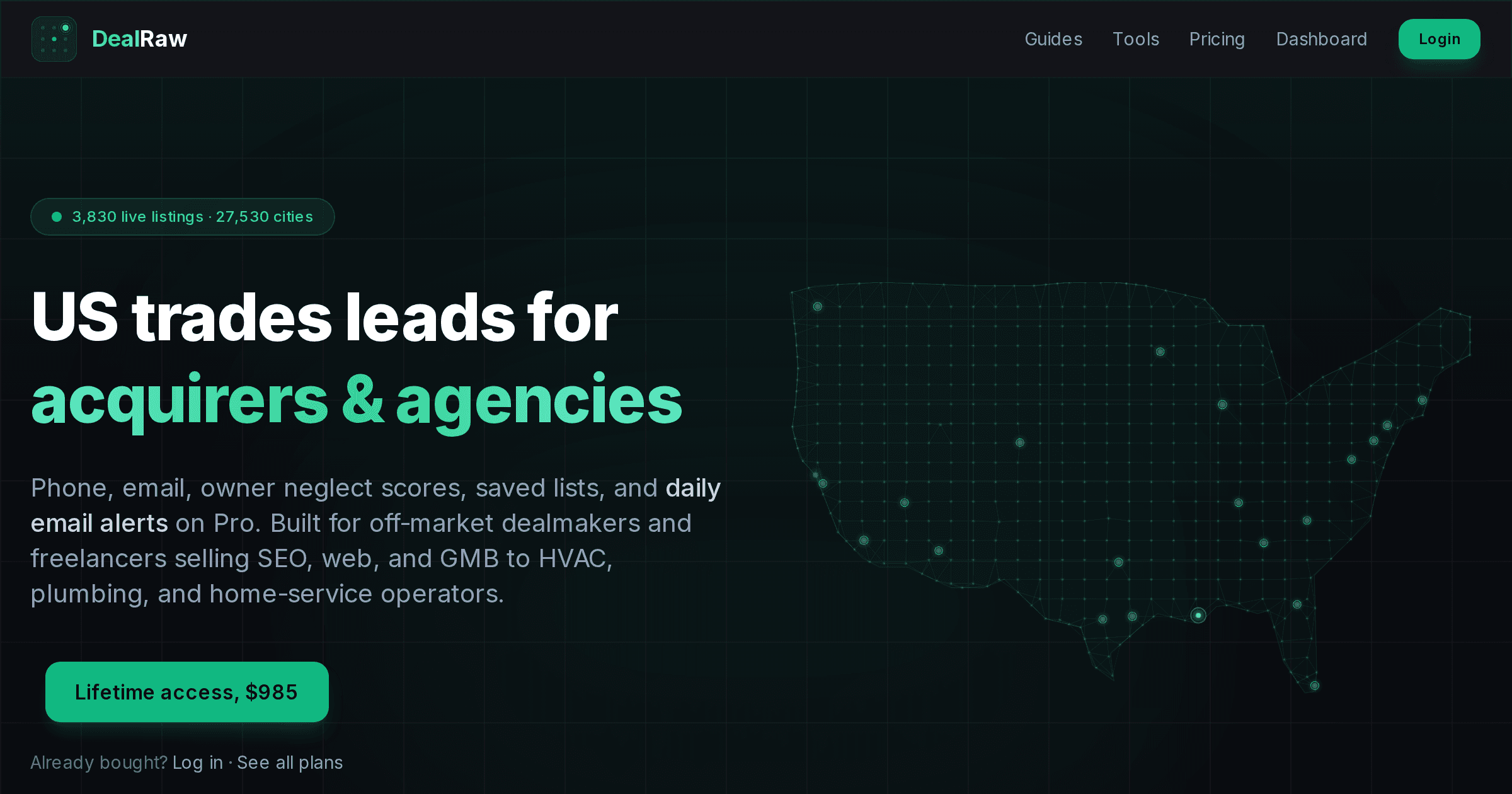
DealRaw is a lead generation and prospecting platform built specifically for professionals targeting local service businesses across the United States. It focuses on HVAC, plumbing, roofing, landscaping, pest control, cleaning, auto repair, and other trade categories. Its database, business filters, owner neglect scores, saved prospect lists, and email alerts help agencies identify potential clients that may need digital marketing or website services.
The platform reports approximately 550 new US trades listings per day, with coverage expanding across different markets. If you sell websites, SEO, Google Business Profile optimization, or related services to local businesses, DealRaw offers a focused way to discover and organize prospects.
What Is DealRaw?
DealRaw is a business prospecting tool designed for agencies, freelancers, and professionals who sell services to local businesses in the United States. Rather than targeting every type of company, it concentrates on trade and home-service businesses that may benefit from website development, local SEO, online reputation improvements, and digital marketing.
The platform provides access to business listings that users can filter by location, trade category, website presence, phone availability, and owner neglect score. This helps narrow a broad pool of local businesses into a more relevant list for a particular service offering.
For example, a web designer could search for HVAC contractors without websites in a target city. An SEO freelancer could look for plumbing businesses with signs of neglected online presence. A marketing agency could build a prospect list of landscaping companies in selected states and organize the results for future outreach.
DealRaw also includes saved prospect lists, bounded CSV exports, daily and weekly email alerts, and an MCP integration for AI agents on its Pro plan. These features are intended to help users turn business discovery into a repeatable prospecting workflow.
The platform is paid, with a listed lifetime option of $190 and a Pro subscription at $19 per month.
Why Local Business Lead Generation Is Difficult
For freelancers and agencies, finding potential clients is only the first step in acquiring new business. The more important question is whether those businesses have a problem the agency can realistically solve.
A general business directory may provide thousands of company names, but that does not mean every listing represents a suitable prospect. A business may already have a professional website, maintain an active online presence, or have little need for the service being offered.
This creates several challenges for agencies that rely on manual prospecting.
First, researching each company individually takes time. Freelancers may need to inspect websites, search for contact details, review business listings, and determine whether the company fits their target market.
Second, relevant prospects can be difficult to prioritize. A business with no website may be a better fit for a web designer than one with an established online presence. Similarly, an SEO agency may want to investigate businesses whose public listings appear neglected.
Third, prospecting is an ongoing activity. New businesses appear, existing companies change their online presence, and agencies need to replenish their lead lists regularly.
DealRaw addresses these challenges by combining trade-specific business data with filters and tools that help users organize their research. Instead of starting every prospecting session from scratch, users can focus on businesses that match their target service and location.
Key Features of DealRaw
1. Business Listings Across 10 US Trade Categories
DealRaw focuses on 10 trade verticals, providing a targeted starting point for agencies that sell services to local businesses.
Its listed categories include:
- HVAC and heating and air conditioning
- Plumbing services
- Roofing and gutter services
- Landscaping and lawn care
- Pest control
- Commercial cleaning and janitorial services
- Auto repair and detailing
- Laundromats and coin laundry
- Self-storage facilities
- Car wash services
These categories cover a range of local service businesses with different operational needs and customer acquisition challenges.
For instance, an agency specializing in Google Business Profile optimization may focus on plumbers and HVAC contractors, while a web development freelancer may search for auto repair shops or cleaning companies with limited online visibility.
Having trade categories available within a dedicated prospecting platform helps users build lists that align with their existing expertise instead of searching an unrelated collection of businesses.
DealRaw reports more than 16,000 live US listings and over 27,000 markets indexed. Coverage varies by market, and the platform continues to add locations as its data collection processes run.
2. Owner Neglect Scores to Prioritize Prospects
One of DealRaw's distinguishing features is its owner neglect score, which ranges from 0 to 100. The score is calculated using signals such as reviews, business hours, web presence, and other indicators.
The goal is to help users identify businesses whose public-facing digital presence may deserve closer attention.
For example, a local contractor without a website could be relevant to a web design agency. A business with an outdated online presence might be worth investigating for an SEO or Google Business Profile service.
The score gives prospectors another way to organize search results beyond basic business names and locations.
However, it should be treated as a prioritization signal rather than proof that a business owner needs a particular service. A high score does not guarantee that a prospect is interested in buying, has an available budget, or will respond to outreach. Users should review individual businesses before contacting them.
3. Find Businesses Without Websites
A business's website presence can be an important filtering criterion for freelancers selling website design, development, or digital transformation services.
DealRaw includes a no-website filter that helps users identify listings without an associated website. This can reduce the amount of manual research needed to find businesses that may be relevant to a website development offer.
Consider a freelancer who builds websites for home-service companies. Instead of browsing every HVAC contractor in a city, the freelancer can narrow the search to businesses without websites and then inspect the available listing details.
This creates a more targeted starting point for outreach and makes it easier to build a prospect list around a specific service.
A missing website does not automatically mean that a business wants one. Some businesses rely on referrals or other channels, so personalized research remains important before sending a pitch.
4. Advanced Filters for Targeted Prospecting
A useful lead generation tool needs to help users narrow the data to match their ideal customer profile. DealRaw offers dashboard filters that include state, trade, city, ZIP code, neglect band, website presence, and phone verification status.
These filters can be combined to create more focused prospect lists.
For example, an agency could search for plumbing businesses in a particular state, narrow the results to a selected city, and then filter for companies without websites. A local SEO consultant might prioritize a different trade category and select businesses whose neglect scores fall within a particular range.
The platform's location coverage varies, so available results depend on the market being searched.
This flexibility can make prospecting more practical for small agencies that serve specific geographic areas. Instead of working through a large, generic database, users can focus their attention on businesses that fit their service offering and location preferences.
5. Phone Numbers and Public Contact Information
Finding a relevant business is not enough if the prospecting workflow lacks a way to contact it. DealRaw provides phone numbers and email addresses when those details are publicly available through a listing or business website.
The platform also includes a phone-verified badge when a listing's phone number has been matched against independent directories. Users can filter for records with phone numbers before preparing a call list.
This can help freelancers organize their outreach and prioritize businesses with accessible contact information.
However, contact details are not guaranteed to be available for every listing, and the verified badge should be understood within the platform's stated matching process. Users should check important details before relying on them.
Anyone using the data for sales outreach should also follow applicable privacy rules, telemarketing requirements, email regulations, and any relevant restrictions on contacting businesses.
6. Daily and Weekly Email Alerts
Prospecting is rarely a one-time task. Agencies often need to discover new potential clients every week while continuing to work through existing leads.
DealRaw offers daily and weekly email alerts on its Pro plan. Users can save filters based on factors such as state, trade, and city where listing coverage is available. The platform then sends alerts when new matches appear for those saved filters.
This feature can help users keep their prospecting lists fresh without repeatedly running the same searches manually.
For example, a freelancer targeting roofing businesses in selected cities could save a relevant search and receive alerts about new matching listings. Those prospects can then be reviewed and added to an outreach workflow.
Alerts are particularly useful for agencies that want to maintain a steady pipeline of potential clients rather than conducting occasional large research sessions.
7. Saved Prospect Lists and CSV Exports
DealRaw includes saved prospect lists that help users organize businesses discovered through search. These lists can be used to build call sheets, group prospects by location or trade, and prepare outreach batches.
The platform also offers CSV exports with limits designed to control how much data can be exported.
The listed limits are:
- Lifetime plan: Up to 100 leads per day, with 50 leads per file.
- Pro plan: Up to 150 leads per day, with 50 leads per file.
These limits make it important to plan exports around the actual size of a prospecting campaign.
For a freelancer who wants to contact a manageable number of businesses each day, the workflow can be straightforward. Search for relevant companies, review their details, save suitable prospects, and export the records needed for outreach.
DealRaw describes saved lists as a simple CRM-style workflow. They can support basic prospect organization, although users who need advanced pipeline management, automated follow-ups, or extensive sales reporting may still require a dedicated CRM.
8. MCP Integration for AI Agents
DealRaw also supports the Model Context Protocol (MCP) on its Pro plan. MCP allows compatible AI applications and agents to interact with supported tools and data sources through a standardized interface.
According to DealRaw, its Pro plan provides 30 bounded queries per day through MCP. This allows users to research prospects from compatible AI environments, including tools such as Cursor or Claude, without exporting the entire database.
For agencies that already use AI-assisted workflows, this can provide another way to search and examine business prospects.
For example, a user could incorporate prospect research into a broader workflow that helps organize potential clients by trade, location, or website presence. The usefulness of that workflow depends on the available MCP operations, query limits, and the user's own process.
The integration is an additional capability rather than a requirement for using the core prospecting dashboard.
9. Free Templates and Outreach Resources
DealRaw provides a collection of free templates, calculators, and outreach resources through its tools section. The platform advertises more than 90 resources, including scripts and materials for professionals selling services to local trades businesses.
Examples include a Loom outreach script for trades owners, a cold email template focused on local map pack gaps, and proposal openings for web design freelancers.
These resources can help users structure their initial outreach and explain the specific problems their services address.
The platform also offers guides for different types of service providers, including SEO agencies, Google Business Profile specialists, web designers, social media freelancers, and outbound sales professionals.
This combination of prospect data and outreach material can be useful for newer freelancers who are still developing their sales process. The templates should be adapted to the individual business rather than sent as generic messages without research.
How DealRaw Works
DealRaw brings business discovery and prospect organization into a single workflow.
Step 1: Choose your target market. Decide which US trade category and geographic area match the service you sell. For example, a website developer might focus on HVAC contractors in selected cities.
Step 2: Apply relevant filters. Narrow the listings by location, website presence, neglect score, and phone availability. The available results depend on the platform's coverage of the selected market.
Step 3: Review potential prospects. Examine the listing information and public business details to determine whether each company is a suitable fit for your offer.
Step 4: Save and organize leads. Add relevant businesses to saved prospect lists so you can prepare call sheets or outreach batches.
Step 5: Export or monitor new matches. Export a limited number of leads for your outreach process, or use Pro email alerts to discover new listings matching your saved filters.
This approach creates a repeatable process for identifying, evaluating, and organizing local business prospects.
Who Should Use DealRaw?
DealRaw is most relevant to professionals who sell services to US trades businesses and want a more targeted way to find potential clients.
Web designers and developers can search for businesses without websites or companies whose online presence may need improvement.
SEO agencies and freelancers can identify local businesses to investigate for website optimization, search visibility, and local SEO services.
Google Business Profile specialists can focus on businesses whose public listings may need attention and build prospect lists for local visibility services.
Social media freelancers can use the platform to research local service companies and identify potential clients for social media management.
Local marketing agencies can organize prospects across HVAC, plumbing, roofing, cleaning, and other trade categories based on their service areas.
Outbound sales professionals can build targeted call lists and use available contact details to support business development workflows.
The platform is less directly suited to companies looking for a broad database of enterprise executives or prospects across every industry. Its main focus is local US trade businesses.
DealRaw Pricing: Lifetime Access vs. Pro
DealRaw offers two main paid options, with different access models depending on how frequently users need new prospect data and automation features.
| Feature | Lifetime | Pro |
|---|---|---|
| Listed price | $190 one-time | $19 per month |
| Lead exports | Up to 100 per day | Up to 150 per day |
| Leads per CSV file | 50 | 50 |
| Daily and weekly email alerts | Not listed | Included |
| MCP access | Not listed | Included, 30 queries per day |
| Priority refresh on active markets | Not listed | Included |
The lifetime plan may suit freelancers who prefer a one-time payment and mainly use the dashboard for manual prospecting. Pro may be more appropriate for agencies that want ongoing alerts, priority refresh on active markets, and MCP access.
DealRaw also advertises more than 90 free templates and tools that can be explored separately from its paid prospecting features.
Before choosing a plan, consider how many prospects you expect to review, whether you need recurring alerts, and whether MCP integration would fit your workflow. Pricing and usage limits can change, so verify the current terms on the official DealRaw website.
DealRaw vs. General Lead Databases
DealRaw lists Apollo and Lusha as alternatives. These tools serve the broader lead generation and sales intelligence market, while DealRaw concentrates on local US trades prospecting.
The distinction is primarily one of focus. If your business development strategy involves reaching decision-makers across many industries, a general sales intelligence platform may fit your needs better. If you specifically sell websites, SEO, Google Business Profile services, or local marketing to home-service businesses, DealRaw's trade-focused categories and website filters may be more relevant.
Its owner neglect score, saved searches, bounded exports, and location-specific listings are designed around identifying local business opportunities rather than building a broad contact database for every possible sales use case.
The best choice depends on your ideal customer profile and outreach process. Evaluate the quality of the records in your target markets before committing to any prospecting tool.
Is DealRaw Worth Trying?
DealRaw addresses a specific problem for freelancers and agencies: finding local businesses that may need the services they sell. Its focus on US trades, including HVAC, plumbing, roofing, landscaping, and cleaning, makes it more targeted than a general business directory.
The combination of website filters, owner neglect scores, public contact information, saved prospect lists, CSV exports, and Pro email alerts can help users create a repeatable lead generation workflow. Its MCP integration also provides an option for professionals who want to incorporate prospect research into compatible AI-assisted workflows.
There are limitations to consider. Coverage varies by market, contact information is available only when public, and a neglect score cannot establish whether a company is ready to buy. The daily export limits may also influence how users organize larger outreach campaigns.
For freelancers and agencies whose ideal clients are US trades businesses, DealRaw is worth evaluating as a specialized prospecting tool. Start by searching your target locations and checking whether the available listings match the businesses you want to reach.
Explore DealRaw to find relevant US trades prospects and build a more focused local business outreach pipeline.
Frequently Asked Questions
1. What is DealRaw?
DealRaw is a lead generation and business prospecting platform focused on US trades businesses. It helps agencies and freelancers find, filter, save, and export potential clients for services such as web design, SEO, and local marketing.
2. Which industries does DealRaw cover?
The platform lists 10 US trade categories, including HVAC, plumbing, roofing, landscaping, pest control, commercial cleaning, auto repair, laundromats, self-storage, and car washes.
3. Can DealRaw help find businesses without websites?
Yes. DealRaw includes a no-website filter that helps users identify local businesses without an associated website, making it relevant to freelancers and agencies offering website development and related services.
4. What is the owner neglect score?
The owner neglect score ranges from 0 to 100 and uses signals such as reviews, business hours, and web presence. It helps users prioritize businesses for further research, but it does not guarantee that a business needs or wants a service.
5. Does DealRaw provide phone numbers and email addresses?
It provides phone numbers and email addresses when those details are publicly available through a business listing or website. Some listings may not include contact information.
6. How much does DealRaw cost?
DealRaw lists a $190 one-time lifetime plan and a Pro subscription priced at $19 per month. The Pro plan includes features such as email alerts and MCP access. Check the official pricing page for current terms.
7. Does DealRaw support AI agents?
Yes. The Pro plan includes MCP access with 30 bounded queries per day, allowing compatible AI applications to interact with supported prospecting data.
8. Who benefits most from DealRaw?
Web designers, SEO freelancers, Google Business Profile specialists, local marketing agencies, social media professionals, and outbound sales freelancers targeting US trades businesses are the primary audience.
9. Does DealRaw guarantee new clients?
No. DealRaw helps users discover and organize potential prospects, but successful client acquisition depends on the relevance of the offer, the quality of outreach, the prospect's needs, and other factors.
10. Is DealRaw suitable for beginners?
It can be useful for beginners who sell services to local businesses. Its filters, saved lists, and free outreach templates provide a starting point for organizing prospect research, although users still need to evaluate leads and develop an effective outreach strategy.