Business Tools
Nice Catalogs: An AI-Powered Online Catalog Tool for Small Businesses
Discover Nice Catalogs, an all-in-one tool for small businesses to create online catalogs, accept WhatsApp orders, manage bookings, collect Google reviews, and build customer loyalty.
CodeHype16 min read
Small businesses need simple ways to showcase products, receive orders, manage appointments, and maintain relationships with customers. Yet many owners still rely on PDF price lists, product photos shared through messaging apps, social media posts, and manually managed bookings. These methods can work initially, but they become harder to organize as a business grows.
Building a traditional website may require additional costs, technical knowledge, and ongoing maintenance. Separate booking platforms and ordering systems can introduce more complexity, while commission-based services may reduce the amount a business keeps from each sale.
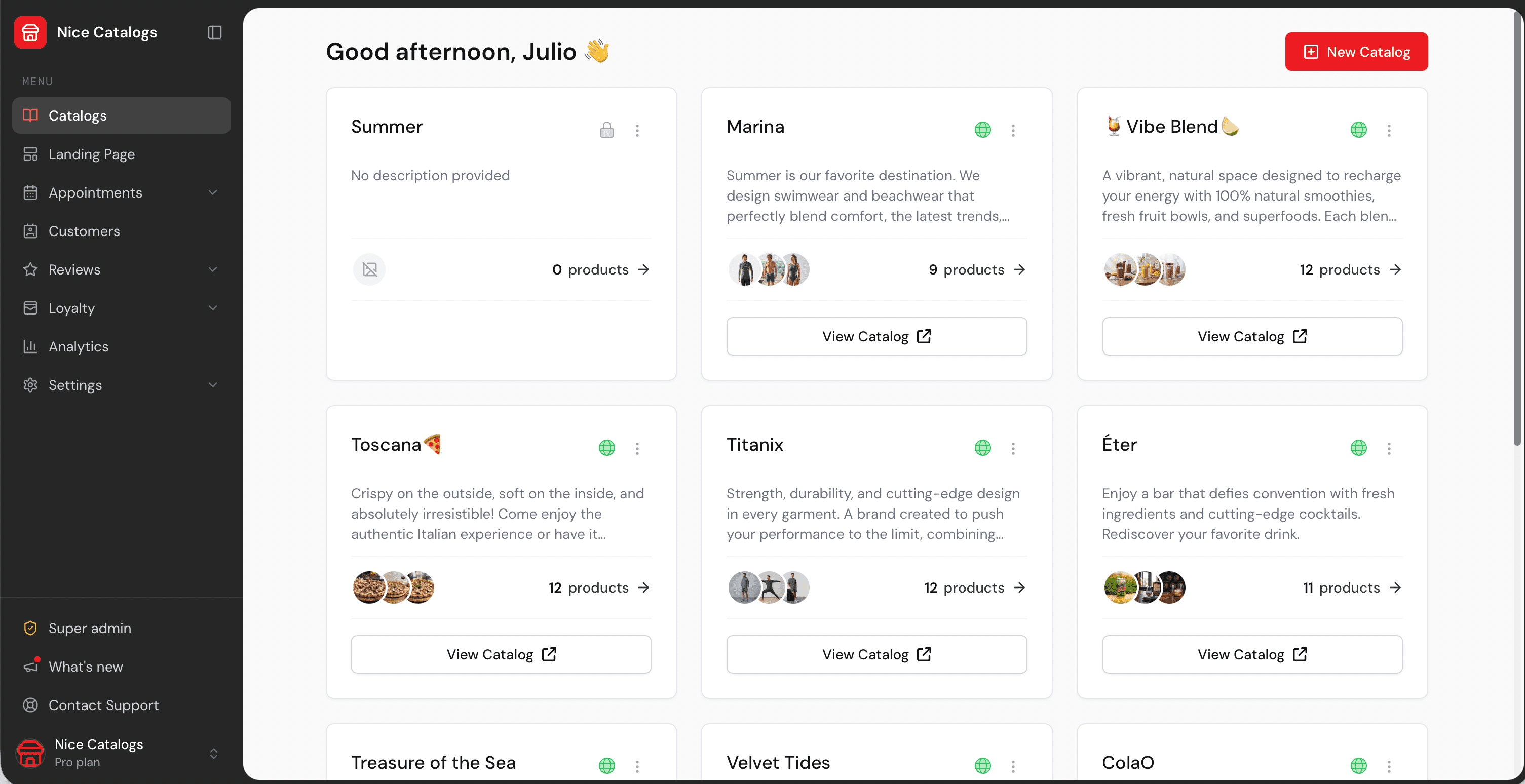
Nice Catalogs brings several of these activities together in one shareable link. It allows small businesses to create mobile-friendly product catalogs and menus, receive orders through WhatsApp or Telegram, manage appointments, collect Google reviews, and encourage repeat purchases with digital loyalty cards. AI-powered image and text enhancements help improve product presentation, while its AI Index feature is designed to make business catalogs discoverable through compatible AI assistants.
The platform is built for businesses that want an online presence without having to build and maintain a conventional website. Whether you run a restaurant, retail store, salon, service business, or wholesale operation, Nice Catalogs offers a way to present your products and services in one accessible destination.
What Is Nice Catalogs?
Nice Catalogs is an all-in-one digital catalog and customer management platform for small businesses. It combines product presentation, ordering, appointment scheduling, customer reviews, loyalty features, and a landing page that can be shared across social media and messaging channels.
Instead of sending customers multiple PDFs or asking them to browse through old social media posts, business owners can create a live catalog with product photos, descriptions, prices, and search functionality. Customers can browse the catalog from their phones, add items to a cart, and send an order directly through WhatsApp or Telegram.
The platform also supports appointment booking for businesses that sell services rather than physical products. Customers can choose a service, select an available date and time, and add the appointment to their preferred calendar. Business owners can manage their schedules and keep customer information organized.
Nice Catalogs extends beyond traditional catalog creation with AI-assisted content improvements and an AI Index system intended to make product and business information accessible to AI-powered discovery tools.
Its central idea is to give small businesses the essential tools to present their offerings, receive inquiries and orders, and encourage repeat customers without maintaining several disconnected systems.
Why Small Businesses Need an Online Catalog
Customers increasingly expect to view products, compare prices, and understand available services before contacting a business. When this information is scattered across social media posts, PDF files, screenshots, and chat messages, the buying process can become unnecessarily difficult.
A customer may need to ask for a menu, request a price list, or wait for a business owner to confirm whether a product or service is available. Owners, meanwhile, may spend valuable time repeatedly answering the same questions and manually copying order details.
A dedicated online catalog creates a more organized experience. Customers can browse products and services at their convenience, while the business has a single destination to share whenever someone asks what it offers.
Nice Catalogs makes this process accessible without requiring a traditional website. Owners can create a catalog, add products, and share the resulting link through WhatsApp, Instagram, TikTok, or other channels. QR codes provide another way to direct customers to the catalog, including at physical locations.
For small businesses with limited time and technical resources, this approach can simplify product presentation and customer communication.
Key Features of Nice Catalogs
1. Create Mobile-Friendly Digital Catalogs
The foundation of Nice Catalogs is its online catalog builder. Businesses can create product pages with images, descriptions, and prices, then organize their offerings into a presentation customers can browse from a phone or computer.
The platform includes themes designed for different business types, allowing owners to choose a presentation that suits their products or services. Smart search and filtering features help customers navigate catalogs containing multiple items.
Business owners can also customize their catalog URL and use a custom domain, depending on their setup and plan.
This is particularly useful for businesses that want to establish a professional online presence without commissioning a complete website. A restaurant can publish a menu, a clothing store can display its products, and a service provider can present available offerings through the same general workflow.
The catalog can be updated as products, prices, or descriptions change, giving customers a central place to find current information.
2. Convert PDFs and Spreadsheets Into Online Catalogs
Many small businesses already have their product information organized in spreadsheets or PDF price lists. Recreating all that information manually can be time-consuming, particularly for stores with large inventories or extensive service menus.
Nice Catalogs includes tools for importing existing information through PDF-to-catalog and CSV-to-catalog functionality.
The PDF tool is designed to help transform a price list into an online catalog, while spreadsheet imports provide a way to bring structured product information into the platform.
This can reduce the work involved in moving from traditional documents to a shareable online catalog. Instead of starting with an empty page, businesses can use information they already have and then review and improve the resulting presentation.
Owners should still check imported product names, prices, descriptions, and images before publishing to ensure the catalog accurately represents their offerings.
3. AI-Powered Product Image Enhancement
Product presentation can influence how customers perceive a business. Poor lighting, inconsistent backgrounds, or low-quality images can make an otherwise useful catalog look unprofessional.
Nice Catalogs includes AI image enhancement tools designed to improve product photos. These features can help businesses create a more consistent visual presentation without needing advanced image editing skills.
For example, a small retailer may have photographs taken under different lighting conditions. AI-assisted enhancement can help improve their appearance before the images are added to the catalog.
The platform also offers AI text improvements, providing assistance with product descriptions and other catalog copy.
These tools are useful for businesses that want to improve their presentation quickly, although owners should review the results to ensure that images remain accurate and descriptions do not introduce incorrect product details.
4. WhatsApp and Telegram Ordering
One of Nice Catalogs' central features is its messaging-based ordering workflow. Rather than requiring a separate checkout system, the platform lets customers build an order through a cart and send the details to the business through WhatsApp or Telegram.
Customers can browse products, select available options, adjust quantities, and add items to their cart. When they are ready, they send the order through the messaging app, with the selected items and total included in the message.
For example, a restaurant customer could select two pizzas, a salad, and a drink. The resulting message can include the item names, quantities, options, and calculated total, giving the business a clearer order summary than a series of unstructured messages.
This approach works with communication channels many small businesses already use. Owners can receive orders through their existing chats rather than managing a separate order inbox.
Nice Catalogs states that it does not charge commissions per order. Since the order is sent through a messaging app rather than a built-in checkout flow, businesses should distinguish the catalog's ordering functionality from payment processing and confirm payment arrangements directly with customers.
5. QR Code Ordering for Physical Locations
Businesses that serve customers in person can use QR codes to connect their physical location with their digital catalog.
Nice Catalogs provides QR code ordering, allowing customers to scan a code with their phone camera and open the catalog in their browser. They can then browse the available products, add items to their cart, and send the completed order through WhatsApp or Telegram.
This can be useful for restaurants, cafés, bars, and other businesses that want to make menus or product lists accessible without distributing printed copies to every customer.
QR codes can also be shared on posters, packaging, business cards, or promotional materials. Because the code directs customers to the catalog, businesses can update their online product information without needing to replace every printed item.
The feature provides a straightforward connection between physical customer interactions and the business's online ordering process.
6. Appointment Booking and Calendar Integration
Businesses that provide services often need a booking system rather than a product cart. Nice Catalogs includes appointment booking features on its Pro plan.
Customers can select a service, choose a suitable day and time, and schedule an appointment through the catalog. Business owners can define their working hours, breaks, and booking rules, while the system is designed to prevent double bookings.
Clients can also add appointments to Google Calendar, Outlook, or Apple Calendar. Bookings appear on the business's Appointments page, and customer records can be maintained in the Customers section with notes and history.
This can be useful for salons, consultants, personal service providers, and other businesses that manage scheduled appointments.
Instead of coordinating every booking manually through messages, owners can provide customers with a more structured way to select an available time. The booking system also keeps appointments connected to the business's broader catalog and customer management workflow.
7. Digital Loyalty Cards for Repeat Customers
Acquiring new customers is only one part of growing a small business. Encouraging existing customers to return can also play an important role in building a sustainable customer base.
Nice Catalogs offers digital loyalty cards on its Pro plan. These cards are designed to give customers a digital alternative to traditional paper punch cards.
For example, a café may want to encourage repeat visits, while a local shop might use a loyalty program to recognize returning customers. A digital card provides a way to keep the loyalty experience connected to the business's online presence.
Because customers already interact with the catalog through their phones, digital loyalty cards can fit naturally into the same customer journey.
The feature is particularly relevant to businesses that depend on repeat purchases and want a simple way to support customer retention without managing a separate loyalty platform.
8. Collect Google Reviews With a Link or QR Code
Online reviews can help potential customers evaluate a business before deciding to visit or make a purchase. However, customers may forget to leave a review even after a positive experience.
Nice Catalogs includes review links and QR codes designed to make the process easier. Businesses can share a link or display a QR code that directs customers toward the review flow.
The platform describes a one-question rating screen, with customers who provide a four- or five-star rating directed to the business's Google review page.
This feature is intended to reduce the steps between a customer expressing satisfaction and reaching the review page.
Businesses should use review collection features transparently and follow Google's current policies on reviews. Feedback requests should not be used to suppress negative reviews or manipulate a business's public rating.
9. Link-in-Bio Landing Pages
Businesses often use several online channels to reach customers. An Instagram profile might need to link to a catalog, a WhatsApp contact, a booking page, and other useful destinations.
Nice Catalogs provides a landing page that brings catalogs, contact details, and links together behind a single shareable URL. This works as a link-in-bio page for platforms such as Instagram and TikTok, as well as for WhatsApp conversations.
Unlike a basic list of buttons, the platform can connect visitors to full product catalogs containing images, prices, search, and an order cart.
This makes the landing page more than a navigation tool. It can act as a central destination where customers explore the business's offerings and take the next step toward ordering or booking.
For small businesses that receive much of their traffic through social media, a single organized link can make it easier to direct interested customers to the right information.
10. AI Index for AI-Powered Business Discovery
Nice Catalogs includes an AI Index feature intended to make business catalogs discoverable through AI assistants and other AI-powered discovery systems.
According to the product description, the feature makes business information available through a directory that compatible assistants can search. It is also designed to make catalog pages more accessible to AI crawlers that may have difficulty processing JavaScript-dependent content.
This matters because customers increasingly use conversational tools to ask questions about products, services, and businesses. A person might ask an AI assistant to help find a place to eat, a product to buy, or a service provider in a particular area.
The AI Index feature aims to make relevant business information, products, and prices easier for compatible systems to discover.
However, enabling the feature does not guarantee that a business will appear in AI-generated answers. Visibility depends on factors beyond the catalog itself, including how discovery systems access, evaluate, and present information.
For businesses interested in improving their presence across emerging AI discovery channels, AI Index provides an additional feature to explore alongside conventional sharing and search visibility.
11. Password-Protected Catalogs for Wholesale and VIP Customers
Not every catalog is intended for the general public. Some businesses need to share different product ranges or pricing with wholesale buyers, business partners, or selected customers.
Nice Catalogs includes password protection for catalogs that should remain private. This can help businesses share a dedicated catalog with a specific audience without presenting all of its contents publicly.
For example, a wholesaler may want to provide trade pricing to approved buyers, while a retailer may create a catalog for a VIP customer group.
The feature gives business owners more control over who can access certain catalog information. It can be useful when a business operates both public-facing and business-to-business sales channels.
How Nice Catalogs Works
Nice Catalogs is designed to make catalog creation accessible even for business owners without web development experience.
Step 1: Create your catalog. Choose a name, select a category, and set a catalog URL. The platform describes the initial setup as a process that can take less than a minute.
Step 2: Add your products or services. Upload photos, enter descriptions and prices, and arrange the items in the order you prefer. If you already have a PDF price list or spreadsheet, you can explore the relevant import tools.
Step 3: Customize and improve the presentation. Choose a suitable theme and use the available AI image and text tools to improve product presentation where needed.
Step 4: Configure ordering or bookings. Enable the relevant features for your business. Customers can build orders to send through WhatsApp or Telegram, while eligible service businesses can use appointment booking.
Step 5: Share your link or QR code. Add the catalog to your social media profiles, send it directly to customers, or display a QR code at your physical location.
Once the catalog is published, you can update it as your products, prices, or services change.
Who Should Use Nice Catalogs?
Nice Catalogs is built for small businesses that want a practical online presence without maintaining multiple disconnected tools.
Restaurants and cafés can publish menus, display prices, and receive customer orders through WhatsApp or Telegram. QR codes make it easier for customers at a physical location to access the menu.
Retail stores can create digital product catalogs with photographs, descriptions, and prices. This is useful for sharing product collections with customers through social media or messaging apps.
Salons and service businesses can present their services and use appointment booking to manage customer schedules.
Wholesale businesses can create password-protected catalogs for selected buyers and keep specific pricing or product information private.
Small business owners using Instagram or TikTok can use the landing page as a central link that connects visitors to their catalogs, contact information, and other destinations.
Businesses focused on repeat customers can explore digital loyalty cards and review collection tools as part of their customer engagement process.
The platform is particularly relevant to businesses that already use messaging apps for customer communication and want to organize their online sales process without replacing those familiar channels.
Nice Catalogs Pricing: What Should You Know?
Nice Catalogs advertises a seven-day free trial, with $0 due today at the start of the trial. Its pricing and feature structure distinguishes between basic catalog capabilities and selected Pro features.
Some of the features identified as Pro include appointment booking, digital loyalty cards, and AI Index. The platform also offers a custom domain option, AI enhancements, analytics, and other catalog management capabilities.
Plan limits and full subscription pricing can change, so check the official Nice Catalogs website for current prices and allowances before subscribing.
When evaluating the platform, consider which features your business actually needs. A business that primarily wants a product catalog and WhatsApp ordering may have different requirements from a salon that needs appointment scheduling or a wholesale supplier that needs password-protected pricing.
Starting with the free trial can help you test the catalog creation process, mobile presentation, and ordering workflow before deciding whether a paid plan is worthwhile.
Nice Catalogs vs. Linktree and Traditional Catalog Tools
Nice Catalogs lists Linktree, WhatsApp Catalog, MENU TIGER, and Flipsnack among its alternatives. Each type of product addresses a different part of the process of presenting products and reaching customers.
A link-in-bio tool generally organizes links to external destinations. A digital catalog platform focuses more directly on presenting products, displaying prices, and supporting customer actions within the catalog.
Nice Catalogs combines these approaches by providing a landing page alongside full product catalogs, cart-based messaging orders, appointment booking, review collection, and loyalty features.
Compared with managing a PDF price list, the platform offers a live catalog that can be updated and shared through a single link. Compared with handling every order manually through chat, its built-in cart can help customers send itemized orders with quantities and totals.
Its main appeal is the combination of features rather than one isolated function. Small businesses can organize several customer-facing activities without needing to manage a separate platform for every task.
The best alternative depends on your workflow. If you only need a list of links, a simpler link-in-bio tool may be enough. If you want a catalog connected to ordering, bookings, reviews, and loyalty features, Nice Catalogs may be a closer fit.
Is Nice Catalogs Worth Trying?
Nice Catalogs offers a practical approach to a common small business challenge: making products and services easy to discover, browse, order, and book without building a complete website.
Its combination of mobile-friendly catalogs, PDF and CSV imports, AI-assisted content improvements, WhatsApp and Telegram ordering, QR codes, appointment scheduling, digital loyalty cards, and review links provides several useful functions in one platform.
The AI Index feature adds another dimension by aiming to make catalogs accessible to AI-powered discovery systems. This is a potentially useful addition for businesses exploring how customers may discover products and services through conversational AI, although it should not be treated as a guarantee of visibility.
There are some considerations. Messaging-based ordering is not the same as a complete online payment checkout, and businesses should confirm how payments and fulfillment will work for their customers. Appointment booking and loyalty features also need to fit the specific needs of the business.
For small businesses that want a simple catalog and customer communication workflow, Nice Catalogs is worth exploring. Its free trial provides an opportunity to build a catalog, test the customer experience, and decide whether the additional features justify a subscription.
If you want to organize your products, bookings, and customer relationships behind one shareable link, try Nice Catalogs and explore how it fits your business.
Frequently Asked Questions
1. What is Nice Catalogs?
Nice Catalogs is an online catalog platform for small businesses. It combines digital product catalogs, WhatsApp and Telegram ordering, appointment booking, landing pages, Google review links, QR codes, and loyalty features.
2. Can I create an online catalog without a website?
Yes. Nice Catalogs is designed to let businesses create and share a mobile-friendly catalog without building a traditional website. You can share the catalog link through social media, messaging apps, or QR codes.
3. How does WhatsApp ordering work?
Customers browse the catalog, add products to a cart, choose quantities and available options, and send the order through WhatsApp. The message contains an itemized order and total, allowing the business to receive the details in its existing chat.
4. Can Nice Catalogs convert a PDF into an online catalog?
Yes. The platform includes a PDF-to-catalog tool designed to help convert an existing PDF price list into an online catalog. It also supports importing product information from CSV files.
5. Does Nice Catalogs support appointment booking?
Yes. Appointment booking is a Pro feature. Customers can select a service, date, and time, while business owners configure their hours, breaks, and booking rules. Appointments can be added to Google, Outlook, or Apple Calendar.
6. What is the AI Index feature?
AI Index is designed to make business catalogs and product information accessible to compatible AI assistants and AI crawlers. It aims to improve discoverability, but enabling it does not guarantee that a business will appear in AI-generated recommendations.
7. Can I collect Google reviews with Nice Catalogs?
Yes. Nice Catalogs provides review links and QR codes to help customers reach the review process. Businesses should use these tools transparently and comply with Google's review policies.
8. Does Nice Catalogs offer digital loyalty cards?
Yes. Digital loyalty cards are included as a Pro feature, giving businesses a digital alternative to paper-based loyalty cards for encouraging repeat customer visits.
9. Is there a free trial?
Nice Catalogs advertises a seven-day free trial with $0 due today at the start. Check the official website for the current subscription terms and full pricing details.
10. Who should use Nice Catalogs?
Restaurants, cafés, retail stores, salons, service providers, wholesalers, and other small businesses can use Nice Catalogs to present their offerings, receive orders, manage bookings, and maintain customer relationships through one shareable link.