AI Tools
Takibi Base: A Shared Knowledge Base for AI Agents
Discover Takibi Base, a shared knowledge base for AI agents that lets teams organize documents, control agent access, retrieve cited evidence, manage tasks, and share structured knowledge.
CodeHype6 min read
As AI agents become capable of handling more complex work, giving them access to the right information becomes just as important as giving them the right tools. An agent can have strong reasoning capabilities, but if it cannot reliably access company documents, project information, procedures, or previous work, it may still struggle to complete tasks accurately.
Takibi Base approaches this problem as a shared knowledge layer for AI agents. Instead of asking the platform to generate answers itself, humans organize documents into projects and folders, define what each agent can access, and let agents retrieve exact passages from the underlying knowledge base.
Takibi Base · The shared knowledge base for AI agents is designed around structured knowledge retrieval, access control, agent collaboration, and evidence.
What Is Takibi Base?
Takibi Base is a shared knowledge base for AI agents. It gives a human operator a central workspace where documents can be organized into projects and folders, while Profiles determine what individual AI agents or tools are allowed to access.
The important distinction is that Takibi Base does not generate answers from the documents. Instead, an agent can use the Takibi CLI or an authenticated HTTP API to retrieve exact passages from the available knowledge base. Retrieved information includes citations and an evidence support score, allowing the agent to work with specific source material rather than relying on an opaque generated response.
This makes Takibi Base relevant for teams building AI agents that need controlled access to internal documentation, product information, research, operating procedures, project files, or other structured knowledge.
Why AI Agents Need a Shared Knowledge Base
AI agents increasingly work across multiple tasks, tools, and environments. A coding agent might need access to technical documentation. A research agent may need a collection of reports. An operations agent could require company procedures and project-specific information.
Keeping all of this information available in separate folders, applications, or conversations can make it difficult to control what an agent can see and what information it should use.
A shared knowledge base for AI agents creates a defined layer between human-managed information and agent workflows. Documents can be organized into projects and folders, while access can be granted through Profiles. This creates a structured approach to AI agent knowledge management where the human operator remains responsible for organizing and controlling the source material.
Takibi Base is designed around this model rather than treating an AI agent's generated response as the source of truth.
Document Management for AI Agents
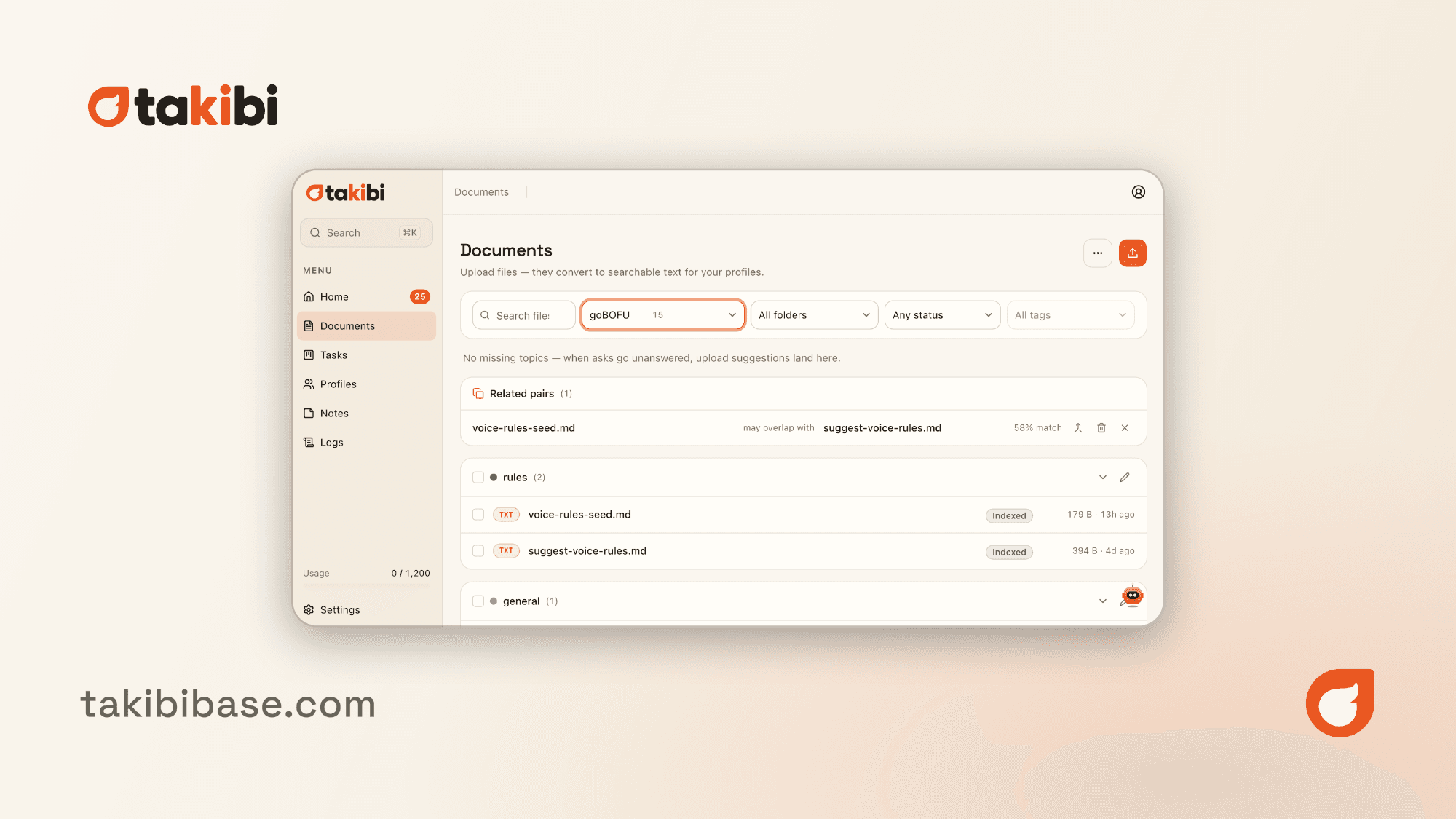
The shared library in Takibi Base supports several common document formats, including PDFs with extractable text, Word documents, Markdown files, and plain-text files.
Documents are organized through projects and folders. Takibi Base converts Markdown for search and provides statuses such as indexed, converting, and quarantined. Files that are held because of an unresolved status are not made available until the issue is resolved, while original files remain downloadable.
For teams looking for an AI document retrieval system, this provides a structured way to maintain the documents that agents need to access.
The underlying idea is straightforward. Humans maintain the knowledge base, while agents retrieve information from it when they need specific context.
AI Agent Access Control With Profiles
One of the more important parts of an AI agent knowledge management system is deciding which information each agent should be able to access.
Takibi Base uses Profiles to handle this. Profiles can have individual tool keys and can be granted access to particular folders or projects. When new documents are indexed within folders that a Profile can access, those documents are automatically included within that allowed scope.
This approach allows different agents or tools to work with different collections of information instead of giving every agent unrestricted access to the entire knowledge base.
Profiles can also be paused to stop all of their keys, while individual keys can be rotated or revoked. The platform also provides access and activity review capabilities.
For teams building multiple AI agents, this creates a more controlled approach to an AI agent workspace with access management.
Retrieve Exact Evidence Instead of Generated Answers
Takibi Base takes a different approach to AI knowledge retrieval.
Through the Takibi CLI, including the takibi ask command, or through an authenticated HTTP API, agents can request information from the knowledge base. The system returns exact passages with citations and an evidence support score.
If there is no matching evidence, Takibi Base does not return passages.
This distinction matters when building AI workflows where the source material needs to remain visible. Rather than asking a knowledge base to summarize everything into a new answer, the agent receives source passages that it can then use as context for its own work.
For developers searching for AI agent document retrieval with citations, this model can be particularly useful when traceability matters.
Agent Notes With Human Review
Takibi Base also includes Notes for agents, but these notes are deliberately treated differently from trusted source documents.
Notes are untrusted, Profile-scoped agent scratch space. They have a fixed 30-day time-to-live, even when they are kept. This means notes can provide agents with temporary memory without automatically becoming permanent source material.
Humans can review notes overnight and choose to Keep them, Add them to a draft, or Remove them. Drafts can also be exported.
Importantly, Notes never become trusted Sources automatically. They are not shared across Profiles and cannot be automatically promoted into the main knowledge base.
This provides a structured approach to AI agent memory and knowledge management where temporary agent-generated information remains separate from the documents that humans have intentionally approved as sources.
Conversations for Agent-to-Agent Context
AI systems are increasingly being designed as collections of specialized agents rather than a single agent handling every task.
Takibi Base includes Conversations for agent-to-agent context exchange around shared work. This allows agents to exchange contextual information while operating within the broader workspace.
For developers creating a shared workspace for autonomous AI agents, this can provide another layer of coordination alongside the central document library.
The knowledge base remains the place for organized source information, while conversations can support the exchange of context between agents working on related tasks.
Tasks and Human Review
Takibi Base also includes a task system for agent workflows.
Tasks can include context, an assignee, and an optional due date. Agents can claim tasks, update them, attach result links, and submit completed work for review.
An owner or an Orchestrator Profile can then accept the work as Done.
This gives Takibi Base capabilities beyond being a traditional document repository. The platform combines knowledge retrieval with agent collaboration and task management, creating an environment where information, agent work, and human review can exist within the same system.
For teams developing AI agent collaboration and task management workflows, this can help connect the knowledge layer with the work being performed by agents.
Export Knowledge in an Open Format
Takibi Base supports Open Knowledge Format, or OKF, export.
Projects can be exported with their documents and structure, alongside the original files. This gives teams a way to take their organized knowledge and its structure outside the immediate workspace.
For organizations building long-term AI knowledge systems, structured export can be useful because knowledge should not necessarily remain locked inside a single interface or workflow.
Building AI Agents Around Reliable Context
The challenge with AI agents is increasingly shifting from simply making an agent capable of generating text to making sure it has access to the right context at the right time.
An AI coding agent, research agent, operations agent, or internal business agent may need access to different information. The quality of its work can depend heavily on whether it can retrieve the relevant source material and whether that information is actually within its authorized scope.
Takibi Base provides a model where humans organize the knowledge, Profiles control access, and agents retrieve source passages through a CLI or API.
That makes it less about creating another chatbot and more about creating an infrastructure layer for AI agents.
Takibi Base for AI Agent Developers
For developers building AI agents, the CLI and HTTP API make Takibi Base accessible directly from agent workflows.
An agent can retrieve relevant information when required instead of depending entirely on a static prompt or manually supplied context. Profiles can define which projects or folders are available to each tool, while citations and evidence scores provide additional information about the retrieved material.
This can be useful for applications such as internal company agents, documentation assistants, research systems, project-specific coding agents, and multi-agent workflows.
The exact implementation will depend on how an agent is built and what information it needs, but the underlying architecture is centered around controlled knowledge retrieval.
Takibi Base vs Traditional Knowledge Management
Traditional knowledge management tools are generally designed around humans searching, reading, editing, and organizing information.
Tools such as Notion and Obsidian can be useful for human knowledge management, but AI agents introduce additional requirements. Agents need programmatic access, defined permissions, structured retrieval, and a way to distinguish trusted source material from temporary agent-generated information.
Takibi Base is designed specifically around these agent-oriented requirements.
The result is a knowledge management platform for AI agents where document organization, access control, retrieval, temporary notes, agent conversations, tasks, and exports are connected within one workspace.
Who Can Use Takibi Base?
Takibi Base can be relevant to developers and teams building AI agent systems that need controlled access to documents and shared knowledge.
A software team could organize technical documentation and project information into folders and grant an agent access to the relevant material. A research workflow could maintain a collection of reports and allow agents to retrieve exact passages. A company could create separate Profiles for different internal tools so that each agent receives only the knowledge it needs.
It can also be useful for multi-agent environments where several agents need to work around the same source material while maintaining separate permissions and temporary working context.
A Structured Approach to AI Agent Knowledge
The central idea behind Takibi Base is that AI agents do not necessarily need another system that simply generates answers. They need reliable access to the information that humans have chosen to make available.
By combining projects and folders, Profiles, document retrieval, citations, evidence scores, temporary Notes, agent conversations, Tasks, and Open Knowledge Format export, Takibi Base creates a structured environment for AI agent knowledge management.
Takibi Base · The shared knowledge base for AI agents provides a dedicated knowledge layer for AI agent workflows.
As AI agents take on more work, the systems around them will need to manage not only what agents can do, but also what they can access, what information they can trust, and how humans can review their work. Takibi Base is built around that layer of the AI agent stack.
Frequently Asked Questions
What is Takibi Base?
Takibi Base is a shared knowledge base for AI agents. Humans organize documents into projects and folders, then control which agents can access that information through Profiles.
How do AI agents access Takibi Base?
AI agents can connect through the Takibi CLI or an authenticated HTTP API. The CLI includes the takibi ask command for retrieving information from the knowledge base.
Does Takibi Base generate AI answers?
No. Takibi Base does not generate answers. It retrieves exact passages from the available documents and provides citations and an evidence support score.
Can AI agents save information in Takibi Base?
Agents can create Notes that function as Profile-scoped scratch space. These Notes are untrusted, have a fixed 30-day TTL, and go through human review before anything can be added to a draft. They are never automatically promoted to trusted Sources.
Can multiple AI agents use the same knowledge base?
Yes. Takibi Base is designed as a shared knowledge base for AI agents. Profiles allow different tools or agents to receive access to specific projects or folders.
What documents can be uploaded to Takibi Base?
The shared library supports PDFs with extractable text, Word .docx documents, Markdown, and plain-text files.
Does Takibi Base support AI agent task management?
Yes. Tasks can include context, an assignee, and an optional due date. Agents can claim and update tasks, attach result links, and submit their work for human review.
Can Takibi Base knowledge be exported?
Yes. Takibi Base supports Open Knowledge Format export, including project structure and documents, along with the original files.
Is Takibi Base free?
The CodeHype listing identifies Takibi Base as a paid product. Current plans and pricing are available on the product website.
Who is Takibi Base designed for?
Takibi Base is designed for people and teams building AI agent workflows that need shared document knowledge, controlled access, evidence-based retrieval, agent context, and human review.