Startup Tools
RevenueBug: Verified Revenue Profiles and a Startup Acquisition Marketplace
Discover RevenueBug, a platform that verifies startup revenue through connected payment providers, showcases growth, and helps founders list businesses for acquisition.
CodeHype11 min read
For startup founders, revenue is one of the clearest ways to demonstrate that a business has attracted paying customers. However, sharing revenue publicly can be difficult when potential customers, partners, investors, or buyers have no straightforward way to verify the numbers behind a claim.
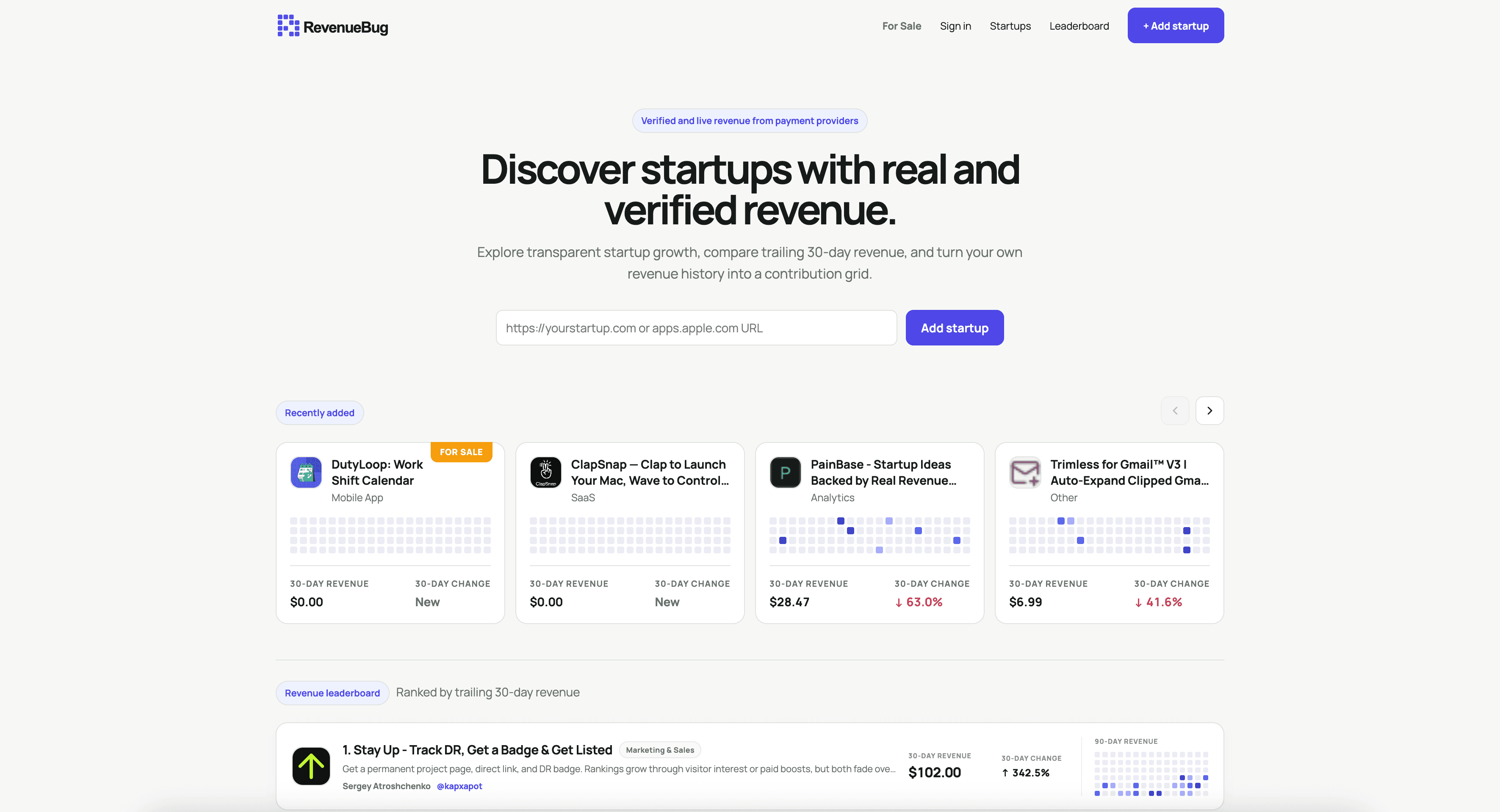
RevenueBug addresses this challenge by helping founders create public startup profiles backed by connected payment provider data. The platform displays revenue information, growth, and historical performance, giving visitors a clearer view of a business's financial traction.
Beyond revenue verification, RevenueBug also provides a place to discover other startups and explore businesses available for acquisition. Founders who want to sell their products can create for-sale listings and receive buyer enquiries privately.
For indie hackers, SaaS founders, bootstrapped entrepreneurs, and startup buyers, RevenueBug brings verified revenue profiles and startup discovery into one platform.
You can explore RevenueBug to see how the platform works.
What Is RevenueBug?
RevenueBug is a startup discovery and revenue verification platform designed for founders who want to demonstrate their business traction and connect with potential buyers.
Instead of relying entirely on self-reported revenue figures, founders connect a supported payment provider. RevenueBug uses the connected transaction data to build a public profile showing the startup's trailing 30-day revenue, growth, and revenue history.
The resulting profile can be shared with customers, partners, and potential buyers who want to understand how the business is performing.
RevenueBug also supports startup listings for acquisition. Founders looking to sell can mark their business as available for sale and receive buyer enquiries privately, while people exploring acquisition opportunities can browse businesses listed on the platform.
This combination makes RevenueBug relevant to founders who want to build credibility around their revenue and entrepreneurs who want to discover businesses with visible financial traction.
How Revenue Verification Works on RevenueBug
Revenue verification is the central feature of RevenueBug. The process starts when a founder connects a supported payment provider to the platform.
RevenueBug then builds the startup's profile from the connected transaction data. This creates a revenue presentation based on provider information rather than relying solely on a number typed into a profile.
The platform highlights trailing 30-day revenue as its headline figure and also displays growth and revenue history.
This distinction matters because a startup's recent revenue can differ from its monthly recurring revenue, annual recurring revenue, or total lifetime revenue. RevenueBug specifically identifies its headline metric as trailing 30-day revenue, which should not automatically be interpreted as MRR.
The platform also notes that verification covers the connected account, store, app, or brand. Depending on how the connected account is structured, the verified data may include more than one product.
For anyone reviewing a profile, understanding what the connected account represents is important when interpreting the figures.
Why Verified Revenue Matters for Startup Founders
Founders frequently need to communicate traction to people who do not have direct access to their business dashboards. A public revenue profile can make that conversation easier by providing a shareable view of recent performance.
Build credibility with customers and partners
For some businesses, showing evidence of existing commercial activity can help establish credibility. A founder may want to demonstrate that a product has paying customers and an observable revenue history rather than relying only on product descriptions or marketing claims.
A RevenueBug profile provides a place to share those figures with interested visitors.
Verified revenue does not establish every aspect of a company's quality, reliability, or long-term prospects, but it can provide useful context when evaluating a business.
Demonstrate traction to potential buyers
A potential buyer evaluating a startup may want to understand its revenue performance before starting a more detailed acquisition discussion.
RevenueBug gives founders a public profile they can share as an initial reference point. Buyers can review the displayed revenue information and decide whether they want to enquire about the business.
The profile can help start a conversation, although a serious acquisition still requires appropriate financial, legal, operational, and customer due diligence.
Make revenue history easier to communicate
Preparing revenue information for different audiences can take time. A dedicated profile provides a single destination where a founder can present recent revenue, growth, and historical information.
This is particularly relevant to indie hackers and bootstrapped founders who want a straightforward way to communicate their progress without creating a separate presentation for every conversation.
Discover Startups by Revenue Performance
RevenueBug is not limited to founders who want to publish their own numbers. The platform also allows visitors to discover startups sharing verified revenue information.
This makes startup discovery more focused on observable business performance. Instead of evaluating products solely by their descriptions or features, visitors can explore businesses with revenue data connected to a supported payment provider.
The platform supports browsing startups by category and revenue performance, helping users explore businesses that match their interests.
For entrepreneurs researching the startup landscape, these profiles can offer a useful starting point for understanding how different businesses present their commercial traction.
However, revenue alone does not reveal profitability, customer retention, operating costs, debt, or future growth potential. Buyers should treat a public revenue profile as one source of information rather than a complete assessment of a business.
RevenueBug as a Startup Acquisition Marketplace
Building a startup and selling one are different challenges. Founders preparing for an exit need a way to communicate that a business is available, while potential buyers need a way to discover opportunities and contact sellers.
RevenueBug supports this process through dedicated for-sale listings.
List your startup for sale
Founders can create a listing indicating that their startup is available for acquisition. They can use the platform's revenue information to provide context about the business before a potential buyer makes contact.
This gives interested parties an initial view of the startup's commercial traction and a way to begin an acquisition discussion.
Receive buyer enquiries privately
RevenueBug allows sellers to receive buyer enquiries privately. This is useful for founders who want to explore a possible sale without necessarily making every part of the acquisition conversation public.
The platform's approach separates the public discovery experience from the private communication that follows an interested buyer's enquiry.
Founders should still determine what information they are comfortable sharing publicly and conduct more detailed discussions with suitable buyers through appropriate channels.
Discover businesses available for acquisition
Entrepreneurs and acquisition-minded buyers can use RevenueBug to discover startups that are listed for sale.
Verified revenue information can provide an initial signal when comparing opportunities, while further investigation can establish whether a business fits the buyer's objectives, budget, skills, and operational plans.
RevenueBug helps with discovery and initial contact. Verified revenue does not mean a listing has undergone a full financial or legal audit, so buyers should independently verify claims and review the business before making an offer.
Privacy Options for Public Revenue Listings
Not every founder wants to reveal the identity of a product while sharing its revenue performance.
RevenueBug addresses this with an option to hide a product's identity on a regular revenue listing. This gives founders a way to share verified revenue information without necessarily presenting the product's name publicly.
This can be relevant to entrepreneurs who want to demonstrate traction while protecting aspects of their business strategy or maintaining a degree of privacy.
A regular revenue listing and a for-sale listing serve different purposes. Founders should review the platform's current listing options and disclosure settings to understand exactly what information is visible to other users.
Who Should Use RevenueBug?
RevenueBug is designed for founders who want to share revenue-backed traction and people interested in discovering startups or acquisition opportunities.
Indie hackers and solo founders: Independent builders can create a public revenue profile that helps communicate progress beyond follower counts, product launches, or self-reported milestones.
SaaS founders: Software businesses can use verified revenue profiles to present recent commercial performance to customers, partners, and potential buyers.
Bootstrapped startups: Founders who grow their businesses without relying primarily on external fundraising may value a shareable profile that focuses on actual revenue data.
Entrepreneurs preparing for an exit: Owners considering a sale can list their startup for acquisition and receive private enquiries from interested buyers.
Startup buyers: People searching for acquisition opportunities can discover listed businesses and use their revenue information as an initial point of comparison.
Startup researchers: Founders exploring other businesses can browse profiles by category and revenue performance to understand how companies present their traction.
RevenueBug vs Traditional Startup Directories
Traditional startup directories generally emphasize product descriptions, categories, features, launch information, and links. These details help people discover new products, but they may not provide a consistent way to understand a company's commercial performance.
RevenueBug focuses on revenue-backed profiles and startup acquisition discovery.
Its key distinctions include:
- Provider-connected revenue: Profiles are built from data supplied by a supported payment provider.
- Revenue history: Listings can show trailing 30-day revenue, growth, and historical performance.
- Privacy options: Founders can hide their product identity on a regular revenue listing.
- Acquisition listings: Businesses can be marked for sale and receive buyer enquiries privately.
- Revenue-based discovery: Visitors can explore startups by category and revenue performance.
RevenueBug is also listed as an alternative to TrustMRR. Founders comparing the two platforms should examine their current verification methods, listing options, privacy controls, and acquisition features to determine which better fits their needs.
What RevenueBug Does Not Tell You About a Business
Verified revenue is useful, but it is only one part of evaluating a startup.
A business reporting strong recent revenue may still have high operating costs, low margins, customer concentration, or inconsistent retention. A business with lower current revenue may have valuable technology, a loyal audience, or other assets that require separate evaluation.
RevenueBug's trailing 30-day revenue figure should also not be confused with MRR unless the underlying business model and data support that interpretation.
Potential buyers should consider additional factors such as:
- Net profit and operating expenses.
- Revenue consistency and customer retention.
- Dependence on a small number of customers.
- Ownership of intellectual property and other assets.
- Customer acquisition costs and marketing dependencies.
- Outstanding liabilities and contractual obligations.
- Technical maintenance and operational requirements.
RevenueBug can help people discover businesses and review connected revenue information, but a public profile is not a substitute for comprehensive acquisition due diligence.
How to Get Started With RevenueBug
Founders who want to share their revenue can begin by creating a listing on RevenueBug and connecting a supported payment provider.
After the connection is established, RevenueBug uses the available transaction data to build the public revenue profile. Founders can then share the profile with customers, partners, or potential buyers.
Those exploring an acquisition can browse existing startup listings and review the available revenue information. Founders preparing to sell can create a for-sale listing and use private buyer enquiries to begin conversations.
Before publishing, founders should review the information displayed on their profile, confirm that the connected account represents the intended business, and decide whether to make the product identity public.
Final Thoughts
RevenueBug brings provider-verified revenue profiles and startup acquisition discovery into one platform. It gives founders a way to present recent revenue performance, growth, and revenue history, while helping visitors discover startups that share verified figures.
Its acquisition listings add another use case by allowing founders to mark businesses for sale and receive buyer enquiries privately. Privacy options for regular listings also give founders flexibility in how they present their traction.
For indie hackers, SaaS founders, bootstrapped entrepreneurs, and startup buyers, RevenueBug offers a focused way to explore revenue-backed startup profiles.
If you want to share your startup's revenue history or discover businesses with visible commercial traction, visit RevenueBug to explore its listing and discovery features.
Frequently Asked Questions
What is RevenueBug?
RevenueBug is a platform where founders can share startup profiles with revenue verified through supported payment providers. It also lets users discover other startups and list businesses for acquisition.
How does RevenueBug verify startup revenue?
Founders connect a supported payment provider, and RevenueBug builds the profile from the connected transaction data. The platform displays trailing 30-day revenue, growth, and revenue history.
Is RevenueBug's revenue figure the same as MRR?
Not necessarily. RevenueBug identifies its headline metric as trailing 30-day revenue. That figure should not automatically be treated as monthly recurring revenue, which has a more specific meaning for businesses with recurring revenue models.
Can I list my startup for sale on RevenueBug?
Yes. RevenueBug supports for-sale listings through which founders can present their businesses to potential buyers and receive enquiries privately.
Can I hide my startup's identity?
RevenueBug allows users to hide their product identity on a regular revenue listing. Founders should review the current listing settings to understand what information remains visible.
Who can benefit from RevenueBug?
Indie hackers, SaaS founders, bootstrapped entrepreneurs, startup buyers, and people researching businesses can use RevenueBug to explore revenue-backed startup profiles and acquisition opportunities.
Is RevenueBug a startup acquisition marketplace?
It supports startup acquisition discovery by allowing businesses to be listed for sale and enabling potential buyers to send private enquiries. Buyers should still conduct independent due diligence before proceeding with a transaction.
Does verified revenue guarantee that a startup is profitable?
No. Revenue indicates money generated by a business over a period, but it does not establish profitability. Costs, liabilities, customer retention, and other financial factors must be evaluated separately.
How is RevenueBug different from a traditional startup directory?
Traditional directories usually emphasize product discovery and descriptions. RevenueBug focuses on provider-connected revenue information, growth history, and discovery of businesses available for acquisition.
Is RevenueBug an alternative to TrustMRR?
RevenueBug is listed as an alternative to TrustMRR. Founders should compare the platforms' current verification methods, public profile features, privacy options, and acquisition workflows before choosing one.