AI Tools
RouterGrowth: Connect Your AI Agent to 3,000+ Go-to-Market Tools With One Key
Discover how RouterGrowth connects AI agents to 3,000+ go-to-market tools for lead generation, SEO, competitor research, and automated outreach.
CodeHype16 min read
AI agents can research companies, write personalized cold emails, analyze competitors, and help businesses make marketing decisions. However, turning those capabilities into complete go-to-market workflows often requires access to multiple external services. Finding qualified leads, verifying work emails, enriching contact records, researching keywords, monitoring competitor advertisements, and sending outreach messages can involve several separate subscriptions and integrations.
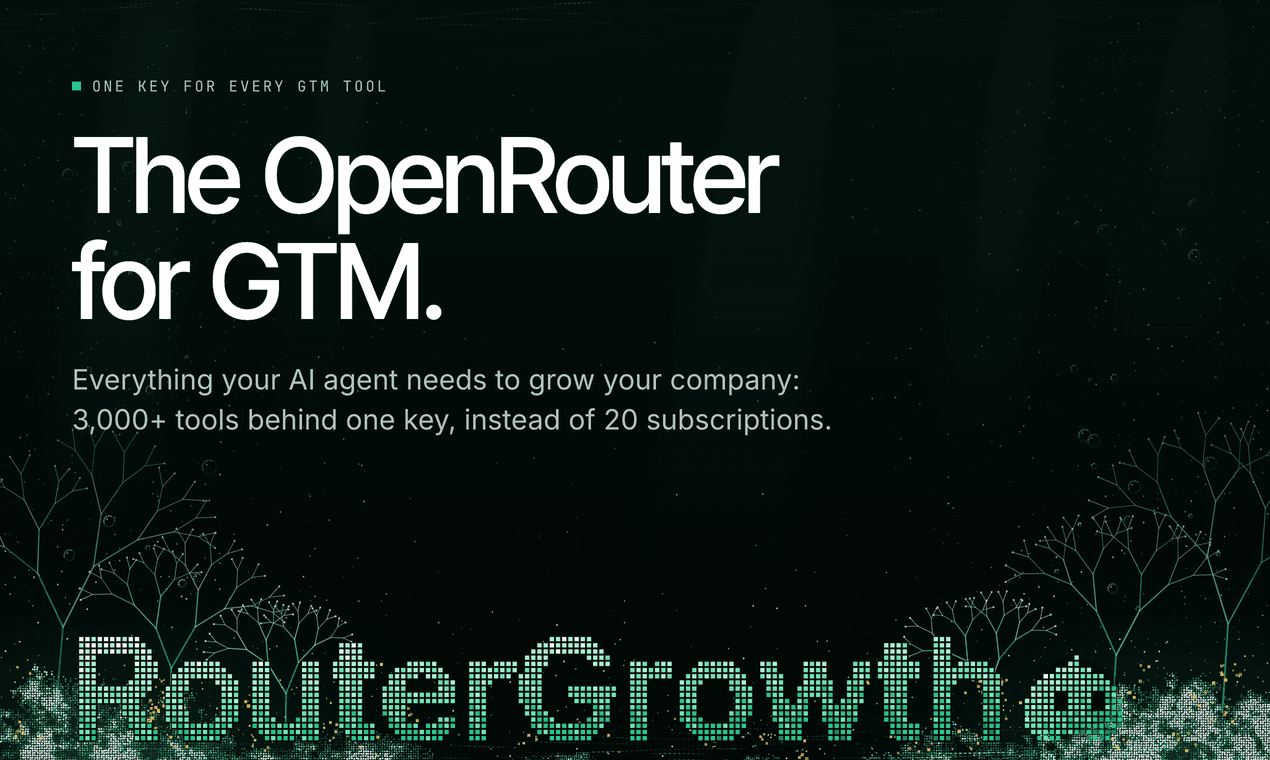
RouterGrowth aims to simplify this process by connecting AI agents to more than 3,000 tools through a single key. Instead of managing multiple accounts and APIs for sales, marketing, SEO, and outbound campaigns, teams can use a unified platform to execute these tasks through agents such as Claude, ChatGPT, Codex, and Cursor.
For founders, sales teams, growth marketers, and agencies experimenting with AI-powered workflows, RouterGrowth offers a way to connect research and execution without building every integration from scratch.
What Is RouterGrowth?
RouterGrowth is a go-to-market infrastructure platform designed to give AI agents access to the tools businesses use to acquire customers and grow their products. It combines capabilities across lead generation, contact data, company enrichment, SEO research, competitor intelligence, social listening, advertising creative, and outbound communication.
The central idea is straightforward. An AI agent might know how to write an effective sales email, but it still needs reliable data to identify the right recipient, a way to verify contact information, and an appropriate service to deliver the message. RouterGrowth connects these separate steps through one interface.
Rather than requiring users to configure every provider independently, RouterGrowth lets an agent discover and execute supported actions through a shared catalog. Users can describe a task in natural language, and the agent can select relevant tools, inspect their prices, run the required operations, and return the results.
The platform supports several connection methods, including a skill file, MCP connectors, a REST API, and a command-line interface. This makes it relevant to teams that use existing AI coding assistants as well as developers building their own automated marketing pipelines.
RouterGrowth is particularly interesting for businesses that want AI agents to do more than retrieve information. Its workflows can connect research with actions such as preparing outreach, managing sending infrastructure, and generating advertising assets.
Why AI Agents Need a Unified GTM Platform
Go-to-market work involves more than writing content or sending messages. A complete customer acquisition process may require finding potential buyers, identifying decision-makers, collecting verified contact details, understanding buying signals, researching competitors, and running outreach campaigns.
Traditionally, these activities are spread across separate platforms. A team might use one subscription for lead databases, another for enrichment, another for SEO research, and additional services for email sequencing, domain management, and social monitoring.
This creates several challenges when businesses introduce AI agents into their workflows.
Too Many Tools and Integrations
Every external service can introduce its own authentication method, API structure, usage limits, pricing model, and configuration requirements. Developers must connect these systems before an AI agent can use them reliably.
RouterGrowth addresses this integration problem by offering one key for its catalog of GTM capabilities. Instead of maintaining individual connections for every supported task, an agent can use a common interface to discover and run the relevant operations.
This can reduce integration overhead for teams building automated sales and marketing workflows.
Research Does Not Automatically Lead to Action
AI agents are useful for analyzing information and generating recommendations, but a marketing workflow often requires several operational steps after the analysis.
For example, identifying companies that are hiring sales development representatives is only the beginning. A complete workflow could also identify their sales leaders, retrieve work email addresses, qualify the contacts, prepare personalized messages, and send approved outreach.
RouterGrowth is designed to connect these steps through the same platform. Its available capabilities include both data discovery and outbound execution, helping agents move from research toward action.
Unpredictable Tool Costs
Using multiple services can make it difficult to understand the total cost of an automated workflow. Some platforms require monthly subscriptions, while others impose minimum commitments or charge according to usage.
RouterGrowth uses pay-per-call billing with a prepaid balance. The platform displays the exact price before a call, allows spending caps per call and per day, and states that failed calls and empty results cost nothing.
This approach gives users more visibility into the cost of individual operations. However, the total cost of a workflow will still depend on the number and type of calls it makes.
Key Features of RouterGrowth
RouterGrowth covers several areas of go-to-market operations. Its capabilities are intended to work together, allowing an AI agent to combine multiple tools into a single workflow.
1. Lead Generation and Verified Work Emails
Finding qualified prospects is a core requirement for B2B sales. RouterGrowth provides access to lead lists, people searches, contact discovery, and work email verification capabilities.
Users can ask an agent to identify companies that match specific criteria, such as businesses hiring for particular roles. The agent can then search for decision-makers and retrieve available work contact information.
For example, a founder could ask for 50 SaaS companies hiring sales development representatives and request the work email addresses of their vice presidents of sales.
The platform's published example describes a run that returned 50 companies and 46 VP Sales contacts with work emails. The remaining four misses were not billed, according to the example.
This type of workflow can help sales teams reduce the manual work involved in building prospect lists. Contact accuracy and coverage will still depend on the underlying providers and the available information.
2. Company and Person Enrichment
A basic lead list may contain only a company name and a contact. Sales teams often need more context to determine whether a prospect is relevant.
RouterGrowth includes company and person enrichment capabilities, alongside hiring, funding, and technology signals. These signals can help an AI agent identify businesses that may be more relevant to a particular offer.
A growth team could use these capabilities to discover companies expanding their sales departments, research their decision-makers, and prioritize accounts for outreach.
Enrichment can also provide useful context for personalization. Instead of sending the same message to every prospect, an agent can use available company information to prepare more relevant communication.
3. SEO and Keyword Research
RouterGrowth also connects AI agents to search engine optimization tools. Its listed capabilities include keyword research, search engine results page analysis, backlink research, and competitor analysis.
A user can ask an agent to identify keywords competitors rank for that their own website does not target. The agent can investigate search results, compare competing pages, and organize potential opportunities.
This can make SEO research easier to integrate into a broader marketing workflow. For example, an agent could identify relevant keyword opportunities and prepare a prioritized research report for a content team.
The platform also includes AI answer visibility capabilities. These are intended to help businesses examine how AI assistants respond to category-related questions, which sources they cite, and whether a particular brand appears in those answers.
For companies working on visibility across both traditional search engines and AI-generated answers, combining these research activities in one workflow can be useful.
4. Competitor Advertising Intelligence
Understanding competitor advertising can help businesses evaluate messaging, creative direction, and campaign positioning.
RouterGrowth provides competitor ad research capabilities for platforms including Meta and Google. Its broader catalog also includes social listening and social content discovery.
A user can ask an agent what a competitor is running on Meta or request research into competing brands' social activity. The agent can use the available tools to gather relevant information for analysis.
This can help marketing teams study how competitors present their products, which messages they emphasize, and what creative approaches appear in their campaigns.
Access to advertising data does not automatically reveal a competitor's complete strategy or actual campaign performance. The value comes from using available evidence to inform research and testing.
5. Social Listening and Brand Mentions
Businesses need to understand how customers, competitors, and industry communities discuss their products. Monitoring these conversations manually across multiple platforms can consume significant time.
RouterGrowth lists social listening and brand mention discovery across sources that include X, Reddit, LinkedIn, TikTok, news, websites, forums, directories, and review platforms.
An AI agent can search for relevant mentions and organize the results so that a team can identify conversations that deserve attention.
For example, a company could ask where its brand was mentioned during the past week and which mentions might require a response. The resulting workflow can help separate useful conversations from the broader volume of online activity.
The available sources and results depend on the tools and providers used for each query.
6. Cold Email Infrastructure and Outreach
One of RouterGrowth's distinguishing capabilities is its focus on the infrastructure required to send outreach, rather than stopping at contact research.
The platform lists capabilities for sending domains, inbox creation, warm-up, and email sending. This means an agent can potentially coordinate several steps that would otherwise require separate tools.
A cold email workflow could begin with identifying suitable prospects, finding their work email addresses, preparing personalized messages, and configuring the required sending infrastructure.
RouterGrowth also supports LinkedIn outreach through a user's connected account, according to its feature description.
These capabilities can reduce the number of disconnected systems involved in outbound sales. However, businesses should still use appropriate consent and outreach practices, respect platform rules, and verify that their campaigns comply with applicable email and data protection requirements.
The platform's listed workflows include a human approval step before messages are sent. This is an important distinction for teams that want AI-assisted execution without automatically sending every message generated by an agent.
7. AI-Generated Advertising Creative
Marketing teams often need multiple creative assets to test different campaign ideas. RouterGrowth includes image and video generation capabilities within its broader GTM catalog.
An agent can incorporate these tools into advertising workflows, helping a team prepare creative variations alongside competitor research and campaign planning.
For example, after analyzing competing advertisements, a team could use an agent to organize creative directions and generate assets for further review.
The usefulness of the resulting images and videos will depend on the selected provider, the quality of the instructions, and the requirements of the intended advertising channel.
8. Open-Source Workflows
RouterGrowth provides open-source skills that allow users to run complete GTM workflows through supported AI agents.
These workflows cover tasks such as cold email, LinkedIn outreach, hiring-signal outbound, AI visibility audits, brand mention research, and advertising creative batches.
The repository is available on GitHub.
Open-source workflows can be helpful for developers who want to inspect how tasks are organized and adapt them to their own processes. They also provide a starting point for teams that prefer working with established workflow patterns instead of assembling every sequence from scratch.
How RouterGrowth's Provider Routing Works
A unified interface is useful, but it does not guarantee that every external provider will return a result. Contact databases may have incomplete records, and individual services can fail or time out.
RouterGrowth addresses this with a provider-routing approach. According to its documentation, a job can be routed across multiple providers, with up to three attempts when a provider errors, times out, or returns no result.
The process works as follows:
- An AI agent identifies the required capability, such as finding a verified work email.
- RouterGrowth routes the request to an available provider.
- If the provider fails or returns no match, the system can try another provider.
- The successful result is returned to the agent.
- The user is charged for the provider call that delivers the result, rather than for failed attempts or empty results.
This approach can improve the chances of obtaining useful data without requiring the user to manage each provider individually.
It is important to distinguish provider failover from guaranteed success. Routing across several services can improve coverage, but it cannot guarantee that every contact exists or that every request will produce a result.
RouterGrowth Pricing: Pay Per Call or Choose a Monthly Plan
RouterGrowth offers a pay-per-call starting option and three paid monthly plans. The platform states that subscription fees are added to the user's balance as credit for that month, while plan discounts reduce RouterGrowth's margin rather than the underlying provider cost.
The published pricing is as follows.
| Plan | Monthly price | Listed benefit |
|---|---|---|
| Pay per call | $0/month | Standard list pricing, with no subscription commitment |
| Plus | $99/month | 20% discount on RouterGrowth's margin |
| Pro | $199/month | 40% discount on RouterGrowth's margin |
| Scale | $499/month | 60% discount on RouterGrowth's margin |
Signup includes $1 in credit, allowing users to run real calls without an initial subscription. The minimum top-up is $10, and users spend their prepaid balance as they run calls.
RouterGrowth also states that users can cancel a monthly plan at any time, with the plan remaining active until the end of the paid month.
For individuals exploring AI-driven sales automation, the pay-per-call option provides a way to test the platform before committing to a monthly plan. Teams that run a large volume of calls may want to evaluate whether a paid plan makes sense for their usage.
The right choice depends on the number of calls, the underlying provider costs, and the expected savings from the applicable margin discount. It is worth testing real workflows and estimating monthly usage before selecting a plan.
How to Connect RouterGrowth to an AI Agent
RouterGrowth offers several connection options, depending on how a team prefers to work.
Connect Through a Skill File
Developers using Claude Code, Codex, Cursor, Gemini CLI, or another compatible agent can use the RouterGrowth skill file.
The platform provides setup instructions at https://www.routergrowth.com/SKILL.md. After configuration, users can describe their GTM tasks in natural language and allow the agent to select the relevant tools.
This approach is suitable for developers who already use coding agents for research, automation, and product development.
Use an MCP Connector
RouterGrowth also offers an MCP endpoint at https://api.routergrowth.com/mcp. Its documentation describes connector support for Claude and ChatGPT.
This option is useful for people who want to access GTM capabilities through supported AI assistant interfaces rather than building a separate application.
Use the REST API or CLI
Teams building custom systems can use the REST API at https://api.routergrowth.com/v1 or the command-line interface.
This approach provides a path for integrating RouterGrowth into internal applications, scripts, and more structured automated pipelines.
Regardless of the connection method, teams should review the platform's documentation, understand how API keys are managed, and configure spending limits before running workflows at scale.
Who Should Use RouterGrowth?
RouterGrowth is designed for people who want AI agents to perform practical go-to-market work.
Founders and small teams can use it to research potential customers, identify decision-makers, monitor competitors, and prepare outbound campaigns without assembling a large collection of separate tools.
Sales teams may find it useful for prospect discovery, contact enrichment, hiring signals, and outreach preparation. The ability to connect lead research and communication can reduce manual work between sales operations.
Growth marketers can use the platform to combine keyword research, competitor advertising analysis, social listening, and AI answer visibility research.
Marketing and lead generation agencies may benefit from reusable workflows that support prospect research, client campaigns, and advertising creative production.
Developers building AI agents can use the common interface to connect GTM capabilities without implementing every provider integration individually.
RouterGrowth is less compelling for teams that only need one narrow capability or rarely run automated GTM workflows. In those cases, a dedicated tool may be simpler or more economical. Its value becomes clearer when several different tools need to work together.
What Makes RouterGrowth Different?
Several aspects distinguish RouterGrowth from a traditional collection of marketing subscriptions.
First, it connects data discovery with execution. An agent can access lead information and research tools while also working with outbound infrastructure and advertising creative capabilities.
Second, it provides a shared interface across a large catalog. This reduces the need to manage separate integrations for every task, although the underlying providers and their limitations still matter.
Third, the platform emphasizes visible usage costs. Users can inspect prices before calls, set spending limits, and avoid charges for failed calls and empty results according to its stated billing policy.
Fourth, its provider-routing system can retry operations through alternative providers when the initial attempt fails or produces no match.
Finally, RouterGrowth supports several ways to connect, including agent skills, MCP, a CLI, and a REST API. This gives both nontechnical users and developers options for incorporating the platform into their existing workflows.
Together, these capabilities position RouterGrowth as a shared infrastructure layer for AI-powered go-to-market operations rather than a standalone lead database or email sequencer.
Limitations and Things to Consider
Although RouterGrowth brings many capabilities into one interface, businesses should evaluate a few practical considerations before depending on it for critical workflows.
Provider coverage and data quality: A catalog of 3,000+ tools does not mean every request will return complete or current information. Results depend on the underlying providers and the type of data being requested.
Usage costs: Pay-per-call pricing provides visibility, but a complex workflow may trigger many calls. Review estimated costs and set per-call and daily limits before running large jobs.
Outreach compliance: Email and LinkedIn automation should follow applicable laws, platform terms, and responsible outreach practices. Teams should review messages and targeting rules before sending campaigns.
Workflow review: Automated research and content generation still need quality checks. Human approval is particularly valuable for outbound messages, sensitive customer data, and actions that could affect a business's reputation.
Setup requirements: Although RouterGrowth aims to simplify integrations, users still need to configure the appropriate connection method and manage credentials securely.
Considering these factors can help teams determine whether RouterGrowth fits their workflows and budget.
Final Verdict: Is RouterGrowth Worth Exploring?
RouterGrowth tackles a real challenge in AI-powered sales and marketing: agents can reason about go-to-market tasks, but they need access to external data and services to execute those tasks effectively.
By bringing more than 3,000 tools behind one key, RouterGrowth aims to connect lead generation, contact enrichment, SEO, competitor intelligence, social listening, outbound communication, and advertising creative. Its pay-per-call model, provider failover, and spending controls are designed to make these workflows easier to manage.
The platform is particularly relevant for founders, growth teams, agencies, and developers who want to move beyond isolated AI prompts and build workflows that connect research with execution.
The best way to evaluate it is to start with a specific task, such as building a qualified prospect list or researching competitor keywords. Run the workflow, inspect the results, and compare its total cost and reliability with your existing tools.
If you want to give your AI agent access to a broader set of marketing and sales capabilities without managing every integration separately, RouterGrowth is worth testing with its included signup credit.
Frequently Asked Questions
1. What is RouterGrowth?
RouterGrowth is a go-to-market platform that connects AI agents to more than 3,000 tools for lead generation, contact enrichment, SEO research, competitor intelligence, social listening, outbound outreach, and advertising creative.
2. Is RouterGrowth free to use?
RouterGrowth offers a pay-per-call option with no monthly subscription fee. New signups receive $1 in credit for running real calls. Usage is charged according to the tools and providers involved, and the minimum balance top-up is $10.
3. Which AI agents work with RouterGrowth?
RouterGrowth lists support for Claude Code, Codex, Cursor, Gemini CLI, and other agents that can read a skill file. It also provides MCP connector support for Claude and ChatGPT, alongside a REST API and CLI.
4. How does RouterGrowth charge for tool usage?
The platform uses pay-per-call billing. It shows the exact price before each call and lets users configure spending caps per call and per day. RouterGrowth states that failed calls and empty results cost $0.
5. Does RouterGrowth include lead generation tools?
Yes. Its catalog includes lead lists, people searches, contact discovery, verified work email capabilities, and company and person enrichment. The results depend on the providers used and the information available.
6. Can RouterGrowth automate cold email outreach?
RouterGrowth lists capabilities for sending domain setup, inbox creation, warm-up, and email sending. Its open-source workflows can coordinate steps in a cold email pipeline, with a human approval gate before messages are sent according to its workflow description.
7. Can RouterGrowth help with SEO?
Yes. Its listed capabilities include keyword research, search engine results page analysis, backlink research, competitor analysis, and AI answer visibility research.
8. What are the RouterGrowth monthly plans?
The published plans are Plus at $99 per month, Pro at $199 per month, and Scale at $499 per month. Their listed benefits are discounts of 20%, 40%, and 60% on RouterGrowth's margin, respectively. A pay-per-call option is also available without a monthly subscription.
9. Is RouterGrowth suitable for small businesses?
It can be useful for small businesses that need several GTM capabilities but want to avoid managing numerous separate integrations. Businesses with limited or highly specialized requirements should compare the platform's usage costs with dedicated alternatives.
10. Does RouterGrowth guarantee successful results?
No. Provider routing can retry failed operations or searches that return no match, but it cannot guarantee complete contact data, successful outreach, better search rankings, or improved sales results. Businesses should evaluate actual workflow performance before relying on it at scale.