SEO Tools
RankControl: AI Agents That Write, Publish, and Track SEO Content
Discover how RankControl uses seven AI agents to create, publish, and track SEO content while monitoring brand visibility across six AI search engines.
CodeHype15 min read
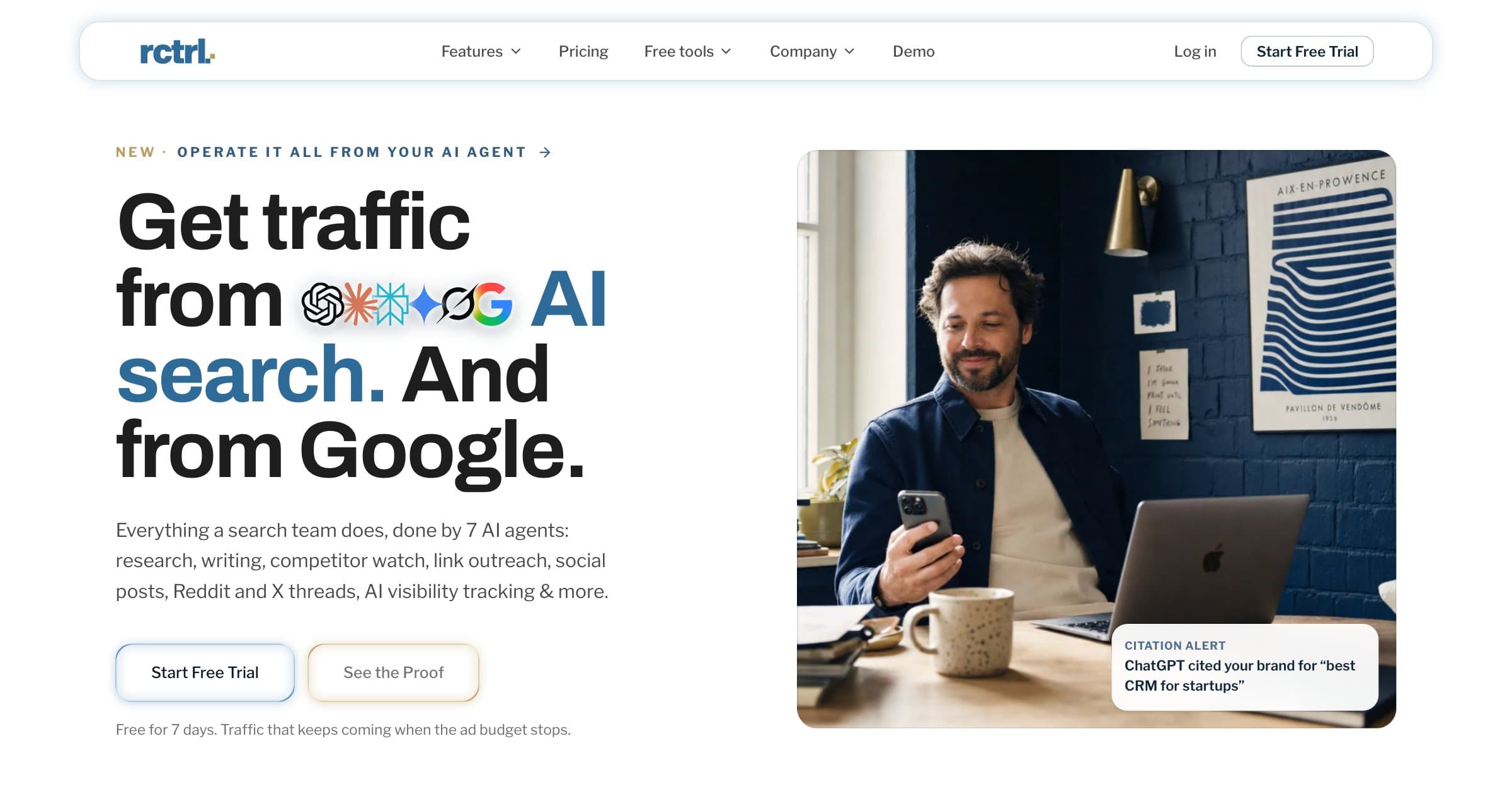
Search engine optimization is changing as buyers increasingly use AI assistants to research products, compare software, and find recommendations. Ranking on Google remains important, but businesses also need to understand whether platforms such as ChatGPT, Perplexity, and Google AI Mode mention their brands when potential customers ask relevant questions.
For many companies, managing both traditional SEO and AI search visibility creates additional work. Teams need to research keywords, identify content gaps, publish useful articles, build backlinks, and monitor how search engines and AI assistants reference their websites. Using separate tools for each task can make the process expensive and difficult to coordinate.
RankControl aims to bring these activities together through seven AI agents that research opportunities, create content, support publishing, and monitor results. The platform combines traditional search engine optimization with answer engine optimization, helping businesses work toward visibility across Google and AI-powered search experiences.
Instead of only showing where a brand is missing from AI-generated answers, RankControl is designed to help businesses act on those gaps by creating and publishing relevant content on their own websites.
What Is RankControl?
RankControl is an AI-powered SEO and search visibility platform for SaaS companies, agencies, ecommerce businesses, and local businesses. It combines content research, AI-assisted writing, publishing, ranking monitoring, citation tracking, and backlink outreach in one system.
The platform's central idea is that identifying an SEO opportunity is only the first step. Businesses also need to create content that addresses the opportunity, publish it on their own domains, and measure whether it earns visibility over time.
RankControl uses seven AI agents to coordinate different parts of this process. These agents can help identify questions that competitors answer, develop content around relevant opportunities, prepare articles for publication, and monitor traditional search rankings alongside citations from AI engines.
The platform supports publishing to WordPress, Webflow, Shopify, Ghost, Notion, Wix, and Framer. It also supports webhooks and headless websites through its Content API, allowing teams to integrate content workflows with different publishing environments.
Another important feature is its focus on approval and control. Auto-publishing is disabled by default, so users can review articles before they go live. Teams can also access RankControl through its dashboard, MCP server, CLI, and API.
This combination makes RankControl relevant to businesses that want to manage SEO content production and AI search visibility without coordinating every task manually.
Why Traditional SEO Monitoring Is No Longer Enough
Traditional SEO tools help businesses understand keyword rankings, backlinks, search volume, and competitor performance. These metrics remain useful, but they do not provide a complete picture of how a brand appears across AI-powered search experiences.
A business might rank for a valuable keyword on Google but remain absent from the answer generated by an AI assistant. Another company might appear in AI-generated recommendations because its website or other trusted sources provide information that the model uses when responding.
This creates a second visibility challenge for marketing teams.
Buyers Are Asking AI Assistants for Recommendations
People can now ask AI assistants questions such as which CRM is suitable for a startup, which project management platform fits a particular team, or which software offers a specific feature.
These questions often resemble the searches people make before choosing a product. If a brand is absent from the answers, it may miss opportunities to reach potential customers during their research process.
RankControl monitors brand visibility across ChatGPT, Perplexity, Claude, Gemini, Grok, and Google AI Mode. Its weekly checks can help teams understand which platforms cite their content, how they describe the brand, and which sources appear in relevant answers.
This information gives marketers a way to investigate where their brand is visible and where further work may be needed.
AI Visibility Requires More Than Tracking Mentions
Knowing that a competitor appears in an AI-generated answer is useful, but the next question is what to do about it.
RankControl is built around this distinction. Its workflow connects visibility research with content creation, publishing, outreach, and ongoing monitoring.
For example, if competing websites are cited for questions related to a product category, a business can investigate those questions, identify missing content on its own website, and develop articles that address the subject.
This does not guarantee that an AI assistant will cite the new content. However, it provides a structured way to respond to identified content gaps rather than simply collecting visibility reports.
How RankControl's Seven AI Agents Work
RankControl organizes its workflow around research, content production, distribution, and monitoring. Its agents are designed to help with the work that usually takes place across several SEO and marketing tools.
1. Discover Content Gaps With Competitor Research
The first step is identifying what potential customers are searching for and where competing businesses already have an advantage.
RankControl's Radar feature finds relevant questions and compares them with the topics competitors answer. The goal is to identify opportunities where a website lacks useful content or where competitors receive citations that the business does not.
For example, a SaaS company might discover that competing products are mentioned in AI answers to questions about the best tools for a particular industry, while its own brand is absent.
Instead of choosing article topics based only on assumptions, a marketing team can use these gaps to prioritize research and content creation.
RankControl also supports competitor monitoring, with its setup description allowing users to track up to 10 competitors. This can help teams keep an eye on competing brands and discover opportunities as their visibility changes.
2. Create Brand-Matched SEO Articles
Once opportunities have been identified, RankControl's Forge content engine helps turn them into articles.
The platform describes its content as brand-matched and designed around the questions discovered during research. It supports 26 content formats and 23 languages, making it relevant to companies targeting different audiences and markets.
Its website describes long-form guides ranging from approximately 1,500 to 4,000 or more words, depending on the content requirement.
Brand matching is another part of the process. RankControl analyzes information from a business's website, including its tone, products, and competitors, so generated content can reflect the company's positioning.
This can help reduce the work required to brief an AI writing system for every article. However, generated content should still be checked for factual accuracy, original insight, product details, and alignment with the company's editorial standards.
Publishing more content alone is not a reliable SEO strategy. The articles need to answer real questions, offer useful information, and provide value beyond repeating what already exists online.
3. Publish Content Directly on Your Own Website
Content creation becomes more useful when the publishing process is straightforward.
RankControl supports publishing articles as native posts on a business's own website rather than placing them on a separate RankControl subdomain. Supported platforms include WordPress, Webflow, Shopify, Ghost, Notion, Wix, and Framer.
For headless websites and custom publishing systems, the platform provides webhooks and a Content API.
This flexibility is useful for businesses that already have a website and want to add AI-assisted content production without migrating their existing publishing setup.
RankControl states that its publishing setup can take around five minutes for supported integrations. Actual setup time will depend on the website, permissions, and configuration requirements.
Auto-publishing is off by default. Users can review finished drafts and approve them before publication, or enable automatic publishing when they are comfortable with the workflow.
For teams that value editorial control, this approach allows automation to handle repetitive work while people retain responsibility for the final content.
4. Build Authority Through Link Outreach
Useful content can support SEO, but earning relevant backlinks and mentions from other websites can also contribute to a site's authority and discovery.
RankControl includes an outreach workflow that drafts emails for link-building opportunities. These drafts wait for approval before anything is sent, allowing users to review the proposed communication.
The platform also offers link tracking and describes managed backlinks as an available add-on.
This can help marketing teams organize outreach alongside content production rather than treating link building as a completely separate activity.
Businesses should still evaluate the relevance and quality of prospective linking websites. A high volume of low-quality links is not a substitute for genuine editorial relevance, useful content, and responsible link-building practices.
5. Repurpose Articles for Social Media
Publishing an article does not have to be the final step in distributing its ideas.
RankControl's Amplify and Social capabilities help turn articles into social content and identify relevant conversations on platforms such as Reddit and X.
A team can use this workflow to develop social posts around a published guide or find discussions where its content may provide a useful answer.
This connects SEO content production with broader distribution. Rather than creating every social post independently, a marketing team can start with a researched article and adapt its key ideas for different channels.
The goal is to make existing content more useful across the marketing process, while keeping each post appropriate for its intended platform and audience.
6. Monitor Google Rankings and AI Citations
After articles are published, teams need to understand whether their work is producing meaningful visibility.
RankControl's Sentinel monitoring capability tracks traditional search rankings, traffic, and AI citations. The platform lists Google and Bing ranking data at the page level, alongside AI-referred traffic attributed to individual assistants.
Its AI visibility monitoring covers six platforms:
- ChatGPT
- Perplexity
- Claude
- Gemini
- Grok
- Google AI Mode
The platform checks up to 50 queries each week, according to its FAQ. Users can investigate which answers cite their brand or competitors and examine the sources referenced in those answers.
RankControl also includes citation alerts, brand perception analysis, and citation source research. Brand perception helps users examine whether mentions are positive, neutral, or negative, while citation source research shows whether AI answers cite the business, its competitors, or other sources such as Reddit, YouTube, and editorial websites.
These insights can help teams identify changes that deserve attention. They can also provide a clearer view of how visibility across AI assistants relates to traditional organic search performance.
7. Refresh Content When Performance Changes
SEO content can lose visibility as competitors publish new material, search results change, or existing information becomes outdated.
RankControl includes a content refresh feature that flags pages when rankings or citations decline. Users can then review proposed updates and approve changes before they are applied.
This provides a way to maintain existing content alongside producing new articles.
For businesses with large content libraries, identifying which pages need attention can be just as important as finding new keywords. Refreshing a relevant article may be more useful than publishing another page covering the same subject.
The review process also helps teams retain control over changes to important landing pages and established articles.
RankControl's AI Search Visibility Features
RankControl combines several monitoring features that help businesses investigate how their brands appear in AI-powered search.
Citation Signals and Alerts
Citation Signals is designed to notify users when an AI engine cites their brand or a competitor. Instead of checking every platform manually, teams can use these signals to identify changes and investigate the relevant queries.
A new citation can reveal that a piece of content is being used in an answer, while a competitor citation can indicate an opportunity to research the sources and information behind that answer.
Citation Source Analysis
RankControl helps users identify the sources AI engines cite for their target queries. These sources may include competing websites, editorial publications, Reddit discussions, YouTube, and other online resources.
Understanding those sources can help a team decide whether to improve its own content, develop more useful supporting resources, or investigate opportunities for legitimate third-party mentions.
Google AI Overviews Monitoring
The platform also tracks Google AI Overviews for relevant keywords. Users can investigate when an AI-generated overview appears and whether their pages are included among its sources.
This is useful for businesses that want to understand how AI-generated search results interact with their existing organic search strategy.
AI Crawler Monitoring
RankControl includes AI crawler monitoring, which shows which AI bots access which pages and alerts users when a crawler is blocked.
This can help technical teams investigate whether relevant pages are accessible to the crawlers they want to reach. Crawler access alone does not guarantee that a page will be indexed, cited, or recommended by an AI assistant.
RankControl Pricing: One Plan With a Seven-Day Free Trial
RankControl lists one primary subscription plan at $400 per month or $4,000 per year. Both pricing options include the platform's listed features, and a seven-day free trial is available.
The platform advertises a content allowance of up to 100 articles per month, along with 26 content formats, 23 languages, and monitoring across six AI search platforms.
| Pricing option | Cost |
|---|---|
| Monthly plan | $400/month |
| Annual plan | $4,000/year |
| Free trial | 7 days |
The annual option costs $800 less than paying the monthly rate for 12 months, based on the published prices.
RankControl's pricing is aimed at businesses that need a broad SEO content and monitoring workflow rather than a single-purpose writing tool. For agencies managing multiple campaigns or companies investing heavily in organic growth, combining research, publishing, and monitoring may reduce the need to coordinate several separate services.
However, the subscription is a significant expense for solo founders and early-stage businesses. Before subscribing, estimate how many articles your team can meaningfully review, how much value AI visibility monitoring provides, and whether the platform fits your existing content workflow.
The RankControl free trial provides an opportunity to test the publishing integration, article quality, tracking features, and approval process before making a longer-term commitment.
Who Should Use RankControl?
RankControl is designed for businesses that want to connect SEO content production with AI search monitoring.
SaaS companies can use it to discover product-related questions, publish educational content, track competitor citations, and monitor whether their pages appear in AI-generated answers.
Digital marketing agencies can use the platform to coordinate research, content creation, publishing, and monitoring across client websites. The supported publishing integrations and workflow tools may be useful for teams managing recurring content operations.
Ecommerce businesses can explore content opportunities around product categories, comparisons, buying questions, and customer education. Publishing and monitoring workflows can help organize these efforts across an existing store website.
Local businesses can use SEO research and content publishing to address location-specific questions and improve the information available about their services. Actual local search performance will depend on competition, relevance, website quality, and other factors.
SEO professionals and content teams may find the platform useful when they want to automate repetitive production and monitoring tasks while keeping editorial review in place.
RankControl may be less suitable for businesses with very limited content needs or budgets. If a company publishes only a few articles each month, a less expensive writing and analytics setup may be sufficient.
RankControl vs. Traditional SEO Tools
RankControl lists tools such as Semrush, Ahrefs, Surfer SEO, Jasper, Profound, BrightEdge, Writesonic, and MarketMuse among its alternatives.
These products cover different areas of SEO, content production, and AI visibility. The appropriate comparison depends on the specific features a business needs.
The distinction RankControl emphasizes is the connection between identifying opportunities, producing content, publishing it on the company's own site, and monitoring results across traditional search engines and AI platforms.
A keyword research tool may help identify topics, while a writing tool can assist with drafting. An AI visibility tool may reveal which brands appear in generated answers. RankControl aims to bring these activities together in a coordinated workflow.
This integrated approach can be valuable when the alternative is managing several separate tools and manually moving information between them.
However, an all-in-one platform is not automatically better for every team. Businesses should compare data quality, content quality, supported integrations, reporting depth, workflow control, and total cost before replacing existing tools.
Limitations and Things to Consider
RankControl offers broad automation capabilities, but businesses should evaluate the platform realistically.
AI citations are not guaranteed. Creating content around competitor gaps does not ensure that ChatGPT, Perplexity, or another AI engine will cite the resulting article. Visibility depends on many factors outside a content platform's control.
Content still needs human review. Brand matching and AI-generated writing can speed up production, but teams remain responsible for factual accuracy, originality, and editorial quality.
Article volume is not the same as organic growth. Publishing up to 100 articles per month may be useful for some organizations, but the right volume depends on available opportunities and the ability to produce genuinely helpful content.
Monitoring has defined limits. The platform's FAQ specifies up to 50 AI queries checked weekly. Businesses should confirm whether this scope covers their target topics, markets, and competitors.
The subscription requires a clear business case. At $400 per month, the platform needs to provide enough value through saved time, content production, monitoring, or improved marketing operations to justify the expense.
Evaluating these points during the free trial can help businesses decide whether RankControl is appropriate for their team.
Final Verdict: Is RankControl Worth Trying?
RankControl addresses an increasingly important marketing challenge: businesses need to create useful content for traditional search while understanding how their brands appear in AI-generated answers.
Its approach combines seven AI agents for research, writing, publishing, outreach, social distribution, and monitoring. It also supports native publishing on existing websites, traditional Google and Bing rankings, AI citation tracking, and connections through MCP, CLI, and API.
The strongest aspect of RankControl is its focus on execution. Rather than only reporting that competitors appear in AI answers, the platform helps users identify content gaps, create relevant articles, publish them, and monitor what happens afterward.
For SaaS companies, agencies, ecommerce businesses, and established content teams with ongoing SEO needs, this integrated workflow may be worth evaluating.
The $400 monthly price means it is not an obvious fit for every business. Teams should use the seven-day free trial to assess article quality, publishing reliability, monitoring coverage, and how well the workflow fits their existing processes.
If your goal is to connect SEO content production with AI search visibility monitoring in one platform, RankControl is worth exploring.
Frequently Asked Questions
1. What is RankControl used for?
RankControl is an AI-powered SEO platform that helps businesses research content opportunities, create and publish articles, monitor Google and Bing rankings, track AI citations, and organize backlink outreach.
2. How much does RankControl cost?
RankControl lists one primary plan at $400 per month or $4,000 per year. It also offers a seven-day free trial.
3. Which AI search engines does RankControl monitor?
RankControl monitors ChatGPT, Perplexity, Claude, Gemini, Grok, and Google AI Mode. Its listed monitoring setup checks up to 50 queries every week.
4. Can RankControl publish articles directly to my website?
Yes. RankControl supports WordPress, Webflow, Shopify, Ghost, Notion, Wix, and Framer. It also supports webhooks and headless websites through its Content API.
5. Does RankControl publish articles automatically?
Auto-publishing is disabled by default. Users can review and approve articles before publication or enable automatic publishing when they are ready.
6. How many articles can RankControl create each month?
RankControl advertises a capacity of up to 100 articles per month, with 26 content formats and support for 23 languages.
7. Can RankControl track Google rankings as well as AI citations?
Yes. The platform lists Google and Bing rankings per page, AI-referred traffic by assistant, and citation tracking across six AI search platforms.
8. Does RankControl help with backlinks?
Yes. RankControl includes AI-drafted outreach emails, link opportunity management, and backlink tracking. Managed backlinks are described as an add-on.
9. Can I use RankControl from Claude or Cursor?
Yes. RankControl provides a hosted MCP server, CLI, and REST API. These interfaces are designed to let compatible AI agents and custom workflows access its tools.
10. Is RankControl suitable for small businesses?
It can be useful for small businesses with ongoing SEO and content requirements. However, the $400 monthly price may be difficult to justify for companies that publish infrequently or have limited budgets. The free trial can help determine whether its features fit their needs.