AI Tools
OpenBot: Cloud AI Agents for Coding, Web Research & Product Development
Explore OpenBot, the cloud workspace for AI agents that coordinates Claude Code, Codex, Cursor, Firecrawl, Notion, Linear, Slack, and GitHub to accelerate software and product development.
CodeHype9 min read
Building software with AI is becoming increasingly powerful, but working with multiple AI tools can still require an overwhelming amount of manual coordination.
You may find yourself using one tool for coding, another for web research, another for browser automation, and entirely separate tools for project management, team communication, and technical documentation. Jumping between fragmented interfaces disrupts flow, wastes time, and forces you to play the role of an administrative middleman between disparate AI models.
OpenBot takes a radically different approach.
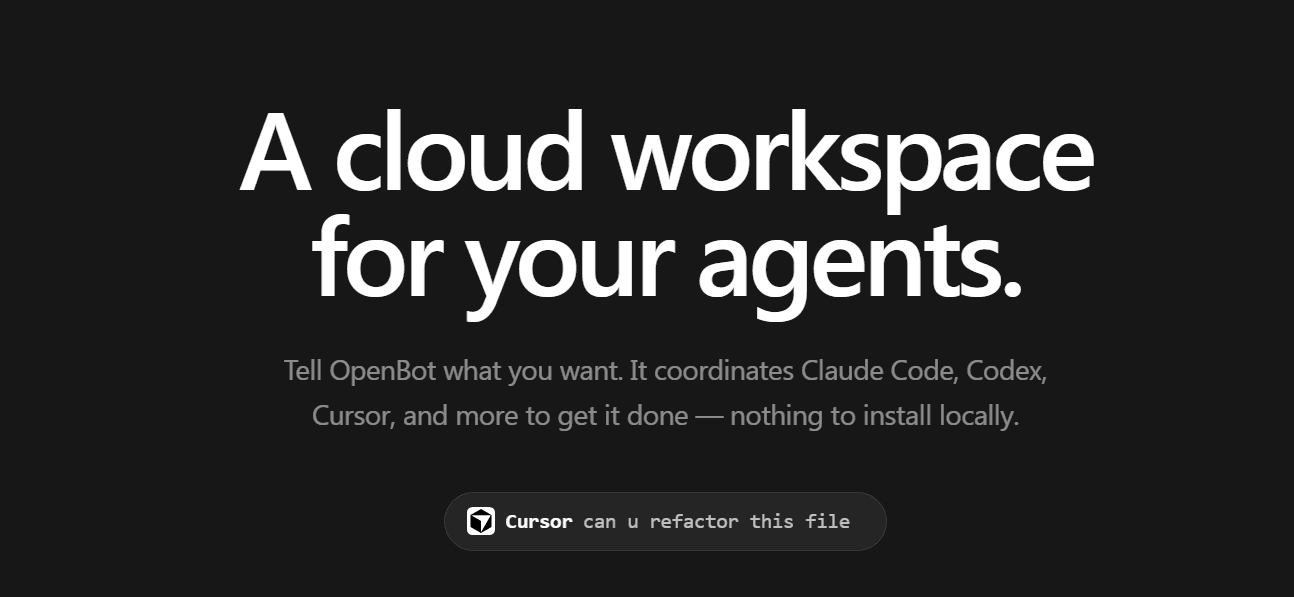
OpenBot is a cloud workspace for AI agents that lets you describe what you want to accomplish and orchestrates specialized agents and tools to work autonomously toward that goal. Instead of installing, configuring, and managing everything on your local workstation, OpenBot provides a persistent, cloud-based environment where agents execute coding, web research, browser tasks, task management, and team collaboration.
What is OpenBot?
OpenBot is a unified cloud AI agent workspace designed to help software engineers, founders, and product teams get meaningful work done with AI agents.
The core philosophy behind OpenBot is refreshingly simple: Describe your goal, let the agents work, and get closer to a finished result.
Rather than locking you into a single proprietary assistant or narrow workflow, OpenBot operates as an extensible AI agent platform. The workspace coordinates best-in-class agents and developer integrations, including:
- Claude Code and Codex for autonomous terminal coding and implementation
- Cursor for AI-first codebase navigation and editing
- Pi for intelligent task assistance and reasoning
- Firecrawl for structured web research, data extraction, and deep technical lookups
- Stagehand for real-time browser automation and web app testing
- GitHub for repositories, version control, branching, and pull requests
- Linear for project issue tracking and milestone progress
- Notion for workspace management, architecture specs, and documentation
- Slack for asynchronous notifications and team communication
For developers and founders looking to move beyond disjointed chat prompts, OpenBot — Ship products with AI agents in the cloud provides an end-to-end environment that handles complex, multi-step workflows in a centralized workspace.
Run AI agents in the cloud
One of the standout advantages of OpenBot is its cloud-native architecture.
Traditional AI development workflows place significant friction on your local setup. Running autonomous coding agents locally often requires installing CLI utilities, managing Python or Node environments, configuring system dependencies, granting elevated terminal permissions, and keeping your laptop powered on for hours while background tasks execute.
OpenBot eliminates these friction points by moving agent execution entirely into the cloud.
As a dedicated AI-powered development workspace, OpenBot provides each agent with a sandboxed cloud computer. The agents can build, test, and run code without consuming your local RAM or battery, and without risking local environment contamination. For developers experimenting with cutting-edge AI coding agents in the cloud, this setup offers an accessible, reliable, and secure environment.
Work with multiple AI coding agents
Modern software engineering cannot be solved with a single monolithic model. Different tasks demand different strengths: one agent may excel at architecting large refactors, while another specializes in fast code edits, bug fixes, or reviewing pull requests.
OpenBot supports an array of leading coding agents and developer utilities:
- Claude Code: Run Claude Code in the cloud to plan features, inspect repositories, and execute terminal commands.
- Codex: Run Codex in the cloud to generate reliable implementations and solve targeted programming challenges.
- Cursor: Leverage Cursor-style contextual codebase intelligence directly in an agentic cloud environment.
- Pi: Engage intuitive reasoning agents for planning and creative problem-solving.
- GitHub Integration: Seamlessly inspect branches, push commits, and open pull requests.
Instead of being restricted to a single AI assistant, OpenBot coordinates these coding agents as part of an overarching workflow. One agent can draft the system architecture, another can write unit tests, and a third can verify the changes against your repository.
AI agents for software development
AI coding agents have evolved far beyond basic code auto-completion. Today, developers require assistance across every phase of the software development lifecycle.
Consider a typical engineering task: you need to investigate an edge-case bug, parse an external API specification, modify multiple files across a legacy codebase, run the test suite, update documentation, and report the status to your team.
Handling this manually across multiple disconnected tools takes hours. OpenBot coordinates agents across the entire pipeline. You specify the target outcome, and OpenBot's cloud workspace aligns the appropriate tools to investigate, implement, test, and document the solution. This transforms AI from an ad-hoc assistant into a goal-driven development partner.
Use AI agents for web research with Firecrawl
Software development rarely happens in isolation from the broader web. Engineers constantly need to consult third-party API documentation, evaluate open-source libraries, verify breaking changes in dependencies, or investigate complex technical errors.
OpenBot directly integrates Firecrawl as a specialized web research agent within its workspace.
With Firecrawl baked into the workflow, web research becomes a seamless step in your software pipeline. When an agent encounters an unfamiliar library or requires current API schemas, it can autonomously research documentation online and feed structured findings directly to the coding agent. This closes the gap between live web information and code generation.
Browser automation with AI agents
Beyond reading static documentation, many workflows require actively interacting with web applications. You might need to verify a user authentication flow, test an onboarding UI, take interface screenshots, or interact with external SaaS portals.
OpenBot features Stagehand as its browser-focused automation agent.
Stagehand enables AI agents to navigate web applications, click buttons, submit forms, and evaluate live application state. Combining browser automation with AI coding agents and web research opens possibilities that were previously impossible in isolated coding tools. Everything operates together within the same cloud computer.
Connect your entire development workflow
High-velocity engineering teams rely on an ecosystem of project management and communication tools to ship software predictably. Writing code is only one piece of the puzzle.
OpenBot bridges the gap between coding agents and your day-to-day productivity tools:
- Linear: Agents can read assigned tickets, clarify requirements, update task statuses, and link relevant pull requests.
- Notion: Agents can review product requirements documents (PRDs), update engineering wikis, and draft user-facing release notes.
- Slack: Agents can send status updates, ping team members for approval, and alert engineers when a task is completed.
- GitHub: Agents can clone repositories, run checks, commit changes, and submit pull requests for peer review.
By connecting Linear, Notion, Slack, and GitHub in a single cloud AI agent workspace, OpenBot ensures that agent actions remain synchronized with your team's ongoing project tracking.
Tell OpenBot what you want: Goal-oriented orchestration
Traditional development with AI requires you to micro-manage every prompt:
- "Which tool should I open for this?"
- "How do I format this prompt for web scraping?"
- "How do I pass this output into my IDE?"
OpenBot flips this dynamic on its head. Instead of worrying about tool mechanics, you start with your high-level objective:
"What do I want to get done?"
You provide the objective, and OpenBot's orchestrator determines which agents to deploy, in what sequence, and with which parameters. If a task requires web research, code modification, browser testing, and a Notion documentation update, OpenBot orchestrates each phase automatically.
Who is OpenBot for?
OpenBot is engineered for technical builders who want to multiply their engineering throughput:
- Software Developers & Engineers: Run Claude Code, Codex, and Cursor workflows in the cloud without bogging down your local development machine.
- Startup Founders & Solopreneurs: Build and validate full-stack product ideas rapidly by orchestrating research, code generation, and task management.
- Engineering Teams & Tech Leads: Automate routine development tasks, issue triage, documentation syncs, and pull request drafts across GitHub, Linear, and Slack.
- AI Builders & Experimenters: Explore the frontiers of multi-agent collaboration in a fully configured cloud sandbox without manual environment setup.
OpenBot for AI-powered product development
Shipping a commercially viable product requires far more than churning out syntax. It demands market research, competitor analysis, architecture design, front-end development, backend integrations, automated testing, deployment, and ongoing documentation.
OpenBot provides an all-in-one cloud workspace built specifically for this end-to-end process. By pairing autonomous coding agents (Claude Code, Codex, Cursor, Pi) with web scrapers (Firecrawl), browser testers (Stagehand), documentation hubs (Notion), issue trackers (Linear), and version control (GitHub), OpenBot powers workflows that standard AI chatbots cannot touch.
For founders and developers looking to ship high-quality products faster, it represents a significant leap forward in AI-assisted productivity.
Why use a cloud AI agent workspace?
Running multi-agent systems on local machines introduces severe limitations:
- High System Overhead: Running language models, compilers, and browser instances simultaneously consumes heavy CPU, RAM, and battery resources.
- Complex Dependency Management: Managing incompatible SDKs, CLI tools, and runtime versions creates maintenance friction.
- Machine Availability Constraints: Local processes stall when your machine sleeps, disconnects, or restarts.
- Security & Isolation: Running untrusted or autonomous scripts locally risks overwriting local files or misconfiguring environments.
A cloud workspace resolves these challenges by offloading execution to isolated, persistent cloud infrastructure. Tasks continue running in the background, progress is saved centrally, and you can access your development environment from any browser.
OpenBot pricing and free trial
Getting started with OpenBot is risk-free:
- 7-Day Free Trial: Test the full cloud AI agent workspace, try multiple agents, and evaluate autonomous workflows before committing.
- Monthly Subscription: Priced at $60 per month following the trial period, with the freedom to cancel anytime.
- Priority Support: Subscribers gain direct access to priority support via a private Discord community, enabling fast onboarding and collaboration with the core development team.
This clear pricing structure allows developers, startups, and agencies to trial agentic development workflows on real projects.
Get started with OpenBot
As AI tools continue to mature, the competitive advantage belongs to teams that coordinate multiple specialized agents toward concrete goals.
Instead of juggling isolated command-line tools, browser tabs, and chat windows, you can manage your entire development lifecycle from one centralized cloud platform. Whether you are running Claude Code in the cloud, performing automated web research with Firecrawl, or keeping Linear and GitHub in sync, OpenBot brings your development workflow together.
Ready to see how autonomous agents can help you move from idea to production?
Experience the power of cloud-based multi-agent development today with OpenBot — Ship products with AI agents in the cloud.
Frequently Asked Questions
What is OpenBot?
OpenBot is a cloud workspace for AI agents. It lets you describe what you want to accomplish and coordinates specialized AI agents and connected tools to help complete the work autonomously in a sandboxed cloud environment.
What AI agents does OpenBot support?
OpenBot supports leading AI agents and developer integrations including Claude Code, Codex, Cursor, Pi, Firecrawl (for web research), Stagehand (for browser automation), Notion, Linear, Slack, and GitHub.
Can OpenBot run AI coding agents in the cloud?
Yes. OpenBot is specifically designed around running agents on a persistent cloud computer, allowing you to run tools like Claude Code and Codex without installing, configuring, or running them on your local machine.
Can OpenBot be used for full software development?
Yes. OpenBot supports coding-focused agents such as Claude Code, Codex, Cursor, Pi, and GitHub, making it suitable for end-to-end software development workflows from bug investigations to pull requests.
Does OpenBot support web research?
Yes. OpenBot integrates Firecrawl as a dedicated web-focused agent, allowing real-time web research, documentation scraping, and API exploration to be directly integrated into broader coding workflows.
Does OpenBot support browser automation?
Yes. OpenBot includes Stagehand as a browser-focused agent in its workspace, enabling agents to navigate websites, click buttons, fill out forms, and test live web applications.
Does OpenBot integrate with project management tools?
Yes. OpenBot integrates with Linear for task tracking, Notion for documentation and architecture specs, Slack for notifications, and GitHub for repository version control.
How much does OpenBot cost?
OpenBot offers a 7-day free trial. After the trial, the service is priced at $60 per month with the flexibility to cancel anytime. Subscribers also receive priority support through a private Discord channel.
Where can I try OpenBot?
You can start your 7-day trial by visiting the official OpenBot website and signing up for immediate cloud workspace access.