AI Tools
Liora: AI Productization Lab for Validating and Launching AI Products
Discover Liora, an AI productization tool that finds business opportunities, scores AI product ideas, analyzes competitors, and creates a business blueprint with pricing and a 90-day launch plan.
CodeHype12 min read
Building an AI product has become easier, but choosing the right idea remains one of the biggest challenges for founders. You can use AI coding tools to build a prototype quickly, yet that does not guarantee customers will pay for it. Without validating demand, researching competitors, and understanding the business model, it is possible to spend weeks building a product that solves a problem people are not willing to pay to fix.
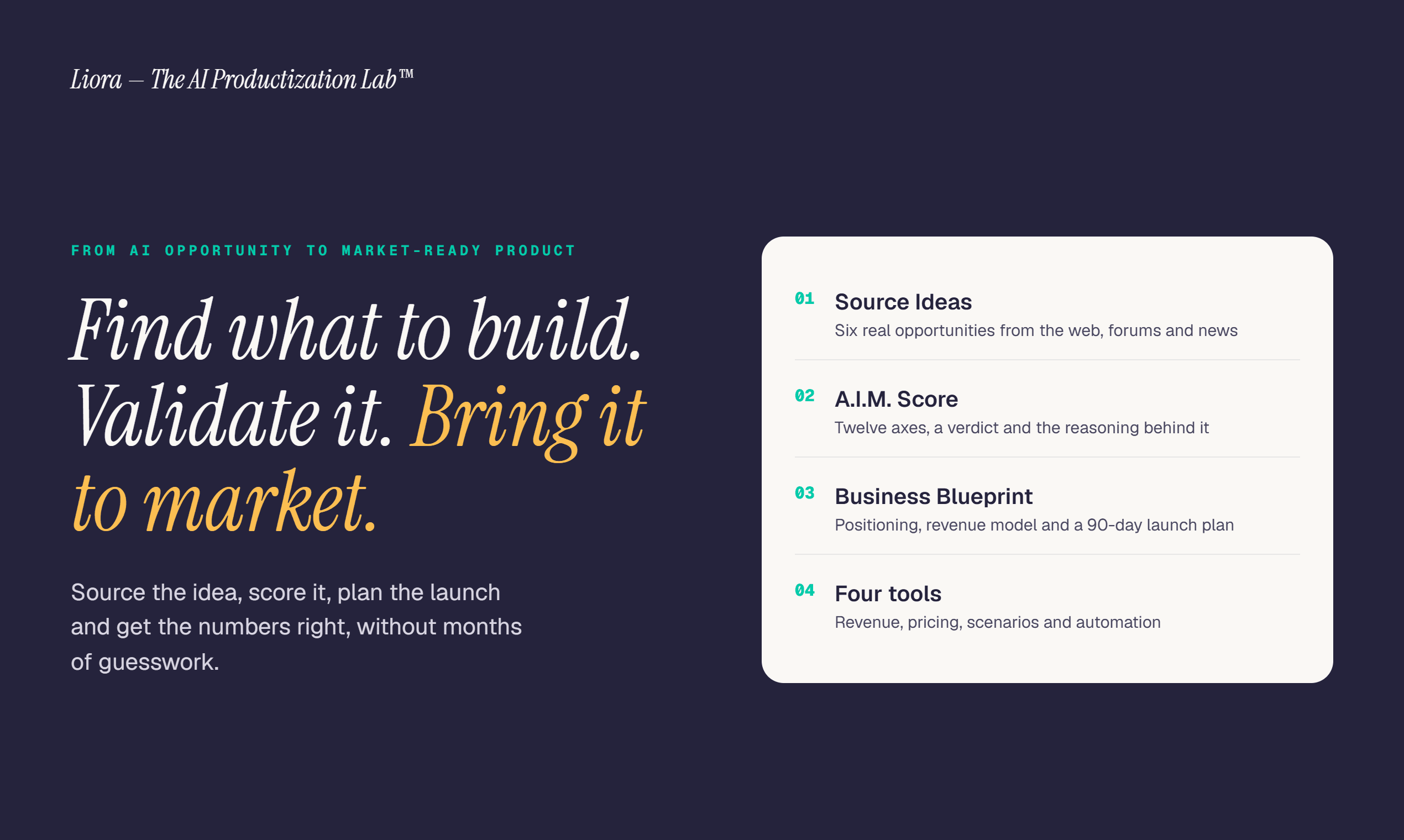
Liora, also known as the AI Productization Lab, is designed to help entrepreneurs move from an initial idea to a structured, market-ready AI offer. It discovers potential business opportunities, evaluates ideas through its A.I.M. Score™, identifies competitors and risks, and produces a business blueprint with positioning, pricing, revenue targets, and a 90-day launch plan.
Rather than jumping directly into development, Liora helps users investigate what to build, assess whether the opportunity is worth pursuing, and plan how to bring it to market.
You can explore Liora AI Productization Lab to evaluate an AI business idea and start building a practical launch strategy.
What Is Liora AI Productization Lab?
Liora is an AI-powered business idea validation and product planning platform built for founders, consultants, entrepreneurs, agencies, and business owners who want to develop AI-powered products or services.
Its central purpose is to shorten the journey from discovering an opportunity to creating a sellable offer. Instead of relying entirely on brainstorming or intuition, users can investigate market signals, score an idea, examine the competitive landscape, and build a plan around the opportunity.
The platform brings several activities into one workflow, including AI business opportunity discovery, idea scoring, competitor analysis, demand validation, pricing and profit calculations, automation planning, and go-to-market strategy.
This makes Liora relevant to people who have an AI startup idea but need a clearer way to decide whether to build it, test it with potential customers, or move on to another opportunity.
Discover AI Business Opportunities With Idea Sourcer
One of the main challenges for aspiring founders is finding a business idea that addresses a genuine problem. Brainstorming can produce plenty of possibilities, but it does not necessarily reveal which problems customers are actively trying to solve.
Liora's Idea Sourcer is designed to discover AI business opportunities using information from the web, online forums, and recent product launches.
The platform presents six AI business opportunities and provides a suggested no-code technology stack for each one. This gives users a starting point for investigating potential products without needing to generate every idea from scratch.
For entrepreneurs looking for AI startup ideas with market context, this approach can help connect idea discovery with practical implementation.
However, identifying a promising opportunity is only the first step. Each idea still needs to be assessed against its intended audience, competing solutions, willingness to pay, and the resources required to build and sell it.
Validate AI Product Ideas Before Building
A common startup mistake is treating the ability to build something as evidence that the business is worth pursuing.
A prototype can demonstrate that a product works technically, but it cannot independently prove that customers want it or will pay for it. Market validation requires understanding the problem, identifying the target customer, and testing whether the proposed solution addresses a meaningful need.
Liora includes a 30-day validation test that outlines three low-cost steps to investigate demand before significant money is spent.
This gives founders a structured starting point for testing assumptions before committing to a full product build. Instead of immediately investing in development, they can use the proposed validation steps to gather evidence about the opportunity.
For anyone searching for an AI tool to validate startup ideas before building, this is one of Liora's most relevant features.
The goal is to make the decision to build, test, or skip an idea more deliberate, rather than allowing enthusiasm for a new technology to drive the entire process.
Understand the A.I.M. Score™
Liora uses its A.I.M. Score™ to evaluate an AI product idea on a scale of 0 to 100.
According to Liora, the score assesses an idea across 12 axes and provides written explanations for individual scores. It also produces a recommendation to Build, Test, or Skip the opportunity.
This can help founders organize their thinking around an idea rather than relying on a general impression that it sounds promising.
For example, an idea might address a real problem but face strong competition. Another might have a clear target audience but an uncertain revenue model. A structured scoring report can help bring these considerations into the same evaluation.
The score should be treated as a decision-support tool, not a guarantee of commercial success. Real customer conversations, market experiments, and financial results remain important when deciding whether an AI business idea deserves further investment.
Competitor Analysis and Market Gaps
An AI product does not enter an empty market simply because its technology is new. Existing products may already address the problem, and customers may have established ways of solving it.
Liora's analysis includes named competitors, potential gaps in their offerings, a relevant case study, and risks that could undermine the proposed business.
This can help founders understand where a product might differentiate itself and which assumptions require further investigation.
For instance, a founder considering an AI tool for a specific industry needs to understand the alternatives available to that audience. A viable product may need to serve an overlooked customer segment, simplify an expensive workflow, or offer a more focused solution than broader competitors.
By combining competitor research with idea scoring, Liora helps users connect market opportunity with the practical question of why customers might choose their product.
Generate an AI Business Blueprint
Once an idea has been evaluated, the next challenge is turning the concept into an actionable business plan.
Liora's Business Blueprint provides a structured plan covering positioning, customer acquisition, revenue modeling, and launch execution.
The blueprint includes a positioning strategy, a plan for reaching the first 10 customers, revenue targets for months three, six, and twelve, and a week-by-week 90-day launch plan.
This is useful for founders who have a general idea but are unsure how to translate it into a concrete sequence of business activities.
Instead of ending with a market analysis document, the process moves toward defining an offer, identifying potential buyers, selecting an approach to customer acquisition, and planning the launch.
The proposed targets are planning inputs rather than guaranteed outcomes. Founders should adjust them based on customer feedback, actual conversion rates, available resources, and the economics of their market.
AI Pricing and Profitability Tools
Choosing a price for a new AI product can be difficult. A price that attracts customers may still be too low to cover infrastructure, software, support, marketing, and other operating costs.
Liora includes pricing and profit tools designed to help users evaluate different pricing decisions. Users can explore potential prices, estimate real profit, and test alternative business scenarios using sliders.
This allows founders to consider how changes in pricing or other assumptions might affect the business model before committing to a particular offer.
For example, an entrepreneur planning an AI subscription product needs to consider more than monthly revenue. Customer acquisition costs, recurring infrastructure expenses, usage-based AI costs, and support requirements can all influence profitability.
An AI business model and pricing calculator can help organize these assumptions and compare scenarios. The resulting estimates are only as reliable as the inputs, so they should be updated as real operating data becomes available.
Plan Your Go-to-Market Strategy
A good product still needs a way to reach its intended customers.
Liora's business blueprint includes positioning and a plan for acquiring the first 10 customers. These elements help connect the product idea to its target market and initial sales strategy.
A go-to-market plan can include defining the ideal customer, identifying the problem the offer solves, explaining the product's value, selecting suitable acquisition channels, and deciding how to test the offer with early customers.
For consultants and agencies, this process can also help turn existing expertise into a defined AI-powered service rather than launching a broad offering without a clear target audience.
Liora's focus on positioning, revenue targets, and a 90-day launch plan makes it useful for people who want to move from idea validation into execution.
The Automation Map: Identify What to Automate First
AI productization is not limited to creating a software product. Existing businesses may also want to introduce AI into their operations or develop an AI-powered service around their current expertise.
Liora's Automation Map identifies tasks that could be automated, suggests tools to use, and estimates the hours that could be saved each week.
This helps users think about automation in terms of specific business processes rather than adopting AI tools without a clear purpose.
For example, a consultant might investigate automating repetitive reporting tasks, while an agency could examine opportunities to streamline research or routine client workflows.
The practical value depends on the processes involved, the reliability of the proposed automation, and the time required to implement and maintain it. The map provides a starting point for evaluating these opportunities.
P.A.C.E., V.A.M. and Scenario Testing
Liora also includes a collection of planning tools described on its website as P.A.C.E., V.A.M., Scenario Testing, and the Automation Map.
These tools form part of the broader productization workflow, alongside Idea Sourcer, the A.I.M. Score™, and the Business Blueprint.
Scenario testing is particularly relevant when founders need to evaluate how different assumptions might affect an idea or business model. Rather than treating the initial plan as fixed, users can explore alternative possibilities and consider what changes if their expectations prove inaccurate.
Liora's website names P.A.C.E. and V.A.M. but does not fully define their individual methodologies, so they are best understood as components of Liora's wider toolset.
Who Should Use Liora AI Productization Lab?
Liora is designed for people who want to develop an AI-powered offer, whether that means launching a standalone product, adding an AI service to an existing business, or testing a side project.
Non-technical founders
People with an idea but no engineering team can use Liora to investigate whether the opportunity deserves further investment. Its opportunity discovery, validation steps, and business blueprint provide a structured starting point before development begins.
Business owners
Existing business owners can explore potential AI products or services for their customers. Liora helps connect opportunity discovery with positioning, pricing, revenue planning, and automation decisions.
Consultants, agencies, and coaches
Consultants and agencies can use the productization workflow when developing AI offers for clients. The platform's reports can be exported as PDFs, and client projects can be maintained separately.
Career changers and side-project builders
People building something alongside a job can use the 90-day action plan to organize the work around their available time and budget. This makes the process more practical for those who cannot dedicate themselves to a startup full-time.
How Liora Helps Reduce Startup Guesswork
Launching a business involves multiple decisions, and each one introduces uncertainty. Founders must determine which problem to solve, who will pay for the solution, how the product should be positioned, what it should cost, and how customers will discover it.
When these decisions are made independently, the resulting plan can become inconsistent. A product may target the wrong audience, use an unsuitable pricing model, or depend on an acquisition channel that does not reach its buyers.
Liora brings these questions into a connected process. Idea discovery identifies potential opportunities, scoring provides a structured assessment, competitor analysis highlights risks and gaps, validation outlines low-cost tests, and the business blueprint connects the findings to launch execution.
This does not eliminate uncertainty, but it can help founders identify assumptions earlier and make more informed decisions about where to invest their time and money.
Is Liora Suitable for Non-Technical Entrepreneurs?
Yes. Liora explicitly targets non-technical founders and states that no coding or prior AI experience is required to use its framework.
The platform focuses on opportunity discovery, validation, business planning, pricing, and automation rather than requiring users to build software within the tool itself.
Its suggested no-code stacks can provide a starting point for thinking about implementation. Founders may still need technical tools, developers, or other services to build and operate their final products, depending on the complexity of the idea.
This distinction makes Liora useful at the planning stage, especially for entrepreneurs who want to determine what is worth building before deciding how to build it.
Pricing and Getting Started With Liora
Liora is listed as a freemium product. Its creator states that users can start with 15 credits for free, allowing them to explore the platform and provide feedback.
This offers a way to try the idea discovery and validation workflow before making a larger commitment.
For the most useful results, users should start with a specific problem, target audience, or business idea rather than entering a vague concept. Clear inputs make it easier to assess whether the suggested opportunity, competitive landscape, and business plan match the intended market.
You can visit Liora AI Productization Lab to get started.
Final Thoughts
Liora AI Productization Lab is designed for founders who want a more structured approach to building AI businesses.
Its combination of AI opportunity discovery, the A.I.M. Score™, competitor analysis, low-cost validation tests, business blueprints, pricing tools, and automation planning addresses several decisions that entrepreneurs face before launching a product.
The platform is particularly relevant to non-technical founders, consultants, agencies, and people building side projects who need help connecting an idea to a practical business model.
Rather than promising that every AI idea will become profitable, Liora focuses on helping users evaluate opportunities, examine assumptions, and prepare a structured plan for bringing an offer to market.
For anyone searching for an AI product validation tool, AI business idea validator, or AI startup planning platform, Liora AI Productization Lab offers a workflow that connects discovery, validation, and execution in one place.
Frequently Asked Questions
What is Liora AI Productization Lab?
Liora is an AI-powered product planning platform that helps founders discover AI business opportunities, evaluate ideas, research competitors, test demand, and create a business blueprint for launching an offer.
How does Liora validate AI business ideas?
Liora combines its A.I.M. Score™, competitor and risk analysis, and a 30-day validation test. The test outlines three low-cost steps intended to help users investigate demand before investing heavily in development.
What is the A.I.M. Score™?
The A.I.M. Score™ evaluates an idea on a scale of 0 to 100 across 12 axes. It provides written reasoning for individual scores and recommends whether users should Build, Test, or Skip the idea.
Can Liora help me find AI startup ideas?
Yes. Its Idea Sourcer identifies six AI business opportunities using information from the web, forums, and recent launches. Each opportunity includes a suggested no-code stack to help users explore implementation options.
Does Liora generate a business plan?
Liora produces a Business Blueprint that includes positioning, a plan to acquire the first 10 customers, revenue targets for months three, six, and twelve, and a week-by-week 90-day launch plan.
Is Liora suitable for non-technical founders?
Yes. Liora is designed for people who want to launch AI-powered offers without requiring coding or previous AI experience to use its planning framework.
Can consultants and agencies use Liora for clients?
Yes. Consultants, agencies, and coaches are among its intended audiences. The platform supports exporting reports as PDFs and keeping client projects separate.
Does Liora help with AI product pricing?
Yes. Its pricing and profit tools allow users to explore prices, estimate profitability, and test different business scenarios using adjustable assumptions.
What is Liora's Automation Map?
The Automation Map identifies tasks that could be automated, suggests tools to consider, and estimates potential weekly time savings.
Is Liora free to use?
Liora is listed as a freemium product. Its creator states that users can start with 15 free credits. Check the current website for the latest terms and available features.