AI Tools
Thesisroom: An AI Thesis Research Assistant for Students and PhD Researchers
Discover how Thesisroom helps Master's and PhD students find research gaps, verify citations, audit thesis chapters, and prepare for their defense.
CodeHype14 min read
Writing a Master's thesis or doctoral dissertation involves much more than collecting information and putting ideas into chapters. Researchers must identify meaningful research gaps, support their arguments with credible evidence, maintain consistent reasoning, verify academic references, and prepare to defend their findings. Even a small mistake in a citation or an unsupported claim can create problems during a supervisor review or final examination.
Traditional research workflows often make these problems difficult to identify early. Students may spend weeks developing a topic before discovering similar published work. A reference list may contain broken citations, while individual chapters may include arguments that contradict each other. Preparing for a thesis defense can also become stressful when researchers are unsure which parts of their work an examiner might challenge.
Thesisroom is an AI-powered thesis research assistant designed to help Master's and doctoral students identify these issues throughout their research journey. Rather than writing academic content on behalf of students, it examines their existing work, highlights areas that need attention, and connects findings to specific passages or real academic references.
Available through a freemium model, Thesisroom helps researchers move from their initial topic search to chapter reviews, citation verification, and thesis defense preparation in one workspace.
What Is Thesisroom?
Thesisroom is an academic research platform built for students working on Master's theses, PhD dissertations, and other substantial research projects. It acts as a second reader that examines the researcher's own writing and identifies potential weaknesses before they become larger problems.
Instead of functioning like a general-purpose AI chatbot that generates paragraphs in response to prompts, Thesisroom focuses on reviewing, verifying, and questioning existing academic work. It can examine a research proposal, an individual chapter, a reference list, or a full thesis uploaded as a PDF or DOCX file.
Its central principle is traceability. Each issue it identifies is connected to the passage that prompted the finding or to a record in an academic research database. This gives students a clear starting point for checking the result and deciding how to improve their work.
The platform covers multiple stages of academic research, including topic exploration, research planning, chapter development, source verification, argument consistency, and defense preparation. It also includes workspace tools for organizing supervisor meetings, reading tasks, research notes, feedback, and publication planning.
For researchers who want to strengthen their own arguments without outsourcing the writing process, Thesisroom offers a structured way to review academic work before submitting it to a supervisor or examination committee.
Why Thesis Researchers Need More Than a General AI Chatbot
General AI assistants can help explain concepts, brainstorm research questions, and summarize information. However, thesis research requires more than receiving a convincing answer. Students need to establish whether a source exists, whether it supports a particular claim, and whether their conclusions follow from their research methods and findings.
A chatbot-generated reference may look academically credible while still being incorrect. Similarly, a chapter can sound polished but contain unsupported assumptions or inconsistencies with another part of the dissertation.
These problems become particularly challenging when researchers are working with dozens of sources and multiple chapters over several months or years.
Thesisroom approaches these challenges through focused checks. It helps identify claims that need stronger support, discover research that may be relevant to a topic, examine whether a paper supports or contradicts an argument, and detect inconsistencies across chapters. It can also generate possible examiner questions from specific passages in the uploaded work.
The distinction is important. Thesisroom is designed to help students investigate weaknesses and make their own revisions, rather than produce academic text for them to submit.
Key Features of Thesisroom
1. Research Compass for Finding Existing Studies
Choosing a research topic is one of the most important early decisions in a thesis project. A topic that appears original at first may already have extensive published research, while a promising research question may need a more precise scope.
Thesisroom's Research Compass helps researchers explore published papers related to a proposed topic before committing to a direction. It uses academic research information to show what has already been studied and where related work exists.
This can help students develop a more informed understanding of their research area before investing significant time in a proposal. For example, a student exploring green finance and sustainability could use the tool to discover related studies, examine influential papers, and identify themes that deserve closer investigation.
The results are a starting point for further academic reading, not a guarantee that a research question is entirely new. Researchers still need to evaluate the literature and establish their own research gap.
2. Scope Check for Reviewing Research Proposals
A research proposal needs to align its research questions, objectives, and methodology. If a proposal promises to establish a relationship that its chosen method cannot demonstrate, the mismatch can become a significant problem later.
Thesisroom's Scope Check helps identify places where the proposed study asks for more than its methodology can support. It encourages researchers to examine whether their questions, intended outcomes, and research design fit together.
Finding these issues early can reduce unnecessary revisions after a project has progressed. Students can discuss the findings with their supervisors and make appropriate adjustments before committing to a complete thesis.
This is particularly useful for researchers who are still refining their research questions or deciding how to approach a complex topic.
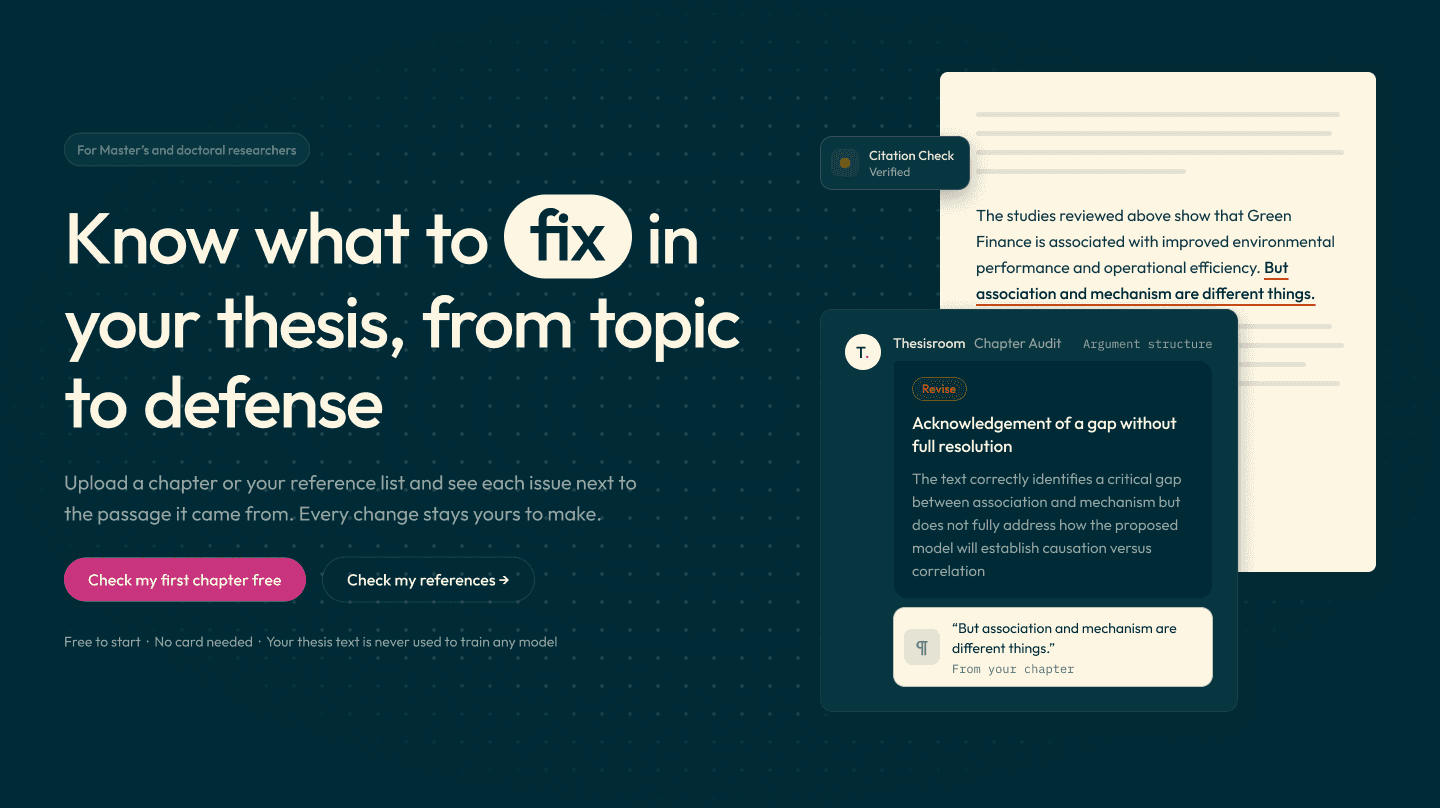
3. Chapter Audit for Identifying Weak Arguments
Writing a chapter does not automatically mean its reasoning is complete. A literature review may acknowledge a gap without explaining how the research addresses it. A claim may be presented without sufficient evidence, or a conclusion may go further than the available findings justify.
Chapter Audit examines uploaded chapters and provides comments on their structure, argumentation, and support. Findings can be categorized by priority, including issues that must be addressed, points that should be revised, and areas worth considering.
Each comment is linked to the passage it concerns, making it easier to locate the relevant section and decide what to change.
This creates a practical review process before sending a chapter to a supervisor. Instead of rereading the entire document and hoping to notice every weakness, researchers receive a structured list of potential issues to investigate.
Thesisroom does not rewrite the chapter. The researcher remains responsible for evaluating each comment, revising the argument, and ensuring that the final work accurately reflects their research.
4. Find Sources and Paper Match
Finding academic papers is only one part of building a strong thesis. Researchers also need to determine whether the available literature actually supports their claims.
Thesisroom includes two tools that address these related tasks. Find Sources helps identify published research that may support a claim, while Paper Match examines whether a paper supports or contradicts an argument in the thesis.
These checks can help students avoid relying on sources simply because their titles appear relevant. A paper might discuss the same general topic but use a different population, methodology, or interpretation of the evidence.
Researchers can use these findings to revisit their claims, investigate alternative explanations, and make their literature reviews more precise. The results should still be checked against the original papers because relevance and evidential strength require academic judgment.
5. Blind Spots and Argument Map
A thesis can contain many references while still overlooking important parts of its research field. A long bibliography does not necessarily mean that every relevant perspective has been considered.
Thesisroom's Blind Spots tool highlights areas of a field that may be missing from the researcher's reference list. It can help students identify subjects that deserve further literature searches and assess whether their existing reading covers the claims they are making.
The Argument Map focuses on consistency across chapters. It helps identify contradictions or tensions between different sections of a thesis, which can become difficult to notice after months of working with the same document.
Together, these tools help researchers look beyond individual paragraphs and consider how their literature review, methodology, results, and discussion fit together.
6. Citation Check and Reference Watch
Academic referencing requires careful verification. A citation can be incomplete, a DOI can be incorrect, or a source may no longer be considered reliable because it has been retracted.
Thesisroom's Citation Check compares references against academic registries and research databases, including Crossref, OpenAlex, Semantic Scholar, PubMed, and Retraction Watch. Its wider source ecosystem also includes services such as DOAJ, CORE, and Unpaywall.
The purpose is to help researchers establish whether references can be found in published research records and identify citations that need further investigation.
Reference Watch adds an ongoing monitoring element by checking cited sources for changes. This is useful for researchers whose projects extend over several semesters or years, because a source that was acceptable when first cited may later require attention.
These features do not replace reading the original paper or checking the context of a citation. Instead, they help researchers identify potential reference problems before submitting their final work.
7. Defense Practice for Master's and PhD Students
Preparing for a thesis defense requires more than memorizing the contents of a dissertation. Students need to explain why they selected a particular method, justify their conclusions, acknowledge limitations, and respond to questions about inconsistencies or unsupported assumptions.
Thesisroom's Defense Practice generates potential examiner or committee questions from the researcher's own pages. Questions can point to specific passages and, when a PDF is uploaded, include the relevant page.
For example, a question might ask how a researcher reconciles two findings that appear to conflict, or why a particular hypothesis remains unsupported despite another analysis producing a different result.
Practising with questions grounded in the actual thesis can help students identify arguments that need further clarification before the examination.
The tool cannot predict exactly what an examiner will ask. Its value lies in helping researchers consider plausible challenges based on their own work and prepare reasoned responses.
8. A Research Workspace for the Entire Thesis Journey
Research projects involve many activities outside writing chapters. Students must keep track of papers to read, supervisor feedback, meeting notes, research decisions, and publication opportunities.
Thesisroom brings these activities together through its workspace, which includes tools such as Supervisor Report, Meeting Pack, Feedback Loop, Reading Queue, Research Journal, and Publication Planner.
This broader workflow can help researchers maintain continuity between reading, writing, revisions, and supervisor discussions. Rather than treating every chapter review as an isolated task, the platform is designed to support the research process from initial exploration through preparation for publication.
Thesisroom also offers additional checks that recalculate results described in the text and compare citations against the reference list, helping researchers identify places where their written account may not match the underlying information.
How Thesisroom Works
Thesisroom follows a straightforward workflow designed around the researcher's current stage.
Step 1: Upload your research. Start with a proposal, chapter, reference list, or full thesis in PDF or DOCX format. You do not need to begin by reviewing the entire dissertation if you only want feedback on one chapter.
Step 2: Choose the relevant check. Select a tool based on your immediate need. You might use Research Compass before finalizing a topic, Chapter Audit while drafting a chapter, Citation Check before submission, or Defense Practice before an examination.
Step 3: Review the findings. Thesisroom returns questions, citation checks, or chapter comments linked to the passage or academic record that prompted them. This helps you understand what the finding refers to rather than receiving only a general assessment.
Step 4: Verify and revise your work. Investigate the cited sources, assess the feedback, and make the necessary changes yourself. You remain responsible for the research, reasoning, and final academic submission.
This workflow makes Thesisroom a review and research support tool rather than an automatic thesis-writing service.
Academic Integrity and Research Privacy
One of Thesisroom's defining characteristics is its emphasis on academic integrity. The platform is designed not to write thesis paragraphs, rewrite sentences for submission, fabricate references, or help students bypass plagiarism detection tools.
Instead, it identifies possible weaknesses and gives researchers information they can use to improve their own work. This approach can be useful for students who want AI-assisted research support while remaining responsible for their writing and academic decisions.
Privacy is another stated priority. According to the platform, a researcher's name, supervisor, institution, and email are removed before processing. Thesis text is not used to train AI models, and users can permanently delete their thesis, results, notes, and reports.
These safeguards are relevant when working with unpublished research, sensitive project details, or early-stage findings. Researchers should still review the platform's current privacy and integrity policies and follow their university's rules for using external research tools.
Thesisroom Pricing: Is There a Free Plan?
Thesisroom uses a freemium pricing model, allowing students to try selected features before paying for broader access.
Its free plan includes up to three potential examiner questions and 15 citations checked from an uploaded document. The platform states that users can start without entering payment card details.
Paid plans provide access to the wider set of thesis research tools. The listed pricing is:
- Free: Start without a payment card, with limited defense questions and citation checks.
- Annual plan: $9 per month when billed yearly.
- Monthly plan: $12 per month.
- Three-month plan: $35 for three months.
Pricing and plan allowances may change, so students should confirm the current details on the official Thesisroom website before subscribing.
For students who are uncertain whether they need a dedicated thesis research assistant, starting with one chapter or a reference list is a practical way to assess whether the findings are useful for their workflow.
Who Should Use Thesisroom?
Thesisroom is primarily designed for Master's and doctoral students, but its different tools can support researchers at several stages of an academic project.
Master's students can use it to explore topics, review proposals, strengthen chapter arguments, and check references before submitting coursework or a dissertation.
PhD researchers may benefit from examining consistency across longer documents, tracking changes to cited sources, and practising questions about their methodology, findings, and contributions.
Students preparing for a thesis defense can use Defense Practice to identify arguments that may need a clearer explanation and develop responses grounded in their own research.
Researchers working with extensive literature reviews can use source discovery and citation verification tools to organize their search process and investigate whether their bibliography supports their claims.
Academic supervisors may find the reports useful as a supplementary discussion aid when reviewing student work. However, the platform should not replace direct supervisor feedback, disciplinary expertise, or formal assessment.
Thesisroom Advantages and Limitations
Thesisroom's main advantage is that it connects feedback to specific passages and verifiable academic records. This gives researchers a more concrete starting point than generic advice about improving a thesis. Its coverage of topic exploration, chapter auditing, references, argument consistency, and defense practice also makes it relevant across multiple stages of research.
Its focus on helping students revise their own work may be particularly appealing to researchers concerned about academic integrity. The free plan also makes it possible to try selected checks before committing to a subscription.
However, Thesisroom should be treated as a research support tool, not an authority on the correctness of a thesis. Its findings require human judgment, and a database match alone does not prove that a source supports a claim. Likewise, a potential contradiction or examiner question needs to be evaluated in the context of the researcher's discipline and methodology.
The platform also cannot guarantee an original research topic, a successful defense, or publication. Those outcomes depend on the quality of the research, the student's decisions, and the standards of the relevant academic institution.
Final Verdict: Is Thesisroom Worth Trying?
Thesisroom offers a focused approach to one of the most demanding parts of higher education: producing research that can withstand academic scrutiny. Rather than concentrating on generating text, it helps researchers examine what they have already written, verify their references, explore related literature, and prepare for questions about their arguments.
Its combination of Research Compass, Chapter Audit, citation checks, argument mapping, and Defense Practice makes it relevant from the early stages of topic selection to the final preparation for an examination. The accompanying workspace also supports the organizational tasks that continue throughout a long research project.
For Master's and PhD students who want to identify potential weaknesses before submitting their work, Thesisroom is worth exploring. Starting with a chapter or reference list allows students to see how the platform handles their own research and decide whether its feedback fits their needs.
If you want a structured way to review your thesis without handing over the writing itself, try Thesisroom for free and explore its research and verification tools.
Frequently Asked Questions
1. What is Thesisroom used for?
Thesisroom helps Master's and doctoral researchers explore research topics, review thesis chapters, find relevant academic sources, verify citations, identify inconsistencies, and practise potential thesis defense questions.
2. Does Thesisroom write a thesis for you?
No. Thesisroom is designed to review existing work and highlight issues rather than write or rewrite thesis content. Researchers make their own revisions and remain responsible for their academic submissions.
3. Can Thesisroom verify academic references?
Thesisroom checks citations against academic research databases and registries, including Crossref, OpenAlex, Semantic Scholar, PubMed, and Retraction Watch. These checks help identify references that require further investigation.
4. Can Thesisroom help with a PhD defense?
Yes. Its Defense Practice feature generates possible examiner or committee questions based on passages in an uploaded thesis. It can help researchers prepare for questions about their arguments, methodology, and findings, although it cannot predict the actual examination questions.
5. Is Thesisroom free?
Thesisroom offers a free starting plan with limited features and no payment card required. The listed free allowance includes up to three potential defense questions and 15 citation checks. Paid plans provide broader access.
6. Is my thesis used to train AI models?
Thesisroom states that uploaded thesis text is never used to train AI models. It also says identifying information is removed before processing and that users can permanently delete their research materials and related results.
7. Who can benefit most from Thesisroom?
Master's students, PhD candidates, and other academic researchers who need help checking arguments, references, research scope, and defense readiness may find Thesisroom useful. It is intended to supplement, not replace, academic supervision and independent judgment.