AI Tools
CompeteScan: See Why AI Recommends Your Competitor Instead of You
Discover CompeteScan, an AI visibility checker that shows why ChatGPT, Gemini, and Perplexity recommend your competitors, which sources they cite, and what to fix.
CodeHype6 min read
Search is changing. People are no longer relying only on traditional search engines to discover products, services, companies, and software. Increasingly, they are asking AI systems questions such as which tool they should use, which company offers a particular service, or which products are worth considering.
That creates a new problem for brands.
Your website might rank well on Google, but what happens when a potential customer asks ChatGPT, Gemini, or Perplexity for a recommendation?
Does the AI mention your company?
Does it recommend a competitor instead?
And if your competitor is being recommended, why?
AI visibility tracker for ChatGPT, Gemini and Perplexity is an AI visibility checker designed to answer those questions. It queries AI answer engines using buyer-style prompts, measures your visibility against competitors, shows the sources being cited, and turns the results into a prioritized playbook of actions.
Instead of simply telling you that your brand has low AI visibility, CompeteScan is designed to show where you are losing and what you can do about it.
What Is CompeteScan?
CompeteScan is an AI visibility tracking platform for brands, founders, marketing teams, SEO professionals, and agencies that want to understand how their businesses appear in AI-generated answers.
The platform focuses on three major AI answer engines:
- ChatGPT
- Gemini
- Perplexity
CompeteScan uses prompts based on the questions potential customers might ask when researching products or services. It then measures how often your brand is mentioned or cited compared with the competitors you select.
The result is an AI search visibility report that helps you understand your position across different buyer questions and AI platforms.
This makes CompeteScan different from an AI writing tool. It does not primarily focus on generating articles or rewriting content. Instead, it focuses on understanding what AI systems are already saying about your brand and competitors.
Why AI Search Visibility Matters
Traditional SEO focuses heavily on search engine results pages and rankings.
AI search introduces another layer.
A customer might search Google for "best project management software for startups." They might also ask ChatGPT the same question and receive a direct list of recommendations.
If your competitor appears in that answer while your company does not, you may be missing an important discovery opportunity.
This is where AI visibility tracking becomes useful.
Companies can monitor how often they appear in AI answers, which competitors are mentioned alongside them, and which websites or pages AI systems use as supporting sources.
CompeteScan is built around this type of analysis.
See Whether ChatGPT Recommends You or Your Competitor
One of the central use cases for CompeteScan is understanding what happens when buyers ask AI systems questions related to your category.
The platform can query ChatGPT using buyer-style prompts and show the resulting answer.
This lets you move beyond assumptions.
Instead of asking whether your brand is visible in AI search, you can inspect the actual answers being generated.
If a competitor is recommended instead of your company, CompeteScan helps identify the sources and gaps that may explain the difference.
This can be particularly useful when your traditional SEO performance looks healthy but your AI search visibility does not.
Track AI Visibility Across ChatGPT, Gemini and Perplexity
AI answers can differ significantly between platforms.
A company might be mentioned frequently in ChatGPT but less often in another answer engine. The sources used by each platform can also vary.
CompeteScan provides tracking across ChatGPT, Gemini, and Perplexity.
The platform can measure your share of visibility against selected competitors and help you monitor changes over time.
This creates a broader picture of AI search visibility rather than relying on a single AI platform.
For companies investing in answer engine optimization, this type of cross-platform monitoring can help reveal where their visibility is improving and where competitors are gaining ground.
Understand Your AI Search Share of Voice
CompeteScan does not only look at whether your brand appears.
It also compares your visibility against competitors.
You can select the competitors you want to track and see how brands rank across the prompts being monitored.
This creates an AI search share-of-voice view.
For example, if customers repeatedly ask an AI system for recommendations within your category, you can monitor which companies are being mentioned and how frequently they appear across those questions.
Over time, this can help you identify changes in competitive visibility.
See the Exact AI Answers
Knowing that you lost visibility on a prompt is useful.
Understanding what the AI actually said is more useful.
CompeteScan allows users to inspect the actual answers generated by the AI engines it queries.
You can see what the AI said about your company, what it said about your competitors, and which sources it relied on.
This provides context that a simple ranking number cannot provide.
If an AI recommends another company, you can investigate the answer rather than guessing about what caused the recommendation.
Discover Which Sources AI Is Citing
AI visibility is not only about mentions.
Citations matter because AI systems can use external sources when constructing answers.
CompeteScan shows the sources cited by the AI engines so you can investigate where your competitors are receiving visibility.
This can reveal citation gaps.
For example, you may discover that competitors are consistently being supported by industry publications, comparison pages, directories, reviews, or other authoritative sources while your company is rarely represented in those sources.
That information can become part of your AI search optimization strategy.
Find Out Why a Competitor Is Winning
One of the most useful parts of CompeteScan is its focus on explaining competitive gaps.
The platform does not simply show that another company is being recommended. It analyzes the answer and the sources behind it to help identify why the competitor is appearing.
The resulting analysis can point toward areas that need attention.
Those areas may include content gaps, citation opportunities, or changes that could improve how your brand is represented across the web.
This is particularly valuable for companies trying to move from simply monitoring AI visibility to actively improving it.
Get a Prioritized AI Visibility Playbook
Finding problems is only the first step.
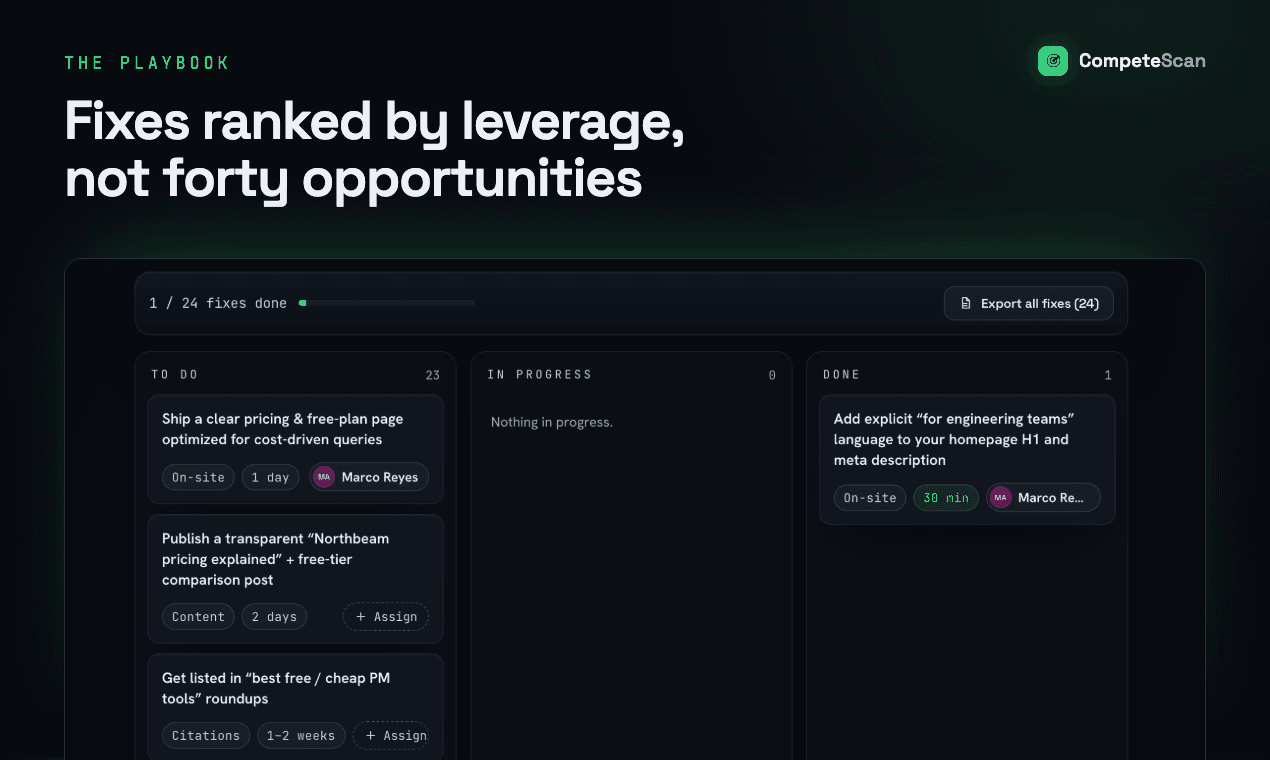
CompeteScan turns visibility gaps into a prioritized playbook.
Rather than presenting a long list of potential tasks without context, the platform ranks recommended actions based on their potential leverage.
The playbook can include areas such as content briefs, citation opportunities, and on-site changes.
This gives marketing teams a practical way to move from AI visibility analysis to execution.
Instead of asking, "What should we do about this?" you can work through the highest-priority opportunities first.
AI Visibility Tracking for Competitors
Competitive monitoring is an important part of AI search optimization.
Your competitors can gain visibility even when you make no changes to your own website. New articles can be published, third-party pages can be updated, and AI systems can change the sources they rely on.
CompeteScan allows teams to track competitors alongside their own brand.
This means you can monitor whether a competitor starts appearing more frequently across important buying prompts and investigate the sources contributing to that change.
For marketing teams, this can turn competitor AI visibility into an ongoing research process rather than a one-time audit.
AEO and GEO: What Do They Mean?
CompeteScan focuses on a growing area commonly described using terms such as AEO and GEO.
AEO stands for Answer Engine Optimization. It generally refers to optimizing your presence so that answer engines can discover, understand, and potentially reference your brand in AI-generated answers.
GEO stands for Generative Engine Optimization and is often used for a similar purpose.
Traditional SEO still matters because AI systems can use information from websites that already have strong search visibility.
The two approaches therefore do not necessarily replace each other.
SEO focuses heavily on traditional search results, while AI visibility tracking focuses on how your brand appears inside AI-generated answers.
Who Is CompeteScan For?
CompeteScan is designed for several types of users:
Founders
Founders can use the platform to understand whether AI systems recommend their company when potential customers ask category-specific questions.
The free scan provides a way to see the current situation before committing to a paid plan.
Marketing Teams
Marketing teams can track AI visibility over time, monitor competitors, review cited sources, and turn gaps into prioritized actions.
This can make AI search visibility part of a broader marketing reporting process.
SEO Professionals
SEO professionals can use AI visibility data alongside traditional search data.
The citation information can also help identify potential content and authority opportunities.
Marketing Agencies
Agencies can use CompeteScan to monitor multiple brands through its Agency plan, which includes unlimited brands, custom prompt volume, unlimited competitors, daily scans, API access, and alerts.
CompeteScan Pricing
CompeteScan uses a freemium model with a free initial scan.
Free Scan
The first scan is designed to let you understand your AI visibility without requiring a credit card.
It includes:
- 5 ChatGPT prompts
- AI visibility report
- Playbook preview
- ChatGPT analysis
The platform states that the first scan takes about 60 seconds.
Starter
Starter costs $49 per month and is designed for founders monitoring one brand.
It includes:
- 1 brand
- 20 tracked prompts
- ChatGPT, Gemini, and Perplexity
- Up to 10 competitors
- Weekly scans
- Full playbook
- Citation source tracking
Pro
Pro costs $199 per month and is designed for marketing teams.
It includes:
- 1 brand
- 50 tracked prompts
- ChatGPT, Gemini, and Perplexity
- Up to 30 competitors
- Daily scans
- Full playbook
- Citation source tracking
- Email and in-app alerts
Agency
The Agency plan is custom-priced for teams managing multiple brands.
It includes unlimited brands, custom prompt volume, unlimited competitors, daily scans, full playbooks, citation tracking, alerts, API access, and priority support.
How CompeteScan Works
The workflow is designed to be straightforward:
1. Enter Your Domain
Start by entering your website domain.
CompeteScan reads your positioning and can automatically detect competitors that may be relevant to your category.
2. Choose Your Competitors
Confirm the competitors you want to monitor.
These competitors become part of your AI visibility comparison.
3. Run Buyer-Style Prompts
CompeteScan queries AI answer engines using questions that potential customers could ask when researching your category.
The free scan focuses on ChatGPT, while paid plans expand coverage to Gemini and Perplexity.
4. Review Your AI Visibility
The resulting report shows where your brand appears, where competitors appear, and how visibility differs across prompts and engines.
5. Investigate the Sources
You can inspect the answers and the sources cited by the AI engines.
6. Follow the Playbook
CompeteScan then turns identified gaps into prioritized recommendations.
This gives you a workflow that connects measurement, competitive research, source analysis, and optimization.
CompeteScan vs Traditional SEO Tools
Traditional SEO platforms are built around search engines, keywords, backlinks, rankings, traffic, and other conventional search metrics.
Those metrics remain valuable.
However, they do not necessarily tell you what ChatGPT, Gemini, or Perplexity will recommend when someone asks an open-ended question.
CompeteScan focuses specifically on this AI answer layer.
It allows marketers to ask a different set of questions:
- Is my brand being mentioned?
- Which competitors are being recommended?
- Which sources are being cited?
- Which buying prompts do I lose?
- Why is another company appearing?
- What can I change?
That makes AI visibility tracking a complementary part of a broader search strategy.
Final Thoughts
AI search is creating a new visibility challenge for businesses.
It is no longer enough to understand only where your website appears in traditional search results. Brands also need to understand how they are represented when potential customers ask AI systems for recommendations.
CompeteScan provides a way to investigate that visibility across ChatGPT, Gemini, and Perplexity.
It combines AI search tracking, competitor share of voice, real AI answers, citation source analysis, and prioritized recommendations into one workflow.
For companies asking how to improve brand visibility in ChatGPT, how to get recommended by AI search engines, or how competitors are gaining visibility in AI answers, AI visibility tracker for ChatGPT, Gemini and Perplexity provides a practical starting point.
The free scan also makes it possible to see your current AI visibility before deciding whether ongoing tracking is necessary.
Frequently Asked Questions
What is an AI visibility checker?
An AI visibility checker analyzes how often a brand appears in AI-generated answers and compares its visibility against competitors. CompeteScan queries AI answer engines using buyer-style prompts and shows mentions, citations, competitor visibility, and recommended actions.
How can I check whether ChatGPT recommends my brand?
You can use an AI visibility checker such as CompeteScan to run buyer-style prompts against ChatGPT and inspect the resulting answers. This can show whether your brand is mentioned, which competitors appear, and which sources ChatGPT cites.
Can CompeteScan track competitors in AI search?
Yes. CompeteScan allows you to select competitors and measure AI search share of voice against them. Paid plans provide additional competitor tracking capacity.
Does CompeteScan track Gemini and Perplexity?
Yes. The free scan focuses on ChatGPT. Paid plans add Gemini and Perplexity, allowing users to compare AI visibility across three major answer engines.
What is AI search optimization?
AI search optimization is the process of improving how your brand and its information appear in AI-generated answers. It can involve content, citations, website structure, and other sources that AI systems use when generating responses.
What is AEO?
AEO stands for Answer Engine Optimization. It refers to efforts aimed at increasing the likelihood that a brand, website, or source is discovered and referenced by answer engines.
What is GEO?
GEO stands for Generative Engine Optimization. The term is commonly used for optimizing visibility within generative AI search and answer experiences.
Is CompeteScan an AI writing tool?
No. CompeteScan is primarily an AI visibility and competitor analysis platform. It queries AI answer engines, analyzes their responses and cited sources, and produces a prioritized playbook rather than functioning as a conventional AI writing tool.
Is the first CompeteScan scan free?
Yes. CompeteScan offers a free initial scan with no credit card requirement. The free scan includes five ChatGPT prompts, a visibility report, and a playbook preview.
How long does a CompeteScan scan take?
CompeteScan states that its first ChatGPT scan can be completed in about 60 seconds after entering your domain and confirming competitors.
Do I still need SEO if I use an AI visibility checker?
Yes. AI visibility tracking and traditional SEO address related but different discovery channels. SEO remains important for traditional search, while AI visibility tracking helps you understand how your brand appears in AI-generated answers.
How can I improve my brand visibility in ChatGPT?
The first step is understanding where your brand currently appears, which prompts you lose, which competitors are recommended, and which sources AI systems cite. CompeteScan is designed to surface those gaps and organize potential improvements into a prioritized playbook.