SEO Tools
Roki AI: An AI SEO Platform That Automates Your Content Strategy
Discover how Roki AI automates SEO with keyword research, AI-written articles, multilingual publishing, Google Search Console reports, and AI search optimization.
CodeHype18 min read
Consistent content publishing is one of the biggest challenges for businesses trying to grow through organic search. Finding relevant keywords, researching competitors, writing useful articles, optimizing content, and publishing on schedule all require time and expertise. For startups, solo founders, small businesses, and marketing teams with limited resources, maintaining this process can become difficult.
Roki AI aims to simplify the entire workflow by acting as an automated SEO team. Instead of functioning only as an AI writing assistant, it combines keyword research, competitor analysis, article generation, multilingual content creation, publishing automation, and SEO performance tracking in one platform.
With Roki AI, businesses can connect their website, identify relevant content opportunities, and publish SEO-focused articles on a regular schedule. The platform also integrates with Google Search Console to track performance and deliver weekly reports with actionable recommendations.
Its approach is particularly relevant for businesses that understand the importance of organic traffic but struggle to maintain a consistent content strategy. Rather than managing several disconnected tools and manual processes, users can automate much of their SEO workflow from a single platform.
What Is Roki AI?
Roki AI is an AI-powered SEO automation platform designed to help businesses grow organic traffic through consistent, search-focused content. It researches relevant topics, analyzes competitors, generates articles, and publishes content according to a schedule.
The platform is built for startups, founders, marketers, agencies, technical teams, and small businesses that want to improve their search visibility without relying entirely on external writers or SEO agencies.
Roki also focuses on the changing search landscape. Alongside traditional Google rankings, it aims to structure content so it can be cited by AI answer engines such as ChatGPT and Perplexity, as well as appear in Google's AI search experiences.
Its workflow covers several stages of SEO:
- Researching keywords and competitor content gaps
- Planning topics around search intent and business relevance
- Writing structured, SEO-focused blog articles
- Checking content quality and factual accuracy
- Publishing articles on a consistent schedule
- Tracking performance through Google Search Console
- Delivering weekly reports with recommendations
By connecting these activities, Roki AI helps businesses move from occasional blog publishing toward a more systematic content strategy.
Why Businesses Need SEO Automation
SEO is not usually a one-time task. Businesses need to identify opportunities, create useful pages, maintain existing content, and evaluate results over time. A few blog posts may not be enough to establish visibility across a competitive market.
For a small team, the workload can become a barrier to consistent publishing.
Keyword research takes time
Choosing topics based only on intuition can lead to articles that attract little relevant traffic. Businesses need to understand what potential customers search for, what competitors already cover, and which keywords may be realistic targets.
Roki AI helps automate this research by analyzing competitor websites, identifying keyword opportunities, and sorting topics according to relevance.
Content production is an ongoing commitment
A useful SEO article requires more than generating a few paragraphs. It needs an appropriate structure, relevant information, clear headings, and alignment with the searcher's intent.
Roki generates full blog articles designed for search visibility and can publish them on a recurring schedule. This reduces the amount of manual coordination required to maintain a content calendar.
Hiring an SEO team can be expensive
Freelance writers, consultants, and agencies can help businesses execute SEO strategies, but these services may be difficult to afford for early-stage startups and small companies.
SEO automation offers an alternative for teams that want to handle more of the workflow themselves. It does not eliminate the need for strategic oversight, but it can reduce repetitive research, drafting, and publishing work.
Measuring results matters as much as publishing
Publishing more articles does not automatically guarantee better rankings or more leads. Businesses need to understand which pages are gaining impressions, which keywords are improving, and where content needs attention.
Roki connects with Google Search Console and provides weekly performance reports, helping users make decisions based on search data rather than publishing content without evaluating its impact.
Key Features of Roki AI
1. Automated Keyword Research and Competitor Analysis
A successful content strategy starts with understanding the search opportunities available to a business. Roki AI analyzes a website alongside its competitors to help identify keywords and topics worth targeting.
The platform can discover competitor content gaps and organize keyword opportunities using factors such as relevance, search volume, and ranking difficulty. Its research workflow also considers questions from Reddit and other forums, which can help reveal the problems and concerns people discuss around a topic.
This is useful when a business has limited ideas for new articles or wants to expand beyond its existing keyword list.
For example, a SaaS company offering customer support software might need content around shared inboxes, customer communication, helpdesk tools, or industry-specific workflows. Competitor analysis can reveal related search opportunities that the company has not yet addressed.
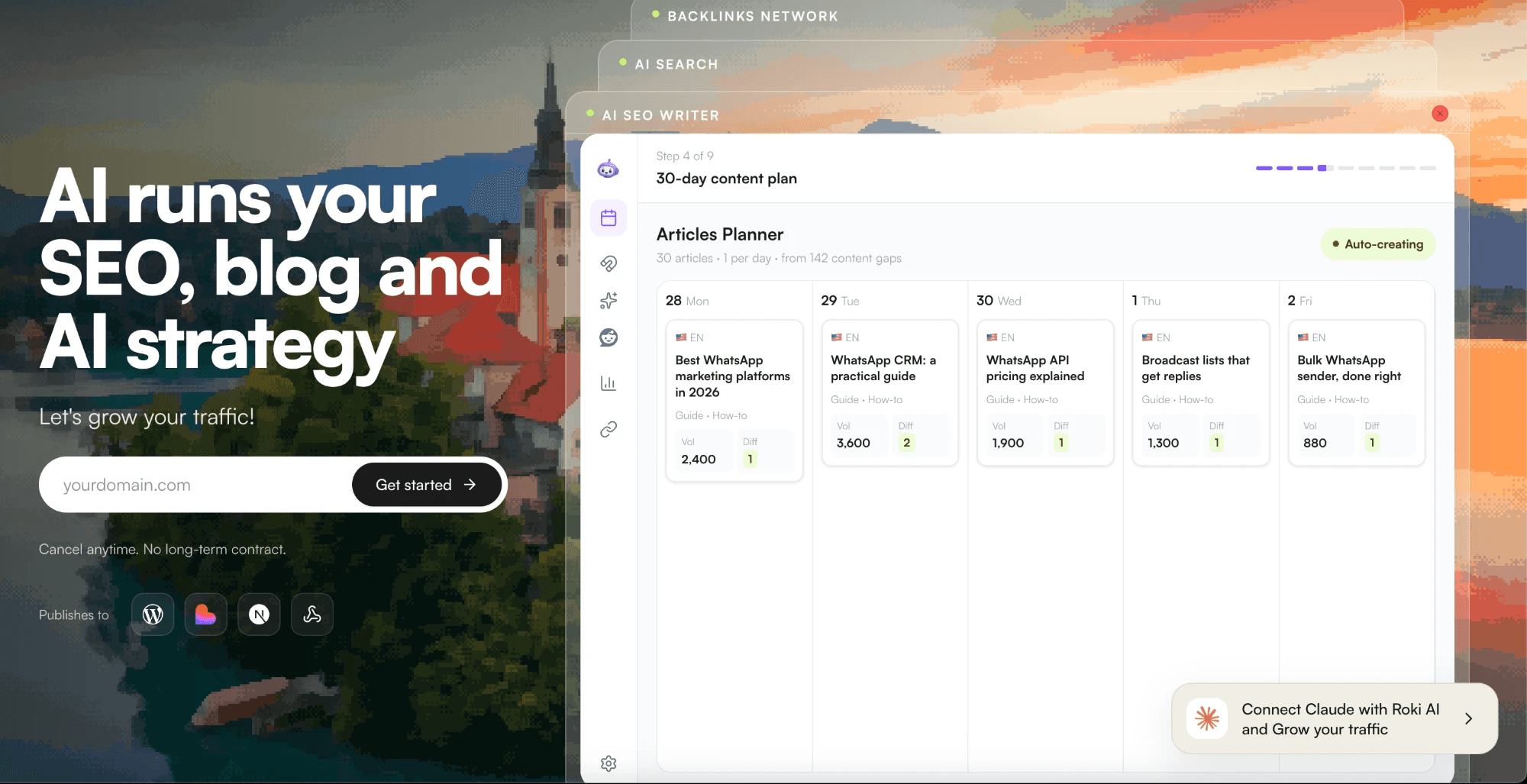
Roki also supports content planning through a 30-day content plan, giving businesses a more organized way to approach publishing.
2. AI-Powered SEO Article Writing
Roki AI generates complete blog articles structured around search intent. Rather than providing only short text suggestions, it supports a workflow intended to take content from research through publication.
Generated articles include headings and an organized structure suitable for SEO content. The platform also supports internal links, brand voice customization, and references to high-authority sources.
These capabilities can help businesses produce content that fits their website and broader content strategy.
However, automated writing should not replace editorial judgment. Businesses should still verify important claims, ensure the content reflects their expertise, and check whether each article genuinely answers the reader's question. Roki's fact-checking and quality-control features are intended to reduce common problems associated with low-quality AI-generated content.
The goal is to make content production more efficient while keeping the published material relevant and useful.
3. Automated Publishing on a Consistent Schedule
Producing articles is only part of the challenge. Teams also need to format, schedule, and publish them consistently.
Roki AI is designed to automate publishing so that new articles can go live according to a regular schedule without requiring someone to manually manage every post.
The platform lists integrations with WordPress, Lovable, and Next.js, making it relevant to businesses using different website setups.
Consistent publishing can help businesses build a broader library of relevant content over time. Each article creates another opportunity to answer a search query, address a customer problem, or direct a potential customer toward a product or service.
The important distinction is that publishing frequency alone does not determine SEO success. Articles still need to provide value, target suitable keywords, and match the quality expectations of their audience.
4. Multilingual SEO Content
Businesses serving customers in multiple countries often need more than a translated version of their English blog. They need content that can address search behavior and customer questions in different languages.
Roki AI supports multilingual content generation, including English, Dutch, Spanish, and additional languages. Its website describes support for more than 100 languages.
The platform also treats related language versions as translations of the same content rather than completely unrelated articles. This can help businesses organize multilingual content as part of a broader SEO strategy.
For example, a company operating in the Netherlands and Spain may want to target relevant Dutch and Spanish search queries without maintaining separate manual content workflows for each market.
Multilingual SEO can be especially valuable for European small and medium-sized businesses, international SaaS companies, and agencies serving clients across multiple regions.
As with any translated content, native-language review can still be important for industry terminology, cultural context, and local search intent.
5. Content Quality Checks and Fact-Checking
One concern with AI-generated articles is the risk of fabricated statistics, unsupported claims, repetitive writing, and generic explanations.
Roki AI positions quality checking as part of its content workflow. Its stated approach includes fact-checking articles and removing invented statistics and obvious AI-generated artifacts.
This matters because an article that is easy to produce is not necessarily an article worth publishing. Businesses need content that readers can trust and that accurately represents their products, industry, and expertise.
Quality checks can help reduce the editing burden, but they should not be treated as a guarantee that every statement is correct. For sensitive, technical, legal, medical, or financial topics, additional human verification may be necessary.
A practical approach is to use Roki to accelerate research and drafting while retaining a review process for claims, examples, links, and brand-specific details.
6. Google Search Console Integration
One of Roki AI's most useful differentiators is its connection to Google Search Console.
Instead of stopping after publishing articles, the platform can use search performance data to help users understand what is happening with their website. This creates a feedback loop between content production and performance measurement.
Its reporting features include:
- Clicks and impressions over time
- Keywords that have improved or declined
- Pages contributing to search performance
- Articles published during the reporting period
- Early performance indicators for new content
- Suggested tasks for the coming week
These reports are designed to make SEO progress easier to understand, even for users without extensive SEO experience.
For example, if a page receives impressions but relatively few clicks, the title and meta description may deserve a closer look. If a keyword begins to gain visibility, the business may consider improving the existing page or creating relevant supporting content.
The value comes from connecting published content with real performance data rather than assuming every article is equally effective.
7. Weekly SEO Reports and Actionable Recommendations
Roki AI provides weekly SEO reports intended to explain what changed and what users should do next.
The reports cover traffic, rankings, AI search citations, published articles, and recommended tasks. According to the Roki AI website, reports are delivered every Monday and are available through email, Slack, and the Roki platform.
This can be helpful for founders and small teams that do not have time to review analytics dashboards every day.
Instead of interpreting several metrics independently, users receive a summary of recent performance and a list of possible next steps. These recommendations can help prioritize work such as improving existing content, reviewing declining keywords, or addressing SEO issues.
A weekly report also gives businesses a regular point at which to assess whether their content strategy is moving in the right direction.
8. Optimization for AI Search and Answer Engines
Search behavior is evolving as people increasingly use AI assistants to discover information, compare products, and find answers.
Roki AI aims to prepare website content for both conventional search engines and AI-powered answer experiences. Its content strategy is designed to support visibility in Google and potential citations from platforms such as ChatGPT and Perplexity.
The platform also includes AI search reporting that helps users track where their website has been cited in supported AI search experiences.
This capability reflects a broader marketing need. Businesses may want to understand not only whether their pages rank in traditional search results, but also whether their brand appears when people ask AI tools questions related to their industry.
AI search visibility is not guaranteed by using a particular writing tool. Citations depend on many factors, including the quality and relevance of the content, the source material available to AI systems, and how those systems retrieve information. Roki provides tools to support this goal rather than a promise of guaranteed placement.
9. MCP Integration for AI Assistant Workflows
Roki AI also supports the Model Context Protocol, or MCP, allowing users to work with its SEO capabilities through compatible AI assistants.
Through its MCP integration, users can create, edit, and publish articles and retrieve Google Search Console data from assistants such as Claude and other compatible AI agents.
This can be useful for technical teams and marketers who already manage their work through AI assistants. Instead of repeatedly switching between a separate SEO dashboard and an AI chat interface, they can bring parts of the workflow into the environment they already use.
MCP support also makes Roki relevant to teams experimenting with agent-based workflows, where an AI assistant helps coordinate research, content preparation, and publishing tasks.
10. SEO Management for Agencies
Roki AI is not limited to individual website owners. Its multi-client workflow is also designed for freelancers and agencies managing SEO content for multiple businesses.
An agency can use the platform to coordinate content work across several client websites from one account. This can simplify the process of maintaining different content calendars and scaling article production.
For smaller agencies, automation may help reduce the repetitive work associated with research, writing, publishing, and reporting.
It can also make recurring SEO services easier to organize, since weekly reporting and content publishing are built into the platform's broader workflow.
Agencies should still establish client-specific quality standards, approval processes, and brand guidelines. Automation is most useful when it supports a clear strategy rather than producing large volumes of generic content.
Who Should Use Roki AI?
Roki AI may be useful for several types of users.
- Startups and SaaS founders: Early-stage companies can use automated keyword research and article publishing to build organic visibility without immediately hiring a large content team.
- Small businesses: Businesses with limited marketing resources can maintain a more consistent blog and use weekly reports to understand which topics deserve attention.
- Freelance marketers: Independent SEO professionals can use the platform to organize content production and reporting for their clients.
- Marketing agencies: Agencies managing several websites can benefit from centralized workflows for keyword research, content generation, publishing, and performance tracking.
- Multilingual businesses: Companies serving several language markets can use multilingual article generation to support a broader content strategy.
- Technical teams and AI enthusiasts: Users who prefer working with compatible AI assistants can take advantage of the MCP integration to access SEO workflows from those environments.
Roki is best suited to businesses that want to publish useful content consistently and are prepared to monitor performance over time. It is less suitable for anyone expecting an instant increase in rankings without a sustained strategy.
Roki AI vs. Traditional SEO Workflows
Traditional SEO content production often involves separate tools and people for keyword research, competitor analysis, writing, editing, publishing, and reporting.
Roki AI aims to bring these activities into one connected workflow.
With a traditional process, a team may manually research keywords, assign articles to writers, edit drafts, upload posts to a CMS, and review Google Search Console reports separately. Each step introduces coordination work that can slow down publishing.
With Roki, users can automate more of the process, from discovering topics through to publishing articles and receiving performance reports.
This does not mean every business should replace its existing SEO team or agency. Complex websites, highly competitive industries, and specialized subjects may still require technical SEO expertise and substantial editorial input.
The main advantage is workflow consolidation. By automating repetitive tasks, Roki can give small teams more capacity to focus on positioning, original insights, product expertise, and other activities that make their content distinctive.
How to Get Started With Roki AI
Businesses interested in using Roki can approach setup as a series of practical steps.
Step 1: Add your website
Start by entering the website you want to grow. This gives Roki a starting point for understanding your business and identifying relevant content opportunities.
Step 2: Select competitors
Add competitors whose search visibility or content strategy you want to analyze. Reviewing competing websites can help reveal keyword gaps and topics that your own website has not yet covered.
Choose competitors that target similar audiences and solve related problems rather than selecting websites solely because they are large.
Step 3: Review keyword opportunities
Examine the keywords and topics suggested by the platform. Consider their relevance to your audience, search intent, competition, and potential connection to your business goals.
A keyword with a lower search volume may be more valuable than a broad term if it attracts people who are actively looking for a solution like yours.
Step 4: Build a content plan
Use the available research to organize topics into a publishing plan. Prioritize content that addresses genuine customer questions and supports your product or service positioning.
A clear plan helps prevent articles from becoming disconnected pieces that do not contribute to a broader strategy.
Step 5: Generate and publish articles
Use Roki to generate structured articles and configure your publishing workflow. Review important claims, links, and brand-specific information before publishing where appropriate.
Once your workflow is established, scheduled publishing can help maintain a consistent content cadence.
Step 6: Connect Google Search Console
Connect Google Search Console to monitor search performance. This provides data on clicks, impressions, and keyword movement that can inform future content decisions.
Step 7: Review weekly reports
Use Roki's weekly reports to understand what is improving, what needs attention, and which actions should come next. Adjust your content priorities based on the evidence rather than relying only on publishing volume.
How Quickly Can You See SEO Results?
SEO results depend on factors such as website authority, competition, technical health, keyword difficulty, content quality, and how well a page matches search intent.
Roki's website suggests that movement for long-tail keywords may begin within two to six weeks, while competitive head terms may take two to four months. These are indicative timelines, not guarantees. Individual websites may take longer, and some pages may never reach their intended rankings.
The platform's automation can help teams research and publish content more efficiently, but it cannot remove the uncertainty inherent in organic search.
Businesses should evaluate progress using several indicators, including relevant impressions, clicks, keyword visibility, engagement, and qualified leads. Rankings matter, but the ultimate objective is to attract the right audience and support business outcomes.
Is Roki AI Worth Considering?
Roki AI stands out because it combines automated content production with competitor research, Google Search Console reporting, multilingual publishing, and AI assistant integration.
For a founder managing a business alone, the platform may reduce the time spent coordinating recurring SEO tasks. For an agency, it can provide a more organized way to manage content workflows across several clients. For a multilingual business, it offers a way to expand content production across different markets.
Its weekly reporting is particularly valuable because it connects content activity with performance measurement. Rather than treating publishing as the final step, Roki encourages users to review results and identify follow-up actions.
However, businesses should remember that automation does not replace a thoughtful SEO strategy. Content still needs to be accurate, useful, relevant, and aligned with what customers are searching for. Human review remains important wherever subject matter expertise or brand accuracy matters.
For teams that struggle to maintain consistent SEO publishing, Roki AI offers an integrated approach to researching, creating, publishing, and measuring content.
Frequently Asked Questions
What is Roki AI used for?
Roki AI is an SEO automation platform that helps businesses research keywords, analyze competitors, generate SEO-focused articles, publish content on a schedule, and track search performance through Google Search Console.
Does Roki AI write and publish blog posts automatically?
Yes. Roki is designed to generate structured SEO articles and publish them according to a schedule. Users can configure the workflow to reduce the amount of manual work involved in maintaining a regular blog.
Can Roki AI help with keyword research?
Yes. Roki analyzes competitor content and identifies keyword opportunities using factors such as relevance, search volume, and ranking difficulty. It also supports content-gap research and topic planning.
Does Roki AI support multiple languages?
Yes. Roki supports multilingual content generation, including English, Dutch, Spanish, and other languages. Its website describes support for more than 100 languages.
Does Roki AI integrate with Google Search Console?
Yes. The integration allows Roki to track search performance and provide reports covering clicks, impressions, keyword changes, and pages contributing to organic visibility.
Can Roki AI help with ChatGPT and Perplexity visibility?
Roki aims to structure content for AI search experiences and includes reporting for AI citations. However, using the platform does not guarantee that ChatGPT, Perplexity, or other AI systems will cite a website.
Can agencies use Roki AI for multiple clients?
Yes. Roki is designed to support agencies and freelancers managing content for several companies from one account.
What is Roki AI's MCP integration?
Roki's MCP integration allows users to access supported SEO workflows through compatible AI assistants. This includes creating, editing, and publishing articles and retrieving Search Console data.
Will AI-generated articles hurt Google rankings?
AI-generated content is not automatically harmful to search rankings. Quality, usefulness, originality, accuracy, and relevance are important considerations. Roki includes fact-checking and content-quality features, but businesses should still review articles before publishing.
How long does SEO take to show results with Roki AI?
Roki's website suggests that long-tail keyword movement may appear in two to six weeks, while more competitive keywords may take two to four months. Actual results vary according to competition, website condition, content quality, and other factors.
Final Verdict
Roki AI is built for businesses that want to make SEO content production more consistent without managing every step manually. Its combination of keyword research, competitor analysis, article generation, scheduled publishing, multilingual content, Google Search Console reporting, and MCP integration makes it more than a basic AI blog writer.
The strongest use case is for founders, small businesses, marketers, and agencies that need a repeatable SEO workflow and want to use performance data to guide their next steps.
As with any SEO platform, results depend on how well the content serves the audience and how effectively the business applies the recommendations. Automation can make the process faster, but meaningful organic growth still requires relevant topics, trustworthy content, and ongoing improvement.
If you want to streamline keyword research, publish SEO-focused articles consistently, and monitor your website's organic performance, explore Roki AI and see how its automated SEO workflow fits your business.